
Advantest (6857) · Semiconductors
Advantest Q2 FY2026 earnings: summary, key numbers & outlook
Results filed 28 Oct 2026 · Quarter ended 30 Sep 2026
Slides (14 pages)Press release ↗Investor relations ↗
Summaries and transcripts are machine-generated and can contain errors.
In brief
Advantest is pulling forward its 10,000-system annual SoC tester capacity target as agentic AI makes CPU testing a third growth driver beside GPUs and custom ASICs.
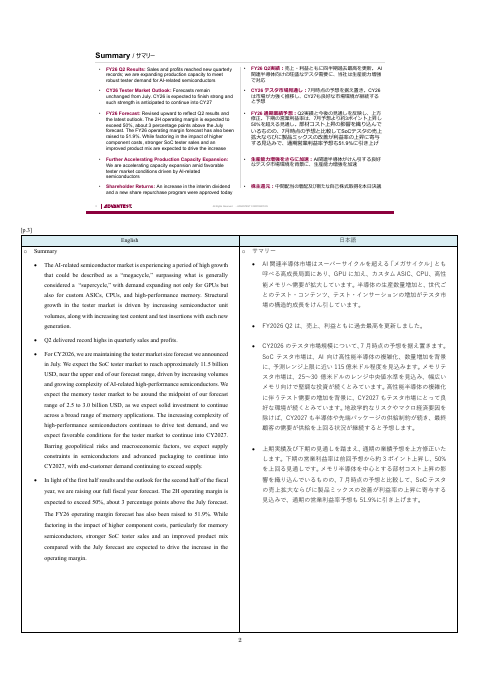
Demand for Advantest's testers widened beyond GPUs this quarter. SoC test sales grew on GPU, custom ASIC and CPU applications as inference AI evolved, and memory test sales also rose. Management says CPU testing tied to agentic AI is now the biggest driver of its higher SoC outlook. It estimates its SoC tester share rose from 56% in CY2024 to 66% in CY2025 and expects further gains.
Management is racing to add capacity, with SoC output already above 5,000 systems a year and a 10,000-system target to be reached well ahead of plan. A 20,000-system step is under internal discussion. The main tension is supply: memory components are tight and costly, and management expects supply constraints to persist through CY2027, so growth depends on keeping suppliers and manufacturing partners in step.
No call transcript for this quarter, so this summary also draws on: Quartr ↗.
Slides & documents
Open the slide deck (PDF, 14 pages) ↗

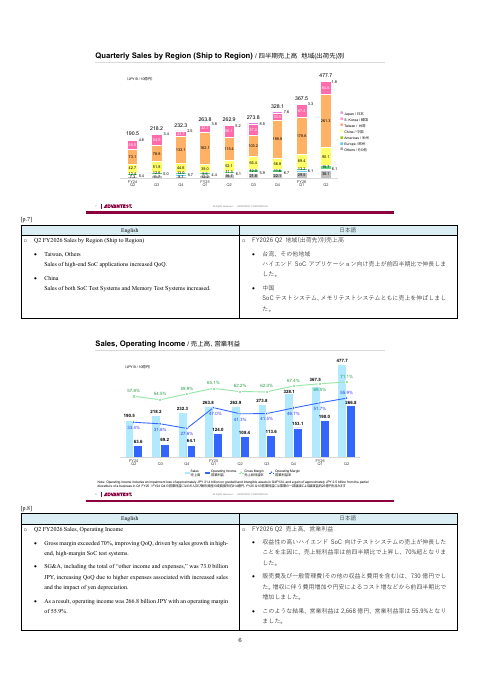
Showing the first 6 of 14 pages.
Results documents
Key numbers
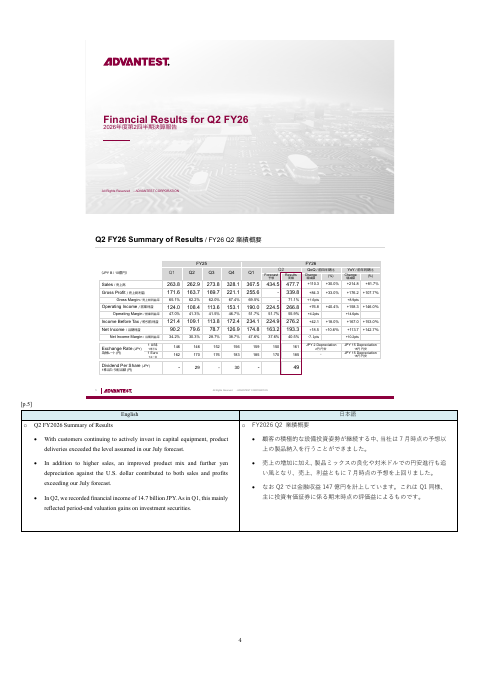
- Net sales (six months)
- (Y) 845.2 billion
- Operating income (Q2)
- 266.8 billion JPY
- Operating margin (Q2)
- 55.9%
- Gross margin (Q2)
- 71.1%
- Net income (six months)
- (Y) 368.1 billion
- Diluted EPS (six months, yen)
- 506.12
- Free cash flow (Q2)
- 61.5 billion JPY
up 60.5% from a year ago
up 1.6pts from the prior quarter
up 116.8% from a year ago
| Segment or metric | Value | Change |
|---|---|---|
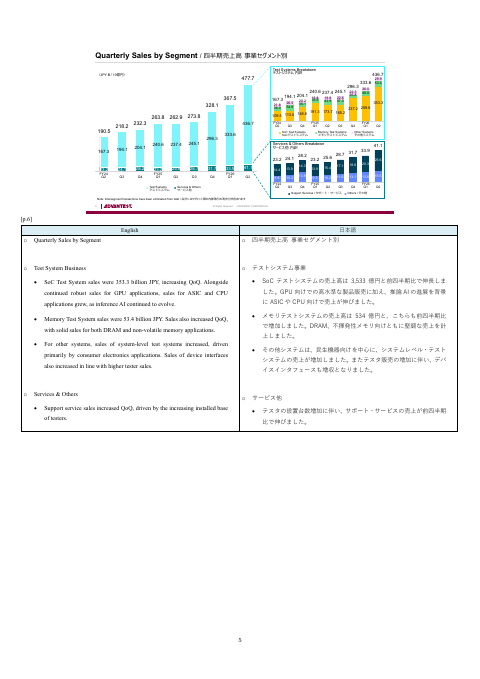
| SoC Test Systems (Q2) | 353.3 billion JPY | up from the prior quarter |
| Test System Business (six months) | (Y) 770.2 billion | up 61.2% from a year ago |
| Services & Others (six months) | (Y) 75.0 billion | up 53.7% from a year ago |
Where each number comes from
- Net sales (six months): “As a result of the above, net sales were (Y) 845.2 billion (60.5% increase in comparison to the corresponding period of the previous fiscal year)”
- Operating income (Q2): “As a result, operating income was 266.8 billion JPY with an operating margin of 55.9%.”
- Operating margin (Q2): “As a result, operating income was 266.8 billion JPY with an operating margin of 55.9%.”
- Gross margin (Q2): “Gross Margin / 売上総利益率 65.1% 62.2% 62.0% 67.4% 69.5% - 71.1% +1.6pts +8.9pts”
- Net income (six months): “and net income was (Y) 368.1 billion (116.8% increase in comparison to the corresponding period of the previous fiscal year)”
- Diluted EPS (six months, yen): “Basic earnings per Diluted earnings share per share Yen Yen FY2026 Q2 508.99 506.12 FY2025 Q2 232.19 231.49”
- Free cash flow (Q2): “However, our free cash flow remained positive at 61.5 billion JPY.”
- SoC Test Systems (Q2): “SoC Test System sales were 353.3 billion JPY, increasing QoQ.”
- Test System Business (six months): “net sales were (Y) 770.2 billion (61.2% increase in comparison to the corresponding period of the previous fiscal year)”
- Services & Others (six months): “net sales were (Y) 75.0 billion (53.7% increase in comparison to the corresponding period of the previous fiscal year)”
Copied from the press release ↗ and other documents in the company's results page ↗. A figure is published only if its sentence is in those documents.
Outlook
| Metric | Period | Outlook |
|---|---|---|
| Net sales | fiscal year ending March 2027 (FY2026) | (Y) 1,863.0 billion |
| Operating income | fiscal year ending March 2027 (FY2026) | (Y) 967.0 billion |
| Basic EPS (yen) | fiscal year ending March 2027 (FY2026) | 1,027.08 |
| Capital expenditure (JPY billion) | fiscal year ending March 2027 (FY2026) | 60.0 |
Key takeaways
Capacity target of 10,000 SoC testers pulled forward
Advantest already makes more than 5,000 SoC testers a year and aims to hit 10,000 well ahead of the original end-FY2028 plan. It is also discussing 20,000 a year, to be detailed with its Fourth Mid-Term Management Plan around May 2027.
Agentic AI CPUs become a third growth layer
Management says CPU testing tied to agentic AI is the biggest factor behind the higher SoC outlook, on top of GPUs and custom ASICs. More server units and a higher CPU-to-GPU ratio in inference are lifting tester demand.
SoC tester share rose to 66%, targeting 70%
Advantest estimates its SoC tester share grew from 56% in CY2024 to 66% in CY2025. It sees a path above 70% from existing customers and new ones, citing the V93000 as an increasingly standard platform in high-performance computing.
Memory component costs are met with richer configurations
DRAM prices are a clear headwind because both SoC and memory testers use a lot of DRAM. Rather than direct price rises, Advantest plans pricing through larger tester configurations, licensing and new instrumentation.
Co-packaged optics test market expected to reach about $1 billion
Advantest expects the CPO tester market to double or triple annually over the next couple of years and says it participates in all test insertions. Management also sees a realistic opportunity from new global SoC and memory capacity, including Terafab, without naming customers.
Questions
What is driving Advantest's higher SoC tester outlook?
Management says elevated test demand across all compute devices, with the biggest factor being CPU testing tied to agentic AI. That adds a third growth layer to GPUs and custom ASICs.
How is Advantest expanding production capacity?
SoC tester capacity is already above 5,000 systems a year, and the 10,000-system target is being pulled well ahead of the original end-FY2028 plan. Memory tester ramp-up is accelerating too, using suppliers plus a hybrid of EMS partner and in-house production.
What is Advantest's market view for CY2026 and CY2027?
It kept its CY2026 forecasts, with the SoC tester market near the upper end of its range at about 11.5 billion USD and memory testers around the midpoint of 2.5 to 3.0 billion USD. It expects favorable conditions and supply constraints to continue into CY2027, barring geopolitical or macro shocks.
How is Advantest handling rising memory component costs?
It says DRAM and other component costs are a headwind and a major reason second-half operating margin is expected to decline from the first half. It expects to offset much of the impact through pricing tied to larger tester configurations, licensing and new instrumentation rather than direct price increases.
Where might new growth come from beyond GPUs and CPUs?
Co-packaged optics testing is expected to grow to about 1 billion USD, and Advantest is participating in all test insertions. It also sees a realistic opportunity from additional global SoC and memory capacity, including Terafab.