“In fiscal 2026 our vas business grew revenue 30% in constant dollars to $14 billion essentially double our 2023 vas revenue”
Shows how large and fast-growing the value-added services business has become.

Visa (V) · Payments
Results filed 27 Oct 2026 · Quarter ended 30 Sep 2026 · Call 72 min · Ryan McInerney (CEO), Chris Suh (CFO)
Read the transcriptSlides (23 pages)Official transcript (PDF) ↗Press release ↗Investor relations ↗
Summaries and transcripts are machine-generated and can contain errors.
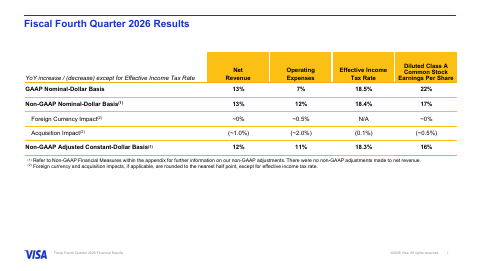
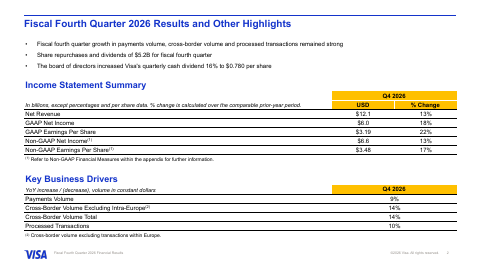
Visa reported fiscal fourth quarter net revenue of $12.1B, an increase of 13% on a nominal and constant-dollar basis, with GAAP net income of $6.0B or $3.19 per share and non-GAAP net income of $6.6B or $3.48 per share.
Visa closed fiscal 2026 with fourth-quarter net revenue of $12.1B, up 13%, and full-year net revenue of $45.9B, up 15%. Payments volume grew 9%, cross-border volume 14% and processed transactions 10%. Non-GAAP EPS of $3.48 was up 17%, helped by a lower tax rate. Value-added services was the standout, growing 31% in constant dollars in the quarter. The board raised the quarterly dividend 16% to $0.780 per share.
For fiscal 2027, management guides to low double-digit adjusted net revenue growth, with adjusted operating expense growing slightly less and EPS growth in the low double digits to low teens. The main tension is that about 25% of payments volume is up for client incentive renewals, and pricing gains weigh toward the back half. Management also assumes steady consumer spending and Middle East travel volumes holding near fourth-quarter levels.
Open the slide deck (PDF, 23 pages) ↗
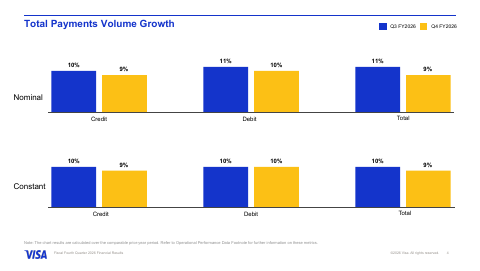
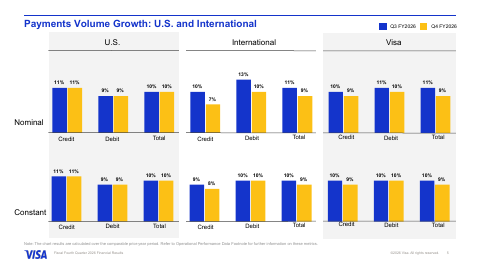
Showing the first 6 of 23 pages.
From Visa investor relations
SEC filing
an increase of 13% on a nominal and constant-dollar basis
up 18%
up 22%
up 17%
| Segment or metric | Value | Change |
|---|---|---|
| Payments volume | 9% | constant-dollar year-over-year growth |
| Cross-border volume excluding intra-Europe | 14% | constant-dollar year-over-year growth |
| Processed transactions | 74.2 billion | a 10% increase over the prior year |
| Service revenue | $5.3 billion | an increase of 14% over the prior year |
| Data processing revenue | $6.2 billion | rose 16% over the prior year |
| International transaction revenue | $4.1 billion | grew 8% over the prior year |
| Other revenue | $1.6 billion | rose 40% over the prior year |
| Value-added services revenue | $4 billion | grew 31% year-over-year in constant dollars |
Copied from the press release ↗ and other documents in the SEC filing ↗. A figure is published only if its sentence is in the filing.
| From the filing | Q4 FY2026 | vs year ago | vs last quarter |
|---|---|---|---|
| Revenue | $12.1B | +13.2% | +4.3% |
| Operating income | $7.3B | +18.1% | +5.6% |
| Net income | $6.0B | +17.9% | +6.6% |
| Free cash flow | $6.9B | +17.8% | +12.3% |
| Operating margin | 59.8% | +2.5 pts | +0.7 pts |
Calculated by code from XBRL, not by the model.
| Metric | Period | Outlook |
|---|---|---|
| Non-operating expense | fiscal 2027 | between $250 and $300 million |
| Tax rate | fiscal 2027 | about 19% |
| Value-added services growth | fiscal 2027 | low to mid-20s |
| Non-operating expense | first quarter of fiscal 2027 | about $60 million |
| Tax rate | first quarter of fiscal 2027 | between 18.5 % and 19% |
Fiscal 2026 net revenue reached $45.9B, an increase of 15%, the strongest growth in over 15 years excluding the post-pandemic recovery and acquisitions. Fourth-quarter net revenue was $12.1B, up 13%.
VAS revenue grew 30% in constant dollars to $14 billion for the year, and 31% to $4 billion in the fourth quarter. Management expects VAS growth in the low to mid-20s in 2027.
Cross-border volume excluding intra-Europe rose 14%, more than two points above Q3, with travel up 13% and e-commerce up 17%. FIFA World Cup spending helped U.S. inbound volumes.
Management expects adjusted net revenue and operating expense growth in the low double digits, with adjusted EPS growth in the low double digits to low teens. Q2 is expected to be the growth low point.
About 25% of payments volume is up for renewal in 2027 versus about 20% in 2026, which steps up incentive growth. Management says it is securing long-term client relationships and the guide is inclusive of this activity.
Fourth quarter worked out from the annual figure.
| Q1 FY25 | $9.5B |
| Q2 FY25 | $9.6B |
| Q3 FY25 | $10.2B |
| Q4 FY25 | $10.7B * |
| Q1 FY26 | $10.9B |
| Q2 FY26 | $11.2B |
| Q3 FY26 | $11.6B |
| Q4 FY26 | $12.1B * |
| Q1 FY25 | 65.6% |
| Q2 FY25 | 56.6% |
| Q3 FY25 | 60.7% |
| Q4 FY25 | 57.3% |
| Q1 FY26 | 61.8% |
| Q2 FY26 | 64.4% |
| Q3 FY26 | 59.1% |
| Q4 FY26 | 59.8% |
| Q1 FY25 | $5.1B |
| Q2 FY25 | $4.4B |
| Q3 FY25 | $6.3B |
| Q4 FY25 | $5.8B |
| Q1 FY26 | $6.4B |
| Q2 FY26 | $2.6B |
| Q3 FY26 | $6.1B |
| Q4 FY26 | $6.9B |
Operating cash flow minus capital expenditure, from cash flow statements.
Each quote matches the transcript word for word.
“In fiscal 2026 our vas business grew revenue 30% in constant dollars to $14 billion essentially double our 2023 vas revenue”
Shows how large and fast-growing the value-added services business has become.
“we expect full year adjusted net revenue growth to be in the low double digits, with Q2 being the growth low point as a result of lapping the very strong performance last year.”
This is the headline fiscal 2027 revenue outlook, including when growth is expected to be weakest.
“we're expecting around 25 % of our payments volume to be renewed, including renewals with several large clients.”
Highlights the main incentive-cost risk in the 2027 plan.
“But as we think about the next, you know, four quarters and 27, it all remains a very small in the big scheme of the enormous size of our business.”
Sets expectations that agentic commerce will not move 2027 results meaningfully.
“Our tax rate is expected to be about 19%, consistent with our long-term tax rate range of 19 % to 20%, up from 2026, primarily due to the lack of claim of right benefits.”
Explains why EPS growth is guided below revenue-driven expectations, since 2026 had one-time tax benefits.
“In stablecoin settlement, our run rate has surpassed $25 billion in annualized volume, up 10x year over year.”
Quantifies Visa's early traction in stablecoin infrastructure.
Ryan McInerney said the quarter was a tipping point for user experience but adoption is still very early and very small in Visa's overall business, though Visa remains convicted about the opportunity. — Ryan McInerney
Ryan McInerney said Visa sees real incremental opportunities, such as Visa Direct and machine-to-machine payments, but over the next four quarters it remains very small relative to the business. — Ryan McInerney
Chris Suh said pricing contribution is consistent with 2026 and more back-half weighted, incentives rise with about 25% of payments volume renewing versus 20%, and Visa keeps investing while improving efficiency. — Chris Suh
Ryan McInerney said yes, newer agreements are broader and deeper across value-added and commercial and money movement services, creating tighter client relationships, with cyber, Pismo and advisory highlighted. — Ryan McInerney
Ryan McInerney said Visa is working across the ecosystem to make issuers and acquirers ready at scale, drawing on its tokenization experience and dozens of Visa Intelligent Commerce partners. — Ryan McInerney
Chris Suh attributed the acceleration to travel in EMEA-region markets and strong U.S. inbound, and Ryan McInerney said the guide assumes stable to slightly improving drivers. — Chris Suh, Ryan McInerney
Ryan McInerney confirmed the renewal figures and said Visa manages to net revenue growth, with its low double-digit plan including all expected renewal activity. — Ryan McInerney
Chris Suh said strong employment and wage growth underpin spending with stability across spend bands, but it is too hard to tell how strong for how long. — Chris Suh
Ryan McInerney said international expansion has exceeded expectations and the U.S. offers opportunity in the medium and low end, with proof points such as Wells Fargo. — Ryan McInerney
Ryan McInerney said cyber is a top-three client issue, the space is fragmented, and Visa's right to win is high given its client relationships and range of risk and security products. — Ryan McInerney
Ryan McInerney said Visa is stablecoin and blockchain agnostic, started with USDC, and plans to activate other stablecoins, with OUSD integrated across products. — Ryan McInerney
Chris Suh said the approach is similar to last year, with macro assumptions and execution on large renewals as key dependencies, and the plan reflects a balanced view of risks and opportunities. — Chris Suh
Net revenue was $12.1B, up 13% on a nominal and constant-dollar basis. GAAP net income was $6.0B or $3.19 per share, and non-GAAP net income was $6.6B or $3.48 per share.
Net revenue was $45.9B, up 15%, with GAAP net income of $23.5B or $12.32 per share and non-GAAP net income of $25.3B or $13.27 per share. Operating cash flow was $23,728 million.
Management expects adjusted net revenue and operating expense growth in the low double digits, with adjusted EPS growth in the low double digits to low teens. It expects a tax rate of about 19% and non-operating expense between $250 and $300 million.
About 25% of payments volume is up for client renewals, versus about 20% in 2026, which steps up incentive growth. Management also assumes resilient consumer spending, steady drivers and Middle East cross-border travel volumes holding near Q4 levels.
Share repurchases and dividends were $5.2B in the fourth quarter and $25.6B for the full year, and the quarterly dividend was raised 16% to $0.780 per share. Visa had $24.4 billion remaining in its buyback authorization.
Call recording on YouTube ↗. Official replay ↗. Timestamps jump to the moment.
Visa also publishes its official transcript (PDF) ↗.
Music do do Welcome to Visa's fourth quarter and full year 2026 earnings conference call.
All participants are in a listen-only mode until the question and answer session. Today's conference is being recorded. If you have any objections, you may disconnect at this time. I would now like to turn the conference over to your host, Ms. Jennifer Como, Senior Vice President and Global Head of Investor Relations. Ms. Como, you may begin.
Thank you. Good afternoon everyone and welcome to Visa's Fiscal Fourth Quarter and Full Year 2026 Earnings Call. Joining us today are Ryan McInerney, Visa's Chief Executive Officer, and Chris Suh, Visa's Chief Financial Officer.
This call is being webcast on the Investor Relations section of our website at investor .visa .com. A replay will be archived on our site for 30 days. A slide deck containing financial and statistical highlights has been posted on our IR website. Let me also remind you that this presentation includes forward-looking statements. These statements are not guarantees of future performance, and our actual results, outcomes, or timing could differ materially as a result of many factors. Additional information concerning those factors is available in our most recent annual report on Form 10-K and any subsequent reports on forms 10Q and 8K, which you can find on the SEC's website and the investor relations section of our website.
Except as required by law, we do not undertake any responsibility to update these forward-looking statements. Our comments today regarding our financial results will reflect revenue on a GAAP basis and all other results on a non-GAAP nominal basis unless otherwise noted. The related gap measures and reconciliation are available in today's earnings release and related materials available on our IR website. And with that, let me turn the call over to Ryan.
Thanks Jennifer. 2026 was a milestone year for Visa.
We finished the year with fourth quarter net revenue of 12.1 $1 billion up 13% year over year this resulted in full year record net revenue of $46 billion up 15% the strongest net revenue growth in over 15 years excluding the post-pandemic recovery and acquisitions cms revenue grew 19 and vas revenue grew 30% both in constant dollars and their revenue collectively represents more than 40% of our total net revenue. Our drivers for the year were strong.
Payments volume was up 9 % year-over-year in constant dollars. Commercial payments volume grew 12 % for the year in constant dollars, faster than consumer and the fastest annual growth rate in eight years, excluding the post-pandemic recovery. Total cross-border volume excluding entry Europe rose 12 % year-over-year, with travel up 11 % and e-commerce up 15 % all in cost of dollars. We process 281 billion transactions up 9 % year over year and with approximately 80 % processing penetration globally.
And Visa Direct topped 15 billion transactions representing about 1 trillion and a half dollars in payments volume. While these numbers speak to our strength, in 2026 we also demonstrated that whenever technology changes commerce, we move with it. We anticipate what's next and we enable its growth as the leading hyperscaler of payments globally. The foundation of all of this is trust. Visa brings trust with our scale, our network and infrastructure, and our products all delivered through our Visa as a Service stack.
Starting with scale, we have scale in issuance and acceptance. In 2026, we had 5.2 billion credentials, up 6 % year-over-year with Latin America crossing the billionth credential milestone, and we continued to grow our credentials globally in a number of ways. We signed new co-brand agreements and expanded existing relationships with marquee brands around the world. In the hotel industry, this included Marriott in Samia, Asia Pacific, Latin America, and North America. And in the airline industry, this included Air India in Asia Pacific, Copa Airlines in Latin America, Qatar Airways, and Ethiopian Airlines in Samia.
We also had the launch of debit portfolios for Alaska Airlines and Southwest Airlines in the U .S., in addition to our existing credit portfolios with these brands. In the U .S., we added the new Samsung Galaxy card and maintained our leadership position with seven of the top 10 U .S. co-brands. In the affluent space, we recently launched our new Visa Infinite card series, signing with more than 70 issuers in over 40 countries in Q4 alone, with more than 15 issuers in Latin America, including Santander in Mexico, as part of an expanded relationship with Visa.
Our flex credentials have tripled since last year with continued strength from existing players, as well as growth from new partners such as Cash App and Chime. We will also soon be launching the world's first stablecoin-linked Visa flex credential with Norwegian Block Exchange or NBX in Europe. VisaPay, which connects wallets to any visa accepting seller worldwide, has nearly tripled its presence since last year to 11 countries. In commercial, we have over 15 new fleet clients this year across our five regions.
We recently renewed our global agreement with WEX to enable B2B travel and solutions for their corporate clients. We also expanded our relationship from Europe to the U .S. with Audien for their travel clients. And through Visa's multinational program, Newline by Fifth Third will be enabling U .S.-based fintechs to offer Visa corporate cards in 46 countries. Across all of this credential growth, we continue to drive adoption of tokens. Today, over 50% of all available credentials are tokenized more than doubling from five years ago.
In 2026, we processed a tokenized transaction in 200 countries and territories for the first time. And now more than 60 % of all e-commerce transactions are tokenized. On acceptance, we have well over 200 million seller locations driven by a more than 40 % increase in Brazil, a more than 60 % increase in Mexico, and a more than 15 % increase in India seller locations year over year. When we incorporate digital wallets, Visa credentials can be used at more than 200 million additional seller locations.
So in total, Visa credentials can be used at more than 400 million seller locations. With this increased acceptance, Visa empowers buyers and sellers with secure ways to pay, such as with tap to pay reaching nearly 85 penetration of face-to-face transactions globally and with the final top 100 seller enabling tap to pay in 2026 we reached 75 penetration in the us well our way to the global total tap to phone has driven new small business acceptance with more than 25 million active Visa accepting mobile devices across more than 100 markets, surpassing more than 1 billion transactions in 2026, with 30 % of tap-to-phone sellers new to our ecosystem this year.
And for micro sellers in more emerging markets, we have Visa Accept, which has grown to 15 markets in just one year. Throughout all of these efforts, we are expanding our reach to power all types of payments, C to B, B to B, P to P, B to C, G to C, and more. In fact, we have the largest money movement platform on the planet with Visa Direct, as measured by transactions, volumes, and accounts, with more than 18 billion endpoints across cards, accounts, and wallets, up from 12 billion in 2025.
Clients value the trust that this brings and we have over 40 clients who each used more than five different Visa Direct use cases this year. A recent example of a client adding new use cases is Navy Federal who we have already partnered with on cross-border remittances and is part of a broader renewal across consumer and commercial portfolios and VAS including DPS. they are positioning Visa Direct to support a number of new domestic money movement use cases over time.
In addition, Wells Fargo has enabled Visa Direct for cross-border payroll, accounts payable, and disbursement payments. With our credentials, acceptance, and our reach, Visa has and will continue to bring scale to the ecosystem. You see this play out across our more than 200 countries and territories. For example, in Asia Pacific in 2026, we renewed and expanded with three of the top four Australian banks, three of the top four Indian banks, two of the top four Chinese banks, initiated new relationships with Japanese clients such as PayPay and Travel Wallet Japan.
Visa also delivers trust through our network and infrastructure. Over the last five years, we have invested $15 billion in our network security and resilience, all to provide that six nines of reliability, always on capability that you expect from Visa. And this year, we tested and strengthened our defenses through our Visa vulnerability agentic harness, which we then open source to the world. We also made progress this year building the next generation of Visanet to enable the future of commerce through a cloud-native, microservices distributed, modular architecture that uses open languages and technologies, enabling easier scaling and configuration and faster feature deployment.
Today this supports live authorization traffic in production across markets in Latin America and Samia, empowers additional payment processing workloads at a global scale. An important area of future development will be mainland China as Visa has received approval of our application to prepare from the People's Bank of China. This significant milestone now marks the beginning of our formal preparations to ultimately process domestically on the Visa network. Another core aspect of our network and infrastructure is enabling new capabilities, including blockchain.
In 2026, we gained even greater conviction in the opportunity and benefits of extending our network on chain. Our vision is simple. One network combining fiat, stable coins, and tokenized deposits with interoperability and utility across our infrastructure, bringing the same ease and trust clients expect for Visa. It requires key capabilities across the full on-chain stack, which we have made significant progress on this year. Specific highlights this quarter include, for the blockchain layer, we were invited to the founding validator cohort for Circle's ARC, adding to our roles on Tempo as a validator and Kanton as a super validator.
For the issuance layer, OpenUSD went live on September 30th, with total supply and circulation surpassing $800 million so far through October 15th. In the orchestration layer, Visa Direct's stablecoin pre-funding and cross-border money movement has moved from pilot to commercial production, and we have our first live partner, Inyo Global, a U .S.-based payments infrastructure provider. In the application layer, our Visa stablecoin platform is now available in the US, Mexico, Puerto Rico, Colombia, Switzerland, and the UK with additional countries to follow, and the pipeline has more than 300 partners.
And the engagement we are seeing with our more established stablecoin offerings is significant. In stablecoin settlement, our run rate has surpassed $25 billion in annualized volume, up 10x year over year. We can now support 10 blockchains, more than doubling from last year, and are operating in all five regions. In consulting, with over 60 unique engagements, Stablecoin Advisory was our fastest growing Visa consulting and analytics practice this year, with nearly half of these projects in Q4 alone.
And it continues to be among the top three focus areas for our clients alongside AI and cybersecurity. We now have over 225 stablecoin-linked card programs, up more than 70 % year-over-year, with 150 % plus growth in volume across 5 million cards in more than 50 countries, with issuers across crypto exchanges, neobanks, wallets, and remitters. That is trust at scale. And the trust that the Visa network and infrastructure represent is only amplified by the products we provide on top of it.
I spoke last quarter about the fundamental changes to the way that we build and ship products enabled by utilizing our agentic tool chain. For example, the Visa stablecoin platform enablement for OUSD was designed, built, and shipped in seven weeks with 12 people. This would have taken much, much longer and required many more people without utilizing our agentic tool chain. Today, more than 60 % of our global product development and engineering teams have adopted this new way of working with the intent of reaching 100 % this year.
One of the key areas of innovation for Visa has been empowering agentic commerce. It is clear that in agentic, trust is the biggest barrier to scale. We believe the best way to break through that barrier is with one simple but powerful idea. Every time someone pays or gets paid, it's with a Visa credential. And as we look at the albeit limited number of agentic transactions today, Visa credentials are being used by consumers, businesses, and agents. We have nearly 50 AI partners live and in production, including more recently Shopify's ShopPay, with that number expected to double in the coming months.
We are also collaborating with Anthropic to bring their commerce blueprints to our merchant network, combining the intelligence of Claude with the trust, security, and global reach of the Visa network. One of the areas we have identified for fast adoption of Agentic has been B2B, and we have had several partners launch and expand offerings. Ramp's Agentic bill pay use case is now generally available and as ramp businesses use visa intelligent commerce to automate bill payments payments volume is growing air wallets is testing visa intelligent commerce enabled credentials and integrating them into their native wallet airy bills payment agent is piloting visa intelligent commerce to pay invoices and bill trust supplier portal will identify the agent and accept payment.
Our Visa Intelligence Commerce solution is enabling all of this. It provides trust for the user with credentials, agentic tokens, and transaction identifiers, trust for the agent with the trusted agent protocol and agent directory, and trust for the transaction. Once we have verified the user and agent identity, we need to make sure that the purchase instructions are clear by capturing consumer authenticated intent. And of course, like on any Visa transaction, our rules clarify the roles and responsibilities and processes should something go wrong.
It is clear that agentic commerce is here and Visa's role is clear, delivering trust. Another important area of product development has been in our value-added services. In fiscal 2026 our vas business grew revenue 30% in constant dollars to $14 billion essentially double our 2023 vas revenue our issuing acceptance and risk and security portfolios collectively grew more than 20% in constant dollars this year a growth rate we believe is sustainable in 2027 for two primary reasons the underlying drivers of revenue and demand from clients I'll go deeper into each one.
First, transactions, cards, and accounts had driven the vast majority of our VAS revenue, more than 80 % over the last five years, and that will continue as our clients grow, we expand to new clients and develop new products, and we were able to price those products to value. For example, Pismo signed clients in Sweden, Belgium, and Guatemala this quarter, bringing the total for the year to 28 countries, almost doubling from last year. Our success has enabled us to sell more products fueled by these underlying drivers.
Now to demand. Cyber related products are a top priority for our clients. We offer many end to end cyber solutions, including several launched this year, and we will continue to invest more over time. The associated revenue spans across the VAS portfolios and represents a meaningful amount of total VAS revenue. We deliver these cyber solutions in four areas, all bringing trust to the ecosystem. One, helping our clients collect threat intelligence and detect cyber problems early. Two, protecting our client's security perimeter with identity access and behavioral trust solutions.
3. Ensuring every transaction on and off the Visa network is safe with transaction intelligence solutions and 4. When an active threat does emerge, enabling our clients to maintain service resilience and recover as quickly as possible. In threat intelligence, our Visa Threat Intelligence platform combines cyber, fraud, brand, identity, and financial crime insights through high fidelity feeds. We connect these indicators to potential fraud outcomes to help our clients defend against would-be attackers. We also recently invested in Overwatch Data, a financial threat intelligence company whose solutions we will soon be offering to our clients globally.
In identity access and and behavioral trust, our authentication and tokenization platforms protect consumer credentials, payment transactions, and merchants and acquirers sensitive data. And we are excited about our pending acquisition of BioCatch, a leading provider of behavioral first, multi-signal fraud intelligence. With over 1.8 billion devices and 760 million users protected around the world, and serving more than 100 to the largest banks globally, we see the opportunity and need to move further upstream, protecting where most of the fraud occurs today at the account level.
In transaction intelligence, we are enhancing our scaled transaction risk services like Visa Advanced Authorization and Visa Decision Manager with our large transaction model. And our feature space solution offers clients a flexible platform to integrate a wide range of risk signals to enrich risk decisions throughout the consumer journey. And in recovering resilience, smarter stand-in processing enables clients to deliver seamless, resilient transaction authorization services. And the newly launched Visa Intelligent Authorization empowers acquirers with advanced processing, payment orchestration, risk settings, and real-time data across multiple local and global payment methods.
Of course, this list is not exhaustive and with all of this, we offer our Visa cybersecurity advisory practice to help clients review, design, and select the best solutions for them. Our advisory and other capabilities had significant revenue growth this year, with successful activation around the Olympics and FIFA, and also around other sponsorships in sports and music and our other highly valued consulting engagements. These underlying set of assets and capabilities in this portfolio will drive strong revenue growth well into the future.
Across all our value-added services, we have the people, technology, data, brand assets, and reach that our customers are looking for. That is what drove the 30 % VAS constant dollar revenue growth in 2026, and is why we expect strong VAS growth in the low to mid-20s in 2027. 2026 was a historic year for payments, and Visa only strengthened our positioning in the ecosystem as the leading hyperscaler of payments globally. We demonstrated our ability to significantly accelerate product development with the true birth of tokenized agentic commerce transactions powered by Visa, with blockchain infrastructure and platforms designed for payments, with the increased utilization of AI across our business to deliver over 350 product releases, up 25 % year over year.
We reach new customers with Taptaphone, Pismo, our B2B travel and fleet offerings, new affluent solutions, and cyber and risk capabilities like FeatureSpace and A2A Protect. And with the first transaction in Syria in well over a decade. We delivered secure, reliable payments, nearly 9 ,000 transactions per second in over 200 countries and territories every day, up 9 % year-over-year. We brought the best of Visa technology to the world for free with the Visa vulnerability agentic harness.
All of this was possible because of what Visa and our brand stand for. Every day across more than 200 countries and territories, over 18 billion endpoints, and more than 400 million seller and wallet locations across consumers, businesses, governments, and agents, trust enables all of this. We've seen meaningful growth acceleration this year And as I look ahead to 2027, one thing is clear. Trust is the next growth vector for Visa. Trust fuels everything we do at Visa every day, and trust will fuel our future.
For more on our 2026 performance and our thoughts on 2027, I will hand it over to Chris.
Thanks, Ryan, and good afternoon, everyone. We closed out our strong fiscal year 2026 with another impressive quarter for Visa. fiscal fourth quarter net revenue was up 13% year over year in nominal and constant dollars in line with our expectations reflecting broad-based strength across all rte drivers in constant dollars global payments volume was up 9% year over year cross-border volume excluding intra-europe was up 14 and total process transactions grew 10% eps was up 17 year over year in nominal and constant dollars better than expected primarily due to a lower than expected tax rate.
Now let's go into the details. U .S. payments volume grew 10 % year over year, generally consistent with Q3, as we saw several factors from Q3 continuing to play a role, including the cost of fuel, retail, strong visa direct growth, and FIFA related spend. From the FIFA World Cup round of 32 matches on July 1st through the final on July 19th, we continued to see both U .S. host cities as well as destination cities benefit from the influx of FIFA fans, with total U .S.
card presence spend payments volume growth elevated above pre - and post-tournament levels. For the quarter, both U .S. discretionary and non-discretionary spend growth remained strong. Fourth quarter US credit grew 11 % year-over-year and debit grew 9%. Growth across consumer spend bands remained relatively consistent with prior quarters with the highest spend band continuing to grow the fastest. We did not see signs of the lower spend consumer weakening in our volumes. Fourth quarter total international payments volume was up 9 % year-over-year in constant dollars, generally consistent with the growth we've seen all year.
Now to cross-border volume, which I'll speak to in constant dollars and excluding intra-Europe transactions. Q4 total cross-border volume was up 14 % year-over-year, more than two points above Q3, primarily due to travel. Travel-related cross-border volume was up 13% three points of acceleration from q3 primarily driven by improvements in both samia inbound and outbound overall u .s inbound cross-border growth for july remained elevated following strong growth in june reflecting in part the demand around the fifa world cup focusing on inbound cross-border card present spend u .s host cities increased by over 20% year-over-year from July 1 to July 19, with the most significant increases driven by fans from
Argentina and Colombia. Cross-border e-commerce volume was up 17%, more than one point above Q3, primarily driven by retail, including spending on AI platforms. With that at the backdrop, I'll move to discuss our financial results. Starting first with the revenue components. Service revenue grew 14 % year-over-year, above the 10 % growth in Q3 constant dollar payments volume, primarily due to pricing. Data processing revenue grew 16%, above the 10 % growth in process transactions, primarily due to pricing, higher cross-border transaction mix, and value-added services.
international transaction revenue was up 8 % below that 14 % increase in constant dollar cross-border volume growth excluding into Europe primarily due to lower volatility levels than last year and mix other revenue grew 40 % primarily driven by growth in advisory and other value-added services especially marketing services revenue as well as pricing client incentives grew 21% a step up of nearly three points from q3 primarily due to new deals that were signed in q3 and early in q4 now to our three growth engines consumer payments revenue was driven by strong payments volume cross-border volume and process transactions growth commercial and money movement solutions revenue grew 16 year over year in constant dollars with strong growth in
the underlying drivers. Commercial payments volume grew 13 % in constant dollars, consistent with Q3 and faster than Visa's overall payments volume growth. Visa direct transactions grew 23 % year-over-year, up nearly two points from Q3, primarily due to strength in the US and LAC. Value-added services revenue grew 31 % year-over-year in constant dollars, to $4 billion, driven by three factors. One, underlying business drivers, which included strength in marketing services engagements related to FIFA.
Two, pricing. And three, the acquisition of Prisma. Operating expenses grew 12%, consistent with our expectations, driven primarily by marketing and personnel expenses. Non-operating expense was $57 million, dollars better than expected primarily due to higher average cash balances our tax rate for the quarter was 18.4 percent lower than our expectations due to claim of right tax benefits related to recent legal settlements eps was $3.48 up 17% year over year better than expected with minimal impact from exchange rates.
For our non-GAAP results, Prisma and NuPay added approximately one point to net revenue growth, approximately two points to operating expense growth, and approximately half a point to EPS growth. In Q4, we bought back $4 billion in stock and distributed $1.3 billion in dividends to our shareholders. We also funded the litigation escrow account by $405 million, which has the same effect as a stock buyback. At the end of September, we had $24.4 billion remaining in our buyback authorization.
Looking at the full year, 2026, net revenue grew 15 % to $46 billion, and EPS grew 16 % to $13.27. Full year 2026 CMS revenue growth was 19%, and value added services revenue growth was 30 % on a constant dollar basis. This foundation of strong growth will continue in 2027. So let's get into the guidance details. And a quick note, when I reference 2026 and 2027, I'm referring to our fiscal years. and remember that our guidance is on an adjusted basis, defined as non-GAAP results in constant dollars and excluding acquisition impacts.
You can review these disclosures in our earnings presentation for more detail. We are still working through regulatory approvals on biocatch and expect to close no later than the end of the fiscal second quarter, upon which we will provide the expected financial impact. Now let's cover our underlying assumptions for net revenue growth. As we regularly say, we're not economic forecasters, so we're assuming the macroeconomic environment stays generally where it is today, and consumer spending remains resilient. The Middle East conflict brings continued near-term uncertainty, in particular to Samia cross-border travel spend, and our assumptions are that those volumes remain generally indexed to where they were in Q4.
This implies key business drivers will be strong and improve modestly from 2026 as we lap the impact of the conflict in the Middle East from last year. On pricing, for 2027, we expect the benefits of new pricing to be similar in magnitude and timing as in 2026, with the majority going into effect in the back half, even more so than in 2026. On volatility, we expect volatility throughout the year to be generally consistent with Q4 of 2026, which implies a drag for the full year.
Q1 is expected to have a slight benefit, and Q2 is expected to have the largest drag, followed by Q3. On incentives, 2027 will be an important year in securing our long-term client relationships to drive long-term success, as we're expecting around 25 % of our payments volume to be renewed, including renewals with several large clients. This implies a step up in the year-over-year growth rate from 2026. Pulling this all together with strength across our growth pillars of consumer, CMS and VAS, we expect full year adjusted net revenue growth to be in the low double digits, with Q2 being the growth low point as a result of lapping the very strong performance last year.
Now moving to expenses. As Ryan highlighted, Visa brings trust with our scale, our network and infrastructure, and our products, all delivered through our Visa as a Service stack. In 2027, we will continue to invest across each of these areas, focused on driving sustainable long-term growth. Let me share a few examples. On scale, we will continue investing to grow credentials, drive token adoption, expand acceptance, increase our reach and money movement, and enhance our affluent and cross-border offerings, while deepening our presence in key markets around the world.
On network and infrastructure, we will continue investing to strengthen the security and resilience of VisaNet and further develop our on-chain infrastructure across fiat, stablecoins, and tokenized deposits. And for our products, we'll continue investing to advance agentic commerce, expand our offerings for small and lower middle market businesses, and accelerate product development across value-added services. By driving operational efficiency in our business, we're able to make these important investments and can sustain industry-leading operating margins. For 2027, we currently expect to grow adjusted operating expense in the low double digits, modestly below net revenue growth.
As we think about the cadence of spend, we expect adjusted operating expense growth to be relatively consistent each quarter, with a moderation in the fourth quarter as we lap FIFA-related spending. Now moving to non-operating expense, which is expected to be between $250 and $300 million, primarily as a result of lower cash balances. Our tax rate is expected to be about 19%, consistent with our long-term tax rate range of 19 % to 20%, up from 2026, primarily due to the lack of claim of right benefits.
On capital return, the board has declared an increase in our quarterly dividend of 16%, and we intend to return excess free cash flow to shareholders through buybacks. All of this results in our adjusted EPS growth to be in the low double digits to low teens. Moving to Q1, but first to comment on monthly drivers. You may recall that we began providing intra-quarter driver data during the pandemic to give greater visibility into the trends during a period of significant volatility.
As the environment has largely normalized for some time now, we believe quarterly trends provide a more meaningful view of the underlying performance of our business. As a result, we will continue to provide monthly driver's data in our earnings presentation through Fiscal Q1, after which we will transition back to quarterly reporting. We will of course continue to highlight meaningful intra-quarter trends in a Reg FB compliant manner when we believe prudent to do so. Now let's look at the drivers through October 21st with volume growth in constant dollars.
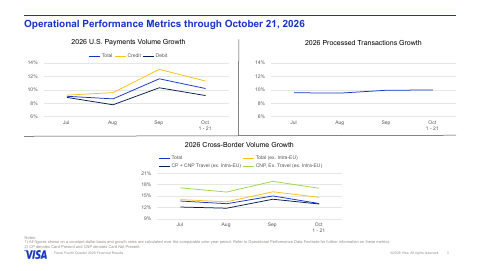
U .S. payments volume was up 10%, with credit up 11 % and debit up 9 % year over year. For constant dollar cross-border volume, excluding transactions within Europe, total volume grew 15 % year over year, with e-commerce up 17 % and travel up 13%. Process transactions grew 10 % year over year. Now moving to Q1 financial expectations, which again are on an adjusted basis. We expect Q1 net revenue growth in the low double digits, just under a point below Q4 adjusted net revenue growth, primarily due to a lack of FIFA-related revenue and pricing.
We expect Q1 operating expense growth also in the low double digits, modestly below net revenue growth. Non-operating expense is expected to be about $60 million. And our tax rate in the first quarter is expected to be between 18.5 % and 19%. As a result, we expect first quarter EPS growth to be in the low end of mid-teens. As always, if the environment changes and there are events that impact our business, we will remain flexible and thoughtful on balancing short and long-term considerations.
As Ryan said earlier, trust has always been at the core of Visa, and trust will be key to our growth going forward. As we look to 2027, we remain focused on driving top-line performance, executing with discipline, and investing in our strategic priorities to capture the significant opportunities ahead. And now Jennifer, I'll hand it back to you.
Thanks Chris. And with that, we're ready to take questions. As a reminder, please limit yourself to only one question.
Thank you. If you would like to ask a question, please press star one and clearly record your name. You will be announced prior to asking your question. To ensure all questionnaires are heard, we ask that you please limit yourself to one question. Once again, to ask a question, please press star one. To withdraw your question, press star two. Our first question comes from Sanjay Sakrani with KBW.
Thank you. I guess one of the big topics this quarter was the launch of initiatives like Muse and Instinct, and it seems like the pace of adoption of agentic experiences seem to have accelerated.
I'm just curious what, Ryan, you guys are seeing in terms of merchant and consumer adoption. And when do you expect it to actually affect your results in terms of these token initiatives, et cetera? Thanks.
I agree, Sanjay, that the quarter was a bit of a tipping point on users being able to experience the type of things we've been talking about on calls like this and other forums for a while now, where you can actually have an agent who can go out on your behalf and execute not just shopping, but real transactions and do it either with or without a human in the loop.
And I think both views and instinct experiences are good examples of that. I think it's still very early. If you just look at just even the user numbers that are public for Muse, you know, it's still very early in terms of the number of consumers that are doing this. And certainly, in the big scheme of things in our overall business, it's a very small amount. Having said that, we remain very excited and have deep conviction about agentic commerce and the promise that it offers, not just for buyers and sellers, but for Visa.
Second, we still have high conviction that Visa and our credentials will play an extraordinarily important role in enabling these experiences. And we're glad that during the quarter, people who don't study the industry, Sanjay, like you and others on the call, and we do, are starting to see the very early use cases and examples of how powerful this can be, both for buyers and sellers. So, you know, we're continuing to invest. We continue to have conviction. We'll continue to work hard across the ecosystem to enable these experiences.
And over time, we're optimistic about the impact that it'll have. Next question, please.
Thank you. James Fossett with Morgan Stanley. Your line is open.
Thank you very much. I wanted to ask kind of a follow-on question related to how you're investing in agentic commerce and all the new money movement capabilities. As these flows continue to develop, how much of an opportunity do you expect to genuinely be incremental to Visa versus potentially a migration of existing card volumes?
And as we look at 27, do we expect any of these to start to have a meaningful impact on growth or the total P &L? Thanks.
I think, you know, I'll kind of come back to where I was with Sanjay. It's still very early. So we do have conviction that the opportunity is significant. We do have conviction that there's real incremental opportunities. But as we think about the next, you know, four quarters and 27, it all remains a very small in the big scheme of the enormous size of our business.
You know, a couple other notes in terms of where we see incremental opportunities. One, you mentioned some of the work we've been doing on Visa Direct and things like that. Those are big incremental opportunities. Two, when you think about machine-to-machine payments and the CLI as a commerce interface, there's a lot of incremental opportunities there. And then just more broadly, in the big scheme of things with Agente Commerce, are agents finding more buying opportunities for us?
Are agents making more purchases at more seller locations because they're optimizing based on value, speed, delivery, like whatever it is important to the user, those are opportunities. So I think we remain very excited and have conviction about the opportunities, but I think we all just need to realize that the development of all of this is still quite early. Next question, please.
Ken Sahotsky with Autonomous Research. Your line is open, sir.
Hey, good afternoon. I wanted to ask just on token pricing.
It's very high margin revenue building in fiscal year 27. The guide has a sort of low double-digit revenue growth, low double-digit OPEX growth, EPS sort of low double-digit to low teens. I was just curious, like how much token pricing are you embedded in the guide? We're just getting some questions as to why there's not more EPS growth. If you could just comment on that. just is the is that pricing being reinvested or their offsets on incentives or anything else we should be aware of.
I can. Yeah, there's a few different things there. And let me let me try to address each of them or at least cover your main points in terms of pricing. I outlined our assumptions on pricing in our guide below double digit adjusted net revenue guide for FY 27. It assumes that the contribution to growth from pricing in 27 is consistent with what we saw in 26. That does include all the pricing plans that we have in motion today.
And also, I did note that in terms of the timing, that it's slightly more back half loaded in 27 as well. So that's one. I think you touched on a couple other things, which ultimately sort of laddered up to an EPS point. On incentives, you brought that one up as well. Well, incentives, we are anticipating a higher volume of incentives in 27. About 25 % of our PV will be renewed versus the 20 % we saw in 26.
You know, as we said many times, we manage our business to drive net revenue growth, and we have a strong plan for 27. And so as you think about incentives, remember incentives are a tool. They're a tool that lets us align with a common set of goals and priorities with our partners as we work together to continue to grow the shared business. And in fact, you know, when we have higher incentive volumes and growth, it does ensure that we're securing these client relationships over the long period and is a key ingredient to our long-term growth.
And then finally, you touched on a little bit of the EPS point. Yeah, we continue to drive productivity growth. We've been focused, as you know, as we've said many times, we're focused on driving both strong top-line growth and profit growth, as we did in 26, delivering 15 % net revenue growth and 16 % EPS growth. In order to continue to do that, to grow in our consumer payments business and accelerate the growth in VAS and CMS, it is necessary that we continue to invest in those growth opportunities.
opportunities. And so, as you've noticed in our guide for next year, we are continuing to become more efficient and we're continuing to invest in these growth opportunities. And when we do that, I think we can continue to drive top line and bottom line growth. Next question, please.
Thank you. Bill Karkachi with Piper Sandler. Your line is open, sir.
Thank you. Following up on your commentary around the significant renewals expected in 2027 uh as more of your clients leverage your vas offerings uh what are the areas as you look um to the new year in particular that you're most excited about beyond your core capabilities and are you seeing your strength in vas trad translate into a deepening of the stickiness
uh in in your client relationships
yeah um so it's ryan in short yes um our it and i would i would kind of expand it to include both VAS and our CMS offerings. The nature of the client agreements that we are engaged in as we kind of migrated into our 2027 fiscal year, they're much broader, they're much deeper, and they include a much more comprehensive set of both value-added services and CMS services such as Visa Direct, some of the commercial and small business offerings I mentioned in our prepared remarks, all in addition to, of course, our consumer payments capabilities.
And, you know, what these broader agreements do is they create a stronger, tighter, deeper, hopefully longer lasting and more comprehensive client relationship with our clients all around the world. So, you know, yes. And then I think finally you asked about, you know, some of the specific things in VAS that we're excited about in that context. Well, I would point to a lot of the cyber capabilities that I mentioned in my prepared remarks. I would point to capabilities like Pismo, which are, you know, new areas where we can support our clients, both in core banking and issuer processing.
You know, I would point to the advisory work that, you know, we've talked about several times in these areas. So all of it are very, very important parts of the types of renewals that you asked about and Chris mentioned. Next question, please.
Thank you, Timothy Chioda with UBS. Your line is open.
Great, thanks a lot. I want to dig in a little bit, and Ryan, you hit on this, but I want to hit on this a little bit more on the Agentec network token.
So our understanding is that this token is sort of a bolstered version of the network token. It's more of a scoped network token, if you will. It'll have all the programmatic aspects, meaning a time window, merchant category code, dollar amount. It'll have the upfront intent, as you mentioned in your prepared remarks. All of that gets kind of bundled up into the agentic network token. The question is, how ready are the issuing banks and what do they need to do in order to say, yes, I'm willing to have an agent issue a agentic network token for one of my customers.
And related, what about the merchant acquirers that are out there, the PSPs? Are they ready to accept the tokenization handshake, if you will? I know you mentioned ShopPay is doing this, but I'm wondering about the others.
First of all, that was a great summary of a lot of the objectives of Visa, Intelligent Commerce, and our agentic tokens. In short, we are doing the work across the ecosystem to ensure that issuers, acquirers, and other ecosystem participants are not only ready, but are ready to enable these transactions at scale.
and we know how to do this work. You know, if you look at our history, even just with tokenization pre-agentic commerce, this is the work that we did broadly across the world. I think I mentioned in my prepared remarks now that we have tokenized e-commerce transactions in 200 countries and territories around the world. We know how to do this work to enable the ecosystem. I also just want to come back and build on your points around these agentic tokens and just put it in context of what we are delivering through Visa Intelligent Commerce.
First, we want to make sure that there's an identifiable user behind every agent. So this is why the identity verification and the tokenization is so important. The second thing we're trying to do is make sure that your agent is your agent. And this is why we've built the agent registration and identification capabilities. The third is that we want to make sure your agent is buying according to your instructions. So these are a lot of the data payloads that you mentioned that ladder up to the intent capture and ultimately the biometric signature.
We want to make sure that there's a clear path to resolution in the event of a problem. So disputes, rules, and processes, and things like that. And then finally, we want to make sure that this all works securely everywhere in the world for billions of users at scale. And you know, that is the work that we're doing. We've announced dozens of partners that are utilizing Visa Intelligent Commerce. We're engaged with many dozens more across the ecosystem that are enablers of all this, as well as all of our issuing partners and acquiring partners around the world to try to enable it at scale.
Next question, please.
Brian Keene with Citi. Your line is open.
Yeah, hi, guys. Solid results here. Just wanted to ask about cross-border. We've seen a little bit of stronger cross-border volumes, both in travel and then in e-com in particular has kind of jumped into the, I think it was 17%. Just curious on any details on both travel and e-comm as we head into next year, how we should think about those growth rates and some of the drivers there.
Thanks.
Hi, Brian. Yeah. Total cross-border volume, as you noted, it was 14 % with two points above Q3. And that difference, as I noted in my prepared comments, was due to travel, which was up three points from Q3. Now, that improvement was primarily due to improvements in both inbound and outbound in Samia. That's the primary driver, but also U .S. inbound remained strong as well in the third quarter. And then, of course, I won't repeat it, but you noted the strength in cross-border, which was up a point from Q3.
Yeah, I mean, when we look across the cross-border volumes in total, both travel and e-commerce, they are strong. They've been strong throughout the course of FY26. And when we look at the history of cross borders, they're above the historical levels. I think it is reflective of strong consumer sentiment, strong demand for travel experiences, and the fact that e-commerce has also just expanded. And e-commerce now encompasses both discretionary and non-discretionary things. So we're seeing strength there.
Obviously, when we look out, we're assuming stable drivers, in fact, maybe slight improvement, depending on the speed of the resolution, potential resolution of the conflict in Samia. But this is something that we'll continue to be very watchful of. But yeah, we agree with you. Cross border and total has continued to be a strength, and that's a good thing for Visa. Next question, please.
Darren Keller with Wolf Research. Your line is open.
Hey, guys. Thanks. You know, you mentioned you're going to be doing about 25 % of the portfolio in terms of renewals in 27.
And I think you did, correct me if I'm wrong, 20 % in 2026. A lot of the portfolio being renewed over a couple of years versus the typical 15 % or so per year. But you're still able to grow low double digits. I know we often see pricing pressure on renewals. You're still guiding low double digits. So maybe just touch on the dynamics of these contracts. Is it fair to say you're seeing two big years of renewals that normally would be 15 to 20 for the years ahead?
And what's driving that pricing power despite the renewals we're seeing? Thanks, guys.
Yeah. Hey, Naren. Yeah, I'm glad you said that, actually. First of all, your facts are exactly right. We're looking at about 25% of our payments volume, which is a bigger year than we saw in 2026, which is around the 20 % mark. But the key point there, which you pointed out, is, you know, we manage the business to net revenue growth, and we have a strong plan for 27 for net revenue growth in the low double digits, inclusive of all the renewal activity that we're seeing, that we're anticipating seeing in 27.
So I think that's exactly the right way to think about it. And as I said earlier, in my previous answer, you know, when we have renewal activity and we're successful in renewing it. It is a great thing for Visa over the long term. It ensures that we have long-term relationships with these very important clients and that'll help us continue to deliver strong revenue growth well into the future. Next question, please.
Thank you. Jason Kupferberg with Wells Fargo.
Your line is open.
Hey, guys. I wanted to talk about U .S. volume growth. I mean, a couple of years ago, we were down in the 5-6 percent range and now we're trending up in the eight to 10% neighborhood over the past few quarters i mean clearly inflation has helped there's been uh probably a little bit of world cup tailwind but how much of this acceleration do you guys feel is more transitory versus being structural and sustainable and just to the extent it's it's the latter what do you really see as the uh the main drivers there what it's ryan what
maybe i'll um try to take a crack at this first of all i think it's tough
to say. You know, we just back, like, zoom out a bit and put it in the context of the macro US economy. We've seen strong growth, as you said, you know, kind of an acceleration from six, seven, 8%, you know, six, 12, 18 months ago to 10%, you know, that you referenced. I think the foundation underlying that more than anything is employment. You know, anyone in this country who wants a job for the most part has a job and that strength of employment despite consumer uncertainty is delivering the strength that you're asking about and ultimately I think driving the strength in spending.
You know the the as I said the uncertainty remains elevated but in the context of strong employment people have jobs they have real wage growth they are spending and by the way we see the resilience across the spending bands on our network. So we've seen stability in that sense. But in terms of how strong for how long and what the new normal is, I just think it's just too hard to tell. Next question, please. Thank you.
Raina Kumar with Oppenheimer. Your line is open.
Good evening. Thanks for taking my question. Can Can you touch on the progress you're making with geographic expansion of PISMO and whether you think PISMO can make progress in core banks processing in the U .S.?
Well, I gave, I believe, some remarks in my prepared comments about the number of new countries and some examples of countries that were entering with PISMO. And I would say our geographic expansion opportunities have exceeded my expectations, you know, going back to when we bought PISMO.
We're having strong demand around the world from clients both for the core banking offerings that PISMO offers, but also the issue of processing capabilities. So I think in general, our thesis on the global expansion for PISMO and having PISMO as part of the Visa network is proven out to be quite strong. In the U .S., I think I spent a fair bit of time on the last earnings call kind of going through the market, the segments, the client types.
You know, we see, you know, opportunity, you know, in the medium and low end for the combined offering that we've brought to market across DPS and Pismo for the more sophisticated clients at the larger end, the largest banks in the United States. We do see opportunities for core banking, but those clients manage core banking very separate from their other capabilities. So it tends to be more of a distinct discussion about core banking. But you asked, do we think it's possible for us to make progress in the U .S.?
Of course. And we've had some great proof points with Wells Fargo and others that we've talked about on this call in the U .S.
Next question. We're going to go a little over so we can get to a few more of you. Next question, please.
Harsha De Rawat, your line is open with Bernstein.
Hi, good afternoon. Ryan, I want to follow up on your comments on visa-ciber-related services. In the current environment, what kind of demand are you seeing on both your visa transaction-related services and also for cyber and risk beyond visa transactions in A2A or even in areas like KYC, identity, et cetera.
And also this feels like a fragmented space beyond kind of these transactions. So what is Visa's right to win here? Thank you.
Well, Arshina, I think our right to win is very significant. We bring strong client relationships. We've delivered some great products to the market. I think it's a, you know, it is a somewhat fragmented competitive space around the world with a lot of different players. And, you know, this is a top three issue for our clients, especially our financial services clients around the world, and they're turning to Visa and looking for help.
And so, you know, in our risk and security value-added services businesses, we have a vast array of these solutions that we've been bringing to market, both new and existing solutions, whether it's Visa Threat Intelligence Program, You know, obviously I mentioned BioCatch, which we're excited about, Visa Advanced Authorization, Visa Decision Manager, those types of things. But if you broaden it to our other areas, as I alluded to and mentioned on my prepared remarks, we're having success deploying and delivering revenue from these services in our acceptance business with our authentication and tokenization platforms, with Visa Intelligent Authorization, which, you know, as I think I mentioned on my prepared remarks, and powers acquirers with advanced processing and payment orchestration and risk settings
and real time data across a bunch of different capabilities. So as well as our advisory business in terms of our kind of visa cybersecurity advisory practice and even in our issuing business with examples like smarter stand-in processing. So it's become a really important set of service lines and services across our entire suite of VAS services. I think our right to win is high. Our progress to date is good, and we'll continue to invest in this space going forward.
Next question, please.
Andrew Jeffrey with William Blair, your line is open.
I appreciate you taking the question. Brian, I read with some interest the Visa Direct stablecoin launch. I know you mentioned it in your prepared remarks. the press release notes that you're going to pre-fund cross-border payouts with USDC, at least for starters. And I know you're part of the Open Standard Consortium. Can you talk a little bit about some of your thoughts around, you know, whether just how stablecoin-in-nostics you're going to be, thoughts on liquidity factors that might impact the incorporation of other stablecoins and so forth?
Just some high level thoughts there would be helpful.
Sure. We're very excited about the Visa Direct product that you mentioned, but just trying to get to the core of your question. We are stablecoin agnostic. We are blockchain agnostic. We serve a vast array of clients with different preferences and different needs around the world. And so in that particular example, while we started with USDC, we planned to activate other stable coins as we push forward. I mean, if you just look at maybe our settlement as an example, I think I mentioned in our prepared remarks, you know, we now support 10 blockchains in settlement.
We now support five stable coins in settlement by USDC, USDG, EURC, PYUSD, and SBC. You know, we have lots of clients who have them for different needs around the world. So we will be agnostic. We think that's the right approach. But we also, as you noted, we are part of the open consortium. We are part of OUSD. OUSD will also, and you should assume, will be an integrated offering into all these other products, not just settlement, but Visa Direct and others going forward.
Last question, please.
Tianjin Wang with JPMorgan Chase. Your line is open, sir.
I'll close it out with my favorite question on visibility, if you don't mind. So, 26 was a pretty special year for growth. Ryan and Chris, I'm thinking about 27. How would you characterize visibility on growth versus this time last year? Where is visibility higher? Where is it weaker? Where might you be more cautious? Thanks.
Yeah, attention. Listen, the approach that we've taken to sharing our initial guide for 27 is very similar to that that we took at the start of FY26.
We shared the initial guidance. We also shared with you a set of planning assumptions that underlie that. Some of those assumptions are macro, like assuming consumer resiliency and that drivers remain stable and healthy. Others are dependent on our strong execution, like securing the large volume of client contracts that are up for renewal this year. And so, you know, you think about those things. And of course, like with any plan, there are risks and opportunities. But the plan we shared with you, I think, reflects a balanced point of view that takes all that into account.
And when you put it together, we feel really good about our plan going into FY27. And with that, we'd like to
Thank you for joining us today. If you have additional questions, please feel free to call or email our investor relations team. Thanks again and have a great day.
Thank you for all for participating in the Visa fourth quarter and full year 2026 earnings conference call. That concludes today's conference. You may now disconnect at this time and please enjoy the rest of your day.
Music