“In fact, R2 is already our best-selling vehicle by volume, outselling both R1 and EDV in the third quarter.”
It confirms the new, lower-priced R2 is already driving Rivian's volume mix.

Rivian (RIVN) · Automotive
Results filed 29 Oct 2026 · Quarter ended 30 Sep 2026 · Call 60 min · RJ Scaringe (CEO), Claire McDonough (CFO)
Read the transcriptSlides (29 pages)Press release ↗Investor relations ↗
Summaries and transcripts are machine-generated and can contain errors.
Rivian generated $2.155 billion in revenue, a 38 percent increase year-over-year, with deliveries up 46 percent and a net loss attributable to common stockholders of $(913) million.
Rivian had record production and deliveries in the third quarter. It delivered 19,248 vehicles, up 46% from a year ago, and revenue was $2.155 billion, up 38%. The new R2 became its best-selling vehicle by volume. Gross profit was $176 million, with an 8% margin. The software and services segment earned $256 million of gross profit, while automotive had a gross loss of $(80) million. The net loss attributable to common stockholders narrowed to $(913) million, and free cash flow was $(1,124) million.
Management raised 2026 guidance: deliveries of 67,000 – 70,000, adjusted EBITDA of $(1.85)B – $(1.75)B and capital expenditures of $1.40B – $1.50B. It expects a positive automotive gross margin exit rate for the year as R2 ramps. The main tension is that cash burn is rising while costs for the R2 ramp, components and memory are rising too. R&D spending is set to accelerate for autonomy, and 2027 capital expenditures will step up. CFO Claire McDonough is leaving, and Derek Mulvey becomes interim CFO.
Open the slide deck (PDF, 29 pages) ↗
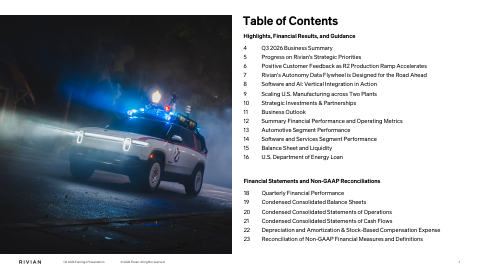
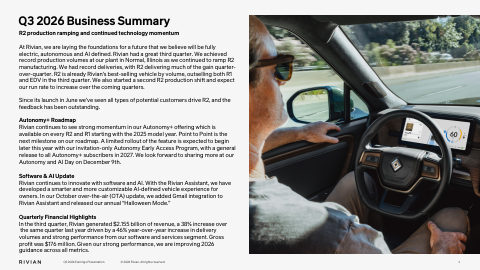
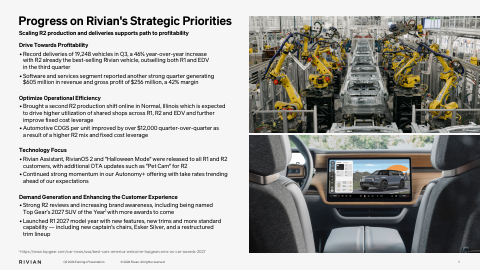
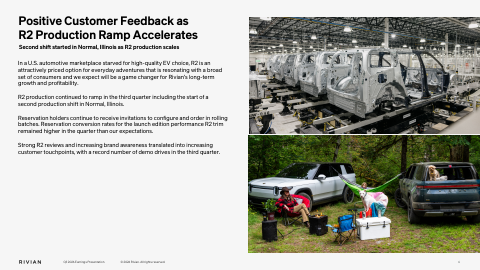
Showing the first 6 of 29 pages.
SEC filing
up 38% from a year ago
compared with $(1.173) billion a year ago
compared with $(0.96) a year ago
compared with $(0.65) a year ago
compared with 2% a year ago
compared with $(983) million a year ago, a $102 million improvement
compared with $(602) million a year ago
compared with $26 million a year ago
| Segment or metric | Value | Change |
|---|---|---|
| Automotive revenue | $1.550 billion | up 36% from a year ago |
| Software and services revenue | $605 million | up 45% from a year ago |
| Software and services gross profit | $256 million | 42% margin; up from $154 million a year ago |
| Automotive gross profit (loss) | $(80) million | compared with $(130) million a year ago |
| Vehicles delivered | 19,248 | up 46% from a year ago |
| Vehicles produced | 19,751 | up 84% from a year ago |
| Cash, cash equivalents and short-term investments | $5.502 billion |
Copied from the press release ↗ and other documents in the SEC filing ↗. A figure is published only if its sentence is in the filing.
| From the filing | Q3 2026 | vs year ago | vs last quarter |
|---|---|---|---|
| Revenue | $2.2B | +38.3% | +30.0% |
| Operating income | -$881.0M | +10.4% | −5.4% |
| Net income | -$913.0M | +22.2% | −9.6% |
| Diluted EPS | -$0.63 | +34.4% | +0.0% |
| Free cash flow | -$1.1B | −167.0% | −32.4% |
| Gross margin | 8.2% | +6.7 pts | −2.6 pts |
| Operating margin | -40.9% | +22.2 pts | +9.5 pts |
Calculated by code from XBRL, not by the model.
| Metric | Period | Outlook |
|---|---|---|
| Vehicles delivered | 2026 | 67,000 – 70,000 |
| Adjusted EBITDA | 2026 | $(1.85)B – $(1.75)B |
| Capital expenditures | 2026 | $1.40B – $1.50B |
Record deliveries of 19,248 units were up 46% from a year ago, with R2 outselling both R1 and EDV in the third quarter. A second R2 shift has started in Normal, Illinois.
Consolidated gross profit was $176 million, an 8% margin, while automotive gross profit was $(80) million. About $120 million of incremental cost of revenues came from the R2 ramp.
The segment brought in $605 million of revenue and $256 million of gross profit, a 42% margin. $354 million of its revenue came from the Volkswagen Group joint venture.
Free cash flow was $(1,124) million versus $(421) million a year ago, driven by working capital. Rivian ended with $5.502 billion in cash and short-term investments, and $7.095 billion of pro forma available liquidity.
Delivery guidance rose to 67,000 – 70,000 units, adjusted EBITDA guidance improved by $100 million at the midpoint, and capex fell by $300 million at the midpoint. Derek Mulvey becomes interim CFO as Claire McDonough steps down.
Fourth quarter worked out from the annual figure.
| Q4 2024 | $1.7B * |
| Q1 2025 | $1.2B |
| Q2 2025 | $1.3B |
| Q3 2025 | $1.6B |
| Q4 2025 | $1.3B * |
| Q1 2026 | $1.4B |
| Q2 2026 | $1.7B |
| Q3 2026 | $2.2B |
| Q1 2025 | -$0.48 |
| Q2 2025 | -$0.97 |
| Q3 2025 | -$0.96 |
| Q1 2026 | -$0.33 |
| Q2 2026 | -$0.63 |
| Q3 2026 | -$0.63 |
Fourth-quarter EPS appears once the press release is read; filings report it only for the full year.
| Q4 2024 | -38.1% |
| Q1 2025 | -52.8% |
| Q2 2025 | -85.5% |
| Q3 2025 | -63.1% |
| Q4 2025 | -64.8% |
| Q1 2026 | -63.8% |
| Q2 2026 | -50.4% |
| Q3 2026 | -40.9% |
| Q4 2024 | $856.0M |
| Q1 2025 | -$526.0M |
| Q2 2025 | -$398.0M |
| Q3 2025 | -$421.0M |
| Q4 2025 | -$1.1B |
| Q1 2026 | -$1.1B |
| Q2 2026 | -$849.0M |
| Q3 2026 | -$1.1B |
Operating cash flow minus capital expenditure, from cash flow statements.
Each quote matches the transcript word for word.
“In fact, R2 is already our best-selling vehicle by volume, outselling both R1 and EDV in the third quarter.”
It confirms the new, lower-priced R2 is already driving Rivian's volume mix.
“we expect that R2 will help us achieve a positive automotive gross margin exit rate for the year.”
It is management's key profitability milestone for the fourth quarter.
“We anticipate the pace of our R &D investment in the strategic area to accelerate in the coming years as we advance our large driving model and progress advanced autonomy development across our consumer vehicles and robotaxi applications.”
It signals rising autonomy spending that will weigh on near-term losses.
“Looking ahead to 2027, we expect a meaningful year-over-year step up in CapEx as construction activity ramps in our Georgia manufacturing facility.”
It flags that this year's capex cut is timing only and that spending rises next year.
“We believe point-to-point capabilities are going to be an important purchase criteria for customers and is becoming a driver of market share.”
It explains why management is prioritizing autonomy as a demand driver.
The large driving model is a foundation model adaptable to R1, R2 and commercial vehicles, with applications in robotaxi through the Uber partnership and in the vans program. — RJ Scaringe
Management intends to exit the year at positive automotive gross profit, not to have a full positive quarter. — Derek Mulvey
The $120 million reflects under-absorbed conversion costs and depreciation at one-shift rates plus items like expedited freight, and cost of goods per unit fell about $12,000 on R2 mix and scale. — Derek Mulvey
Engineering teams are cutting costs through plant details, logistics packaging and supplier redesigns such as part consolidation, to hold the $45,000 to $57,000 trim lineup. — RJ Scaringe
The pace depends heavily on ramping the supply base, since Rivian can only ramp as fast as its slowest supplier, with special teams supporting suppliers. — RJ Scaringe, Javier Varela
Autonomy+ take rates exceeded expectations, and Point to Point is expected to create new levels of demand as a core purchase criterion. — RJ Scaringe
Amazon's data shows structural cost advantages, driving a step up in demand, and other commercial operators are starting to look at the EDV. — RJ Scaringe
The first output launches next year in the Volkswagen ID1, and Rivian sees applications beyond the joint venture, though its focus is on Rivian and Volkswagen programs. — RJ Scaringe
Autonomy has not yet been a major demand driver, but Point to Point is the unlock for an inflection point. — RJ Scaringe
It speeds up closed-loop simulation for evaluating and validating models, so models can be deployed and improved faster. — RJ Scaringe
The program is designed to gather broad feedback on functionality and interface across environments before the full 2027 release. — RJ Scaringe
Pickup and drop-off matter most for robotaxi, while in the supervised consumer product the driver covers complex cases and the interface design is a focus. — RJ Scaringe
Compute pricing is rising, and R&D is expected to grow at a low double-digit rate from Q3 to Q4 and more significantly in 2027. — Derek Mulvey
Teams are working on materials, conversion and logistics costs, from fixes within weeks to multi-year redesigns, with fixed cost absorption the key near-term lever. — RJ Scaringe
It is timing of spend for the Georgia facility, which is lumpy, rather than lower total spend. — Derek Mulvey
Rivian is in talks with commercial customers beyond Amazon but did not comment on a specific deal. — RJ Scaringe
It bolsters simulation work and closed-loop validation, and management did not name further capabilities it needs. — RJ Scaringe
The next hardware generation with lidar goes through an employee program and validation this year, with availability in 2027. — RJ Scaringe
Launch-edition conversion exceeded expectations and test drives rose significantly, though no rate was given. — RJ Scaringe
Variants cover the $45,000 to $57,000 demand curve, and unit costs fall as volume absorbs fixed costs, supporting a healthy positive R2 gross margin. — RJ Scaringe
Rivian did not disclose the attach rate but expects Point to Point to raise take rates further. — RJ Scaringe
Pricing will be market-driven and dynamic, with models ranging from subscription to being bundled in the vehicle price. — RJ Scaringe
No, R1's average selling price is expected to rise as it is intentionally repositioned as a premium flagship. — RJ Scaringe
Revenue was $2.155 billion, up 38% year over year, on record deliveries of 19,248 vehicles, up 46%. Gross profit was $176 million, and the net loss attributable to common stockholders was $(913) million.
Yes. Delivery guidance rose from 65,000 - 70,000 to 67,000 - 70,000 units, adjusted EBITDA guidance improved by $100 million at the midpoint to $(1.85)B – $(1.75)B, and capex guidance fell by $300 million at the midpoint to $1.40B – $1.50B.
R2 is already the best-selling Rivian by volume and lowered automotive cost per unit by over $12,000 quarter over quarter. The ramp still added about $120 million of incremental cost of revenues, and automotive gross profit was $(80) million; management expects a positive automotive gross margin exit rate for the year.
Rivian ended Q3 with $5.502 billion in cash, cash equivalents and short-term investments, and $6.095 billion of total liquidity. Adding the $1.000 billion Volkswagen Group loan received in October gives $7.095 billion, against free cash flow of $(1,124) million for the quarter.
CFO Claire McDonough is stepping down and Derek Mulvey becomes interim CFO. Rivian plans a limited Point to Point rollout later this year and a general release to Autonomy+ subscribers in 2027, and it acquired Third Dimension AI.
Call recording on YouTube ↗. Official replay ↗. Timestamps jump to the moment.
Good afternoon, and thank you for joining us for Rivian's third quarter 2026 earnings call. Today, I'm joined by RJ Scaringe, our founder and CEO, Claire McDonough, our chief financial officer, Javier Varela, our chief operations officer, and Derek Mulvey, our vice president of finance, who will be named interim CFO effective tomorrow. Before we begin, matters discussed on this call, including comments and responses to questions, reflect management's views as of today. We will also be making statements related to our business, operations, and financial performance that may be considered forward-looking statements under federal securities law.
Such statements involve risks and uncertainties that could cause actual results to differ materially. These risks and uncertainties are described in our SEC filings and the presentation we filed with the SEC today. During this call, we will discuss both GAAP and non-GAAP financial measures, A reconciliation of historical non-GAAP to GAAP financial measures is provided in our earnings presentation and press release. Just before the earnings call, we posted our earnings presentation, which includes an overview of our progress over the recent months.
I encourage you to read it for additional details around some of the items that we will cover on today's call. Following our prepared remarks, we will be taking questions from sell-side analysts. In the interest of keeping the call to one hour, we would ask these analysts to limit any follow-on questions to one. With that, I'll turn the call over to RJ.
Thanks, Chip. Good afternoon, everyone, and thank you for joining us for today's call.
We had a great third quarter. We achieved record production volumes of normal as we continued to ramp R2 manufacturing. We also had record deliveries, with R2 delivering much of that gain. In fact, R2 is already our best-selling vehicle by volume, outselling both R1 and EDV in the third quarter. I'm proud of how our team has come together to scale our manufacturing, sales, and service operations. We are also advancing our technology roadmap and I look forward to showcasing that progress at our Autonomy and AI Day on December 9th.
Since its launch in June, we've seen all types of potential customers take R2 for a drive. The feedback on R2 has been outstanding. In the third quarter we hosted over 103,000 R1 and R2 demo drives, surpassing the record we set in the second quarter. Reservation conversion range for the launch edition R2 remained higher in the quarter than our expectations. We are really excited for the launch of additional variants in the coming months.
R2 continues to generate rave reviews and awards from media and recently won Top Gear's SUV of the Year award for 2027 with more awards to come. Amazon continues to expand its fleet of electric delivery vans across North America. Earlier this month, we began delivering new variants that are specifically designed to expand route coverage into more rural networks, including an all-wheel drive configuration, as well as a larger battery pack that offers 30 % more range. Turning to our manufacturing operations, our team in Normal continues to ramp R2 production.
The second R2 shift has started and we expect our manufacturing run rate to increase over the coming quarters. In Georgia, construction of our next manufacturing site is progressing well. Regarding our technology roadmap, autonomy remains one of the most important areas of investment at Rivian. We continue to see strong momentum in our Autonomy Plus offering available on every R2 and R1 starting with the 2025 model year, with take rates trending ahead of our expectations. Today, every vehicle with Autonomy Plus is capable of hands-free driving on millions of miles of roads.
Our next milestone is our point-to-point feature. This means customers can enter an address and their vehicle will follow the route from start to finish, handling city streets, stoplights, highway interchanges, and everything in between with driver supervision. A limited rollout of point-to-point is expected to begin later this year with our invitation-only autonomy early access program with a general release to all autonomy plus subscribers in 2027. We believe point-to-point capabilities are going to be an important purchase criteria for customers and is becoming a driver of market share.
We continue to make progress on our partnership with Uber. We remain on track and expect to achieve our next milestone by the end of this year, which is expected to unlock an additional $250 million of equity investment from Uber. Additionally, last week we announced the acquisition of third dimension AI to support our autonomy development and our associated closed loop simulation efforts. With the Rivian Assistant, we have developed a smarter, more customizable AI-defined vehicle experience for all R1 and R2 owners.
In our October OTA, we added Gmail integration to Rivian Assistant, and we look forward to sharing more at our upcoming Autonomy and AI Day. Dressing up our vehicles for Halloween is a highlight to our customers every year. This October, we collaborated with Sony Pictures and Bill Murray to bring the Ghostbusters universe to life on Rivian vehicles with Halloween mode. This is the perfect demonstration of how the level of deep vertical integration across hardware and software allows us to release immersive features to our customers at speed.
Finally, I want to take a moment to thank Claire for all of her contributions at Rivian over the last six years. On a personal level, Claire has been an incredible partner and friend throughout this journey. I know I speak for the whole team when I say we wish you nothing but the best in your next chapter. I'm also excited to work with Derek as he steps into the interim CFO role. In closing, I want to thank our team for their continued execution in the third quarter.
We are laying the foundations for a future that we believe will be fully electric, autonomous, and AI defined. I could not be more excited about the opportunity ahead for Rivian. With that, I'll turn the call over to Claire to cover our third quarter results.
Thank you, RJ, and good afternoon, everyone. As many of you saw last month, I decided to step down as Rivian's CFO to head back to the East Coast to be closer to my family and pursue a new opportunity.
It has been the highlight of my career to help build Rivian's financial foundation alongside RJ and our teams, and I'm stepping away with complete confidence in this company's trajectory, its mission, and the strength of the team that will carry it forward. Turning through the results of the third quarter, our consolidated revenue was $2.155 billion, a 38 % increase over the same quarter last year. Consolidated gross profit was $176 million, and our gross profit margin was 8%.
Gross profit included $166 million of depreciation and amortization and $28 million of stock-based compensation expense. Adjusted EBITDA losses for the third quarter were $435 million, driven by our $176 million of gross profit and increased adjusted operating expenses as we scale our sales, marketing, and service operations to support R2 volumes and invest in our autonomy roadmap. In the third quarter, we produced 19 ,751 vehicles at our plant in Normal, Illinois and delivered 19 ,248 vehicles. Production and delivery results for the quarter were in line with our expectations, with R2 becoming our best-selling vehicle by volume in the third quarter.
Our $1.55 billion of automotive revenue, a 36 % increase over the same quarter last year, were primarily driven by a 46 % increase in vehicle deliveries and $81 million of regulatory credits, partially offset by a decline in average selling prices from a higher mix of R2 and commercial van deliveries, while R1 average selling prices increased due to mixed improvements. Automotive gross profit loss was $80 million compared to gross profit loss of $130 million in the same quarter last year, a $50 million improvement due primarily to increases in delivery volumes at an improved per unit margin, an increase in revenues related to automotive of regulatory credits, and an IEEPA tariff refund receivable, partially offset by costs related to the ramp
of R2 production. In the quarter, we recognized approximately $120 million in incremental cost of revenue due to the ramp of R2 production as compared to production at more normalized levels. While current macro and geopolitical factors are creating added complexity, cost, and uncertainty, our team continues to work hard to manage supply chain risks and increasing commodity and memory costs. Our software and services segment reported another strong quarter. During the third quarter, the segment generated $605 million of revenue, a 45 % year-over-year increase, primarily due to increases in vehicle electrical architecture and software development services by the joint venture, vehicle repair and maintenance services, and Autonomy Plus, offset by lower remarketing sales.
$354 million, or approximately 60 % of software and services revenue, was attributable to our joint venture with Volkswagen Group. Software and services gross profit was $256 million, a 42 % margin, due to better-than-expected mix of revenues from more profitable revenue streams. With that, I'll hand the call over to Derek to walk through our business outlook and capital roadmap.
Thanks, Claire. It's been a privilege to work alongside you, and I'm excited to step into the interim CFO role and build on the foundation you've established.
Turning to our liquidity and balance sheet, we ended the third quarter with approximately $5.5 billion in cash, cash equivalents, and short-term investments. In addition to this balance, on October 7th, we announced the funding of our $1 1,000,000,010-year term loan facility with Volkswagen Group at a fixed interest rate of 6%. To date, we've received 5.3 of the $5.8 billion in expected capital commitments associated with the joint venture, with the remaining $460 million anticipated in late 2027.
Additionally, we expect to achieve our second milestone under the Uber partnership later this year, which will trigger an additional $250 million equity investment. When factoring in our current liquidity, expected capital from Uber, Volkswagen, and our Department of Energy loan, all of which are subject to certain conditions, our total available liquidity and targeted future capital would be approximately $13 billion. Turning to our outlook, we are improving our full-year delivery guidance from 65 ,000 to 70 ,000 units to 67 ,000 to 70 ,000 units.
In its first full quarter of sales, R2 outsold R1 and our commercial vans, and in the fourth quarter, we expect R2 to represent the majority of our total delivery volume. We are making significant strides to drive down our automotive cost per unit, and we're already seeing the benefit of introducing R2 into our normal production facility. While new vehicle launch complexities in addition to rising costs of core components have, and we anticipate will continue to impact our profitability, we expect that R2 will help us achieve a positive automotive gross margin exit rate for the year.
This would establish a strong foundation for continued margin expansion as R2 ramps through 2027. For full year 2026, we now expect our adjusted EBITDA losses to be between $1.85 and $1.75 billion. At the midpoint, this represents a $100 million improvement driven by favorable regulatory credit revenue, an IEEPA tariff receivable, and our expected increased delivery volume. As RJ outlined, we are making rapid progress in our autonomy roadmap and are excited to launch our point-to-point feature on a limited basis later this year.
We anticipate the pace of our R &D investment in the strategic area to accelerate in the coming years as we advance our large driving model and progress advanced autonomy development across our consumer vehicles and robotaxi applications. We believe autonomy is a primary product differentiator, market share driver, and long-term value creator. Finally, we're lowering our 2026 capital expenditure guidance by $300 million at the midpoint due to a shift in timing of certain capital spend. This brings a revised 2026 CapEx range to $1.4 to $1.5 billion.
Looking ahead to 2027, we expect a meaningful year-over-year step up in CapEx as construction activity ramps in our Georgia manufacturing facility. In closing, I'd like to thank our teams across the company for their execution of the third quarter. We remain confident that R2 and our technology roadmap will be truly transformative for the growth and profitability of our business. With that, I'd like to turn the call back over to the operator to open the line for Q &A.
Thank you. For the Q &A section of today's session, we will be utilizing the Raise Hand feature. If you would like to ask a question, click on the Raise Hand button at the bottom of the screen. Once prompted, please unmute yourself and begin with your question. We will now pause for a moment to assemble the queue. Thank you. Our first question comes from George Janaurikas with Canaccord Genuity. Please unmute yourself and ask a question. Hi, everyone.
Thank you so much for taking my questions. I just want to ask first on autonomy. How leverageable is your platform to the commercial vehicles over time?
Hi, George. The autonomy platform is being built around what we call our large driving model. And so large drive model is a foundation model. It's a large parameter model that we're training. And it's very adaptable to different vehicle form factors and applications. And so that's inclusive of R1, R2, and of course, our commercial vehicles.
And so as we think about the autonomy roadmap and different ways that we can use this to benefit the business, that of course has implications on our consumer business uh you know with the big milestone coming up with our point-to-point features uh but it also has applications in robo taxi uh of course is is part of our uh partnership with uber with the 2028 launch for that and then there's a a number of applications in a commercial space as part of our vans program
thank you uh and maybe just as a financial follow-up just to make sure we heard that correctly you mentioned that i think that auto gross margins should be positive exiting the year, does
that mean we should expect a full quarter of positive auto gross margins or just sort of a run rate in December? Thank you.
Thanks, George. The way we phrased in the fair remarks was that we intend to exit the quarter at an automotive gross profit, so I wouldn't expect the full quarter, but it does set us up really well as we continue to ramp R2 and we think about the progression we see through 2027 for the here.
Thank you. Thank you.
Our next question comes from Joseph Spock from UBS. Please unmute yourself and ask your question.
Thank you. And congratulations to both Claire and Derek. Claire, it's great working with you over the years. and Darcy, and congrats. First, you mentioned this $120 million of incremental cost of revenues due to the ramp, but that's not really cost of good, right? So I guess what I'm wondering if you could help us understand is today's realized pricing and mix, what is the R2 contribution margin before those launch efficiencies and the fixed cost absorption?
because then I think we could get a better sense of, if we add back some of those inefficiencies, what, for lack of a better term, a mature gross margin would be.
Yeah. Thanks, Joe. So the 120 million we quoted really is comparing where our cost structure is today as we think about our conversion costs, our depreciation in relation to what our two-shift operation should be performing at. And so that's just really the effect of not having a full rate of production at a two-shift operation today.
In addition, that 120 includes some of the things like expedited freight and some other costs that we expect to wind off as we continue to scale. I think when you look at R2 today, you know, in the second quarter, we saw about a $12 ,000 per unit step down and costs a good sold per unit delivered. And I think that that is the biggest driver of that is introducing R2. One is R2 is a lower-cost product, but two is R2 is benefiting from a scale perspective within normal.
As we step back and you look at our total automotive gross profit, excluding regulatory credits, on a cash basis, that was positive for the quarter. And we expect that momentum to continue as we scale and ramp R2.
Okay. And I guess just the second question, maybe building off the first one is, since you announced R2 pricing in March earlier this year, there's just been a lot of inflation, whether it's memory, PCB, other electronics, steel, copper, I guess aluminum looks pretty flat.
So maybe that matters less today with the launch additions, but I was wondering if you could give us any anecdotes as to sort of how you're looking for or have been able to find engineering or manufacturing efficiencies or other offsets to be able to maintain those targeted gross margins for the new vehicle.
Well, thanks, Joe. A big part of our engineering team is working on not only ramping production and achieving all the volume that the normal facility is capable of, but also looking at what further improvements we can make to the vehicle.
Some of those will be captured and the vehicle is produced in Stanton Springs in our Georgia facility, but a number of those are going to be flowing into the vehicle over the coming months and quarters. And of course, as you said, with some of the commodity pricing being a lot higher than what we expected i think memories is a really important call out there we've really been focused to find other mechanisms to offset that and to enable us to still deliver on the the various trims we've talked about you know the base trim starting at 45,000 and the top spec trim uh being at about 57,000 and so the team is making great progress in that and it's
really you know in terms of examples it's across the board it's it's how we're uh you know it's details within the plant how we're operating the plant it's looking at improvements and packaging for logistics uh for moving parts from suppliers to our plant uh and then it's down to working really closely with our supplier partners on identifying further cost optimizations in the component level uh really that don't impact the performance of the capabilities of the vehicle that are you know that that often is part consolidation or part elimination through, you know, through redesign of the components.
But, you know, the team's really done an outstanding job of hunting for and looking for those opportunities. And we've got a real full-court press focused on that.
Our next question comes from Mark Delaney with Goldman Sachs. Please unmute yourself and ask your question.
Good afternoon. Thank you for taking the question. And Claire, thanks for all your help. Wishing you the best going forward. And Derek, congratulations on the expanded responsibilities. I was hoping to better understand what's going on with the R2 ramp.
And nice to see the good momentum you just reported and a number of positive comments that you made that you're seeing with that product. Can you share more on what you think are the key factors that will determine the pace of R2 delivery growth in 4Q and 27? And how much is it about converting on those record number of demo drives and positive media reviews into new R2 orders? or is it more about ramping up the supply chain and manufacturing?
Of course, launching a vehicle is a lot of moving components. And I think often the focus and attention gets directed at the plant, at the manufacturing operations. And of course, that's a huge part of this. But I do want to really call out the importance of also ramping the supply base. And in the case of R2, we have a number of new suppliers. We took an aggressive approach of reducing our supply chain complexity to have a smaller set of tier one suppliers to into the business.
And so we can only ramp as fast as our slowest ramping supplier. And that's not to say there's a there's like an acute challenge with a single supplier, but rather the ramp up requires each of each of the suppliers to ramp and they need to be highly coordinated. And so that's something we're very focused on. um you know javier's joining us in the call to have some comments here as well but uh you know our supply chain team our overall uh logistics team has been working very closely uh together to make sure that this ramp is smooth yeah i need that
okay i've been involved in many launches across all my my career and supply chain is always a complex
part of the launch um that we already flag from day one, bringing up hundreds of suppliers and their tier two and their tier three is an immense task. What we are always doing is identifying what are the suppliers that need some support and we have special teams to help them to support our scale. That's the focus area, scaling our supply chain.
Thank you both for those comments. My other question was on autonomy plus. and better understanding the impact it may be having on the business, maybe you can give a bit more color on how impactful Autonomy Plus was in that 45 % year-over-year growth in the software services and other segment.
And when you talk to people who are buying Rivian vehicles, are they telling you that Autonomy Plus is one of the key reasons that they're making that decision?
Yes, as we said in opening remarks, Autonomy Plus, the take credit on Autonomy Plus has exceeded our expectations and we're quite encouraged by it. As it stands to Autonomy Plus, the core feature within it is what we call universal hands-free, which is a hands-free driving capability that can be used on millions of miles across the United States.
What's coming has us even more excited and that's our point-to-point capability. And that's where, in addition to being hands-free, the vehicle can navigate entirely to a destination. So you plug the address in and navigate through four-way stops through complex interchanges uh highway on and off ramps and we think that will start to really create uh you know new levels of demand and new levels of interest and you know today in the market there's really only one other product that that has that of course with with tesla's fsd and so this you know this for us is an important capability we think becomes even more important over the coming quarters and i would say years as more
and more customers get exposed to this and really think of it as a core purchase criteria for the vehicle.
Our next question comes from Dan Levy with Barclays. Please unmute yourself and ask your question.
Great. Thank you for taking the questions. I wanted to ask, first of all, Claire, congratulations and Derek, congratulations to both of you on your new roles. Wanted to ask about EDV, yet another quarterly record in terms of Amazon revenue. If you could just, again, help us unpack the upside there, but maybe you could also talk about some of the upside we're seeing potentially with other customers.
You've probably seen there's some images that went around of an EDV wrapped with another company out there, Walmart. Just maybe you could talk about the potential for uptake with other companies on EDV and if Amazon is finally driving this.
Thanks, Dan. The EDV product, it's exciting to watch. It's something we've really optimized around enabling and really driving an advantaged cost structure. And so we've seen Amazon as they've ramped from the early years of this program up through this year where they've now had a large fleet deployed.
They have lots of data on how the vehicle's performing. and it's creating like true and and very real structural cost advantages that are leading into leading amazon to double down to to continue to buy more vehicles and so as you've heard from us in previous calls uh this year we have seen a significant step up in the level of demand from amazon and that's a you know that's a direct reflection of the advantages that our edv platform provides to your commercial operators.
And so with that said, we do see other commercial operators as they start to really look at ways to drive more efficiency into the business, starting to look at the EDV and we were excited for those potential future customers on this program as well.
Great, thank you. As a follow up, I wanted to ask about the JV with Volkswagen on network architecture and the potential to expand that to others. Maybe you could just talk about how that JV is progressing.
And, you know, just as the technology goes into your vehicle and their vehicles, what are you potentially going to hear from other automakers that might want to adopt this?
well the the first uh real output from the joint venture is going to be launching next year so this is the the volkswagen id1 product this is a roughly 20,000 euro ev that volkswagen's producing for europe and so we're really excited about that it's it's a wonderful way to demonstrate the capabilities of our technology outside of the ravine brand and outside the u .s market you know importantly this is you know being in europe this is uh this vehicle is going to be competing directly against not only european manufacturers
but also chinese manufacturers and we're very confident in the capability of technology and the efficiency or the cost efficiency of being able to deliver deliver a really broad set and impressive set of features in a vehicle at that price point and so i've said this before but we think of that vehicle as really a a billboard for the capability It really demonstrates what can be done. And so the technology we've developed, we certainly think about this as having applications not only beyond Rivian, but also beyond this existing joint venture and into other applications with other manufacturers.
But our focus to date has been heads down on both the Rivian programs as well as the Volkswagen Group programs, the first of which, as I said, is the ID1.
Great. Thank you. Thank you.
Our next question comes from Itai Mikhaeli with TD Coven. Please unmute yourself and ask your question.
Great, thanks. Hi, everybody. Claire, Derek, congrats to you both and best wishes. Maybe your first question, going back to autonomy plus, and it's becoming a driver, a major driver of demand for you.
I'm curious whether you think consumers are sort of coming to purchase the vehicles with the point-to-point feature in the future in mind, or do you think that when you launch point-to-point, could that be another step function improvement in demand? And maybe similarly for the Gen 3 hardware when that's launched as well?
I think in a very broad sense, to date, autonomy has not been a major driver for most customers in the united states um that's sort of evidenced by most of the vehicles that are being sold today do not have very very much autonomous capability i do think that we're at the base of a very significant inflection point though where we're going to start to
see a much broader set of customers start to really look for advanced capabilities and and with that i think point to point is really in many ways the unlock for that where it really becomes in some ways like a magical experience where you get into the vehicle and the cognitive load to have to operate the vehicle and navigate the vehicle is dramatically reduced because you simply have to put in your your end destination and the vehicle can handle uh what happens in between and so this has been as we've talked about in previous calls there's been a major focus for us a major and when i say that that's a major focus of resources, both dollars on the R &D
side as well as people. We've designed our architecture inclusive of the sensor set, our compute topology, the way we're developing a system around this neural net based foundation model, and in the whole business to really support both progress around autonomy, but specifically progress towards some of these key milestones or key steps with point to point being the first of multiple key steps that ultimately lead to the level four capability that we're planning for for 2028. Terrific, RJ.
And a quick follow-up, maybe touch upon just the acquisition of third dimension. Does that kind of help you get to level four? Does it maybe expand the scope of ODD? Just kind of curious a bit on kind of what this does post the acquisition.
Yeah, this is It's an exciting addition to the team. We're really pleased to have completed this acquisition. And, you know, when you look at development of these higher levels of autonomy and really building them around a model-based approach, so, you know, an AI-based approach versus the autonomy 1.0 approach of using a more deterministic rules-based approach, a key part of that is what we call the eval process, you know, how we're
evaluating the model. model and you can do that in an open-loop way by putting it on vehicles and driving those vehicles and that's it's obviously proven we've seen that Rivian has done that many of the companies use that approach and it'll continue to be used but in addition we want to create closed-loop mechanisms whereby we can test the model in real life conditions or simulated conditions and then and make lots and lots and lots of iterations on those conditions, and to do fault injection, to do unique circumstance injection into the simulations.
And so the acquisition of Third Dimension is supporting the simulation work that we've been building on within the company, and the ability to have more rapid closed loop simulations that allow us to deploy models more rapidly, and then of course make progress in advancing the models more rapidly
that's very helpful thank you thank you
our next question comes from alex perry with b of a please unmute yourself and ask your question
hi thanks for taking our questions here and uh definitely want to echo the congrats to Claire and Derek as well.
I guess maybe just following up on point to point, with the autonomy early access program beginning in December, what do you need to see from that group before moving to a broader 2027 release? Is this to gather data and sort of validate the incident profile here? Would love to just get your thoughts on what you need to see there.
Having an early access program is a very common approach for newer technologies to get feedback from a broad spectrum of users.
And that's everything from the functionality of features to the interface and how the features deployed or how they're actualized, what the UI looks like. And so this early access program allows us to do that. It gives us the opportunity to get really rich and diverse feedback from a broad set of customers in different driving environments and different geographies. So that was how it was designed. And of course, as you said, that sets us up to then have the full broad release across all Autonomy Plus subscribers in the 2027 timeframe.
Perfect. And then I guess I wanted to ask about, you know, how the edge cases that you're trying to solve for here at first. First, we've heard about pick up drop off being a little bit of an edge case that's tougher to solve, but love to just get your, when you're first launching point to point, what will the functionality sort of really entail? And then how do you expect it to progress over time?
Yeah, I mean, there's, I guess when you think about education, there's a broad spectrum of types of educations um yeah the the pickup drop off is particularly important for robo tax or level four applications that's you know that's a that's beyond what we're and that's that's
i'd say more even more important uh when we start to look at deployment of our uber partnership in 20 28 and i'm sure many have experienced this the challenges of let's say dropping someone off or picking someone up in a highly urban environment where there's no place for the vehicle to pull off and so you're sort of stopping in lane on a road those are those are challenging uh situations and challenging as we've you know even undeployed vehicles today uh as it pertains to the consumer vehicles and point to point some of those are solved uh you know simply through this being a supervised product so the you know if it's a very complex uh pickup or drop off situation
you have the benefit of someone in the driver's seat and this is where you know really being thoughtful on the ui in that situation is important so what does the vehicle do when it gets the destination and how and how does it indicate uh to the to you know person the driver's seat um and we're working really hard to make sure all those is the ui and the thinking about what that interface feels like experiencing the product is really seamless and easy to use and understand
perfect that's really helpful best of luck going forward Thank you.
Our next question comes from Shreyas Patil with Volv Research. Please unmute yourself and ask your question.
Hey, thanks. Thanks so much for taking my questions. Curious on R &D, I think it was up 7 % year over year excluding stock comp. I know that's an important cost item, or I know an important element there is the cost for leasing AI compute capacity for training. And I'm curious what you're seeing in terms of pricing and available capacity.
We are seeing industry-wide token prices move higher, but just curious what you're seeing on the ground.
Yeah, thanks, Shreya. We are seeing some increased pricing as we think about leasing compute. With that said, as we think about looking at Q3 this year to Q4, we do expect a low double-digit growth rate in R &D. And as we look at next year, we do expect our R &D line to grow more significantly in 27 than it did in 26.
This is really all driven by our strategic investments in autonomy software, autonomy hardware and some vehicle technologies. And so we continue to be efficient in our uses of compute, but we expect to continue to expand that as we think about next year and the progress we're making on our large driving model.
Okay, thanks. And then maybe on input costs, I think you alluded to that as being a headwind. I'm just curious in terms of some of that, if you can drill down more specifically on some of the actions you're taking to try and mitigate that, whether it's coming from higher steel or freight logistics, DRAM, maybe if you could just provide a little more color.
Yeah, there's so many components that go into a vehicle. So the big, big categories are, of course, building materials. Then you have conversion costs, cost to build the vehicle, the plant, and you have logistics costs. So across each of those categories, we have teams of people that are working to identify opportunities and the opportunities we're identifying as I described before range from things that we can deploy in very near term so these are ideas that can be deployed within weeks to then ideas that require years of time meaning like significant redesign or selection of new suppliers and so this is something in any scenario we'd be fighting and pushing for but I think to the to your point of your
question this is of even more importance given some of the headwinds that have that have you know merged around raw material costs and memory costs um but we continue to make progress on that um i think the most important very near-term thing that we're doing is the ramp is focusing on getting better fixed cost absorption through getting more output from the plant that's been installed and from the team that's working those lines and so that's everything from getting our supplier suppliers ramped as you heard from uh derek and i earlier derek earlier uh and then making sure that we can very efficiently convert all those components from suppliers into our vehicles in the plan
okay thanks and maybe if
i could just squeeze the last quick one um and apologize if you mentioned it previously but the reduction in capex for this year uh now 1.4 to 1.5 billion just what's driving that
thanks yes yes the reduction in capex is mostly driven by timing just some timing shift as we look at our our spend related to our Georgia facility. At the moment, it's a very lumpy sequencing of spend as we think about large equipment and purchases and large contracts.
And so as those move from an invoice repayment perspective or timing perspective by a few weeks, it's just between quarters. So I'd characterize the move, the lowering of the capex strictly from a timing perspective.
Okay, great. Thanks a lot.
Our next question comes from Edison Yu with Deutsche Bank. Please unmute yourself and ask your question.
Great, and congrats, Claire and Derek. First question, we saw some media reporting lately about basically one of your vehicles badged with Walmart on it.
Curious if you can comment on all, if this is testing phase or part of some type of! enterprise deal.
yeah as i mentioned earlier as we've we um with our commercial vampire we continue to have discussions with customers uh outside of amazon of course our partnership with amazon is you continues to progress and advance in extremely positive ways uh this year represented a big step up in volume with them and it is really a reflection of the performance and cost advantages enabled by this platform.
And so we do continue to look for and work with other potential partners as we go forward.
Understood. Follow-up, I wanted to ask about Third Dimension. I think my crude understanding is that it sort of turns video, kind of regular video into like a 3D copy of the world of sorts. is that kind of a very simplistic understanding of what it does? And then following up on that, are there any kind of capabilities out there in addition to this that you think you need to kind of complete the autonomy stack?
Sure. I talked about it a little bit before, but the third dimension acquisition is something we're really excited about. It bolsters our simulation efforts within the business and helps us create efficient closed loop mechanisms by which we can validate and improve on our models. And these are efforts that, of course, were underway within the business already. This is a great way for us to help accelerate some of that work. and as you think about simulation and the imports of simulation, this becomes an even, using simulation for validation becomes an even more important element for rapidly iterating on the model architecture model design.
Thank you. Our next question comes from Tobias Baif with Rothschild & Co. Redburn. Please unmute yourself and ask your question.
Hi, good evening. I have just one question, please. Over the next two to three years, what are your priorities for increasing brand awareness or brand equity? And how will you measure whether those efforts are translating into customer acquisition and revenue growth?
Well, that's a great question, Toby. We're really excited with the launch of R2 to have a product now that has a much broader and wider aperture for customers.
Whereas, you know, of course, R1 was our handshake with the world. It was a great product to introduce the European brand to consumers. But by virtue of its price point, by virtue of being our flagship product, you know, its price made it not something that many customers would be considering. And so with the R2, the price starting at 45 and going up through mid to high 50s puts it right smack sort of overlapping with the average price of a new car in the united states in the most popular segment the mid-sized crossover and hdv segment and so that on its own is going to lead to more vehicles on the road which which of course will create more awareness
but bolstering not just the vehicle and its you know increased presence on the roads is we're doing a bunch of really creative ways of getting the brand out there um you know maybe the most recent one as good demonstration this is what we did for halloween this year of course we've we've been doing halloween mode uh since we launched the company uh and each year we think of really creative ways to uh do fun things to bring a lot of excitement to customers but this year we partnered with sony and created a halloween mode where uh we had ghostbusters integrated into the vehicle uh of course working close with phil murray to to do this was a lot of fun
but these are ways we can really cut across culture, cut across a wide spread of demographics and create awareness for the brand as you noted.
Perfect. Thank you so much for your time.
Our next question comes from Rajat Gupta with JP Morgan. Please submit yourself and ask your question. Rajat Gupta, please unmute yourself and ask your question. Our next question comes from Chris Pears. We'd need them. Please unmute yourself and ask your question.
Hey, just a quick one to, can you just kind of talk to the LIDAR variant of the R2?
I believe originally it was supposed to be coming out to consumers this year. I think that term delay might be a bit harsh, but now it's employee only for testing or for purchase. I just kind of want to understand if there was some sort of component delay or just sort of the initial launch variant was better than expected. I'm just kind of curious what drove that decision.
Well, thanks, Chris. On our autonomy platform, I mentioned before the large driving model.
And so large driving model is something that's going to be deployed across all of our two vehicles, including, of course, launch edition and then model 2025 R1s with new model 2025 or newer. um and so importantly that means point to point is going to be available on all those vehicles and the capabilities that that entails we think are quite exciting quite quite exciting the um yeah the next hardware generation which includes our wrap one processor which is for each processor 800 tops we have two of those for 16 our tops in the vehicle we marry that with an enhanced perception platform that includes camera radar and as you pointed out a lidar sensor uh that as you said is going
through employee like an employee program late this year and a validation builds validation process this year and then into 2027 that vehicle will be available uh but we're look we're really excited about what ldm the large drive model represents and what that can bring to everything from as i said model year 2025 r1 uh existing r2 and then future r2
okay perfect and then you've talked about order book to purchase conversion i think just kind of using conversion broadly can you can you talk about test drive to order book conversion given how test drives are up so much sequentially with the launch of the r2 like what you know is it that i guess just sort of what are you
seeing there and is it is a long wait kind of maybe long is not the right word but are people kind of converting from test drives to the order book at what kind of rate versus the r1 or just any color you can share there
yeah that uh maybe the most interesting is we launched with the launch variant and so that's you know, our premium performance trim. And we had certain assumptions around what the conversion for that would be, recognizing it's the most expensive R2.
And the conversion to date has exceeded our expectations, which is really encouraging. That doesn't take away from how excited we are for the other trims to also come in. But it's, you know, outstanding to see so many folks excited just to get into an R2 and also be in the launch configuration. With regards to test drives, I'm glad you called it out. This is an important metric for us and we did see a significant step up in test drives really as a result of having R2 available and the level of excitement from folks to get in and experience the vehicle.
Thank you. Our next question comes from Tom Narayan with RBC. Please unmute yourself and ask your question.
Ah, yes. Thanks for taking the question. Yeah, good luck, Claire. Congrats, Derek. First question is on the R2. You've been selling the kind of higher-end trims, But then next year, you're going to have the kind of lower end trims with a lower battery range. Curious what you think about consumer demand for those products with the lower battery range, especially in light of what model-wise battery ranges relative to price.
And then also the impact on margins for that lower end, lower trim R2. And then I have a follow-up.
yeah as I said we're excited about all the different trends um there's there's sort of two big uh variables to think about in the different configurations so we have a premium trim and then a standard trim that's the you know that's the like the interior appointments of the rear drop glass that that links to that a few other features within the vehicle and then there's propulsion uh variation so we have all-wheel drive performance we have all-wheel drive base and uh and then we have a rear-wheel drive variant and then within the rear wheel drive variant we
have a larger pack and a smaller pack and so really the reason we create all those variants isn't uh uh is i should is because we want to make sure we you know cover the demand curve so cover give customers enough choices across performance range price point content such that we can we can capture customers from the $45 ,000 price point all the way up to the $57 ,000 price point. And from a unit economics point of view, I think we have to recognize that when we launch, as Derek described earlier, the lack of volume and the ramp up, just because of the nature of ramping on a single shift, ramping suppliers, means that our ability to absorb fixed costs,
that's depreciation, that's the labor cost within the plant, is more limited. And as we grow volume, the actual cost structure of the vehicle comes down quite considerably because those fixed elements of cost get absorbed by a lot more volume. And so we've been able to very intentionally sequence the nature of launching with a high-priced variant and then bringing in these other trims as our volume grows, such that in the end it supports a healthy positive gross margin for the R2 business.
And of course, that given its volume, that really drives the financial performance of Rivian overall.
Got it. And then my follow-up is on autonomy.! I think you said the take rates for hands-free are better than what you've expected. I mean, can you give us a sense of what those take rates could be? You know, we know Tesla FSD is around 75%. I mean, is it in that order of magnitude? And then, you know, do you see point to point with higher pricing than your current autonomy product?
You know, Tesla FSDs are on $99 a month, which suggests that consumers are willing to pay more for autonomy, you know, at least at that quality.
Well, yeah, I said this earlier, and I do think it's an important call out. We really think of point to point as being almost an inflection point in terms of the type of experience you can have with autonomy. Hands free as it is today, you can use it on any road, effectively any road that has lines, any marked road.
So it's millions of miles of roads today, but it's not navigating you, you know, off exits onto, you know, urban environments through stoplights and, you know, through four-way stops and those sorts of things. The point-to-point does do that. And with point-to-point, it creates this much easier experience where it takes the cognitive load of having to figure out what you're going to do, navigating, thinking, paying attention to which road you're supposed to turn on all those things sort of fade away and it is a really nice experience i mean it's uh i'm driving it every day it's it's wonderful on my community and out of the office um and so our view is that that is
going to become a big driver of demand and and i think it's unclear how quickly the whole you call it the whole u .s market and the whole whole automotive market starts to shift to really wanting this and this being a major purchase criteria but certainly we're at the front end of an inflection point whereas more and more people are exposed to what this could do uh we think it's going to become very important and it's it's precisely because of that that you know for the last few years we've been investing heavily in in building this capability going back to kicking off an in-house silicon program uh you know which ultimately is is you know bodied in our app
one uh to verdict integrating the the whole platform so that's you know all the perception platform feeding in and running this what we call this ldm our large driving model. So we're, you know, we're extremely excited about this. We do think it's a really big driver in the long term for market share for us. We think it's going to be important that customers have some choices. As I said, with FSD being out there and soon our point-to-point being out there, we think that's great.
And we're, you know, we're looking forward to getting it in the hands of our Autonomy Plus customers. And we think certainly that that will drive an increase, a further increase i should say in the take rate on autonomy plus
okay just to clarify is i mean i guess you guys not giving us the attach rate for uh for your autonomy product um is it close to the tesla uh level or you're not
we're not giving the attach rate um maybe someday we will but we're not giving it here
in the pricing could it be could you guys raise it for point to point you think what do you think
this is a interesting question um in the fullness of time
of course we think this is you know for over the coming years we do see opportunities for this to continue to grow um but i think the dynamics around this are going to depend on ultimately how the market you know how the market is behaving overall um you know this this is something today that's purchased as a separate subscription you know you could imagine models where this gets convetted into the price of vehicle so there's a lot of different ways this is going to be priced i do you know i call it out as an inflation point i would just say autonomy represents a big big shift in in the overall topology of of the auto industry i think it's
going to be a big driver of market share and it could drive huge changes in market share uh shifting between different companies i think the the models by which we charge for it um monthly subscription up front embedded in vehicle price there's there's a whole host of really exciting and interesting opportunities. But like any marketplace, it's going to be market driven. And so we're watching it very closely. But I'd say if I were to say the guide on one thing, I'd say it's going to be dynamic.
It's not going to be the same for 10 years. It's going to change as the market evolves.
Thank you. Our last question comes from Andrew Cooper Coco with Morgan Stanley. Please unmute yourself and ask your question.
Great, thanks so much. Good evening, everyone. I'll just reiterate all my peers' comments. Claire, it's been great working with you, and I know you've got a good opportunity in front of you. So best of luck. And Derek, looking forward to working more with you going forward.
Maybe just one follow-up question for me and around the R1 seems like, you know, just based on what you guys have disclosed, the R2 volumes were, I guess, close to nearly double R1. And it's clear it's outselling the R1, which I would assume was the, you know, intention with the vehicle. But I'm curious how you're thinking about positioning the R1 over time. And I know you've gotten asked about this before. And obviously there's clear value in having that vehicle in the portfolio.
But from a pricing perspective, do you think that there's an opportunity over time to maybe lower the price point as you start to leverage some of the scale and supply chain benefits from the R2 to make the R1 maybe a little bit more in line with some of the other three row SUVs we see in the market from a pricing standpoint? just curious you know medium long-term view on how you're thinking about positioning the product from a pricing standpoint um to maybe leverage some scale and get some incremental volume on the r1 over time thank you
thanks andrew um derek references in his opening remarks um but just to state it to make sure it's clear we we actually
expect the r1 um pricing uh to to go up a bit And so not the price, I should say the average selling price to go up. And it's really strategic. We removed what we call our standard trim for R1 and have intentionally moved the product a bit up market and really doing that because of where R2 sits in terms of pricing. And as we think about how it sits within the portfolio, this is a flagship product.
So it's the highest spec trim. It's got over a thousand horsepower. It's extremely capable on-road, extremely capable off-road. The tri-motor is also incredibly capable. It's more than 800 horsepower, extremely capable. And so by virtue of the quad, the tri, and the performance dual that we have on that, we very thoughtfully have moved it upmarket to really fill that place as a flagship product. And so that was intentional. And we're now seeing the results of that.
and Derek referenced it in terms of when you look at revenue per unit for the quarter. Now, with that, its objective is not to be a high-volved product. It's not trying to compete in the low-priced or lower-priced segment of two or three-row vehicles. It's working to be much more of a premium vehicle. As I describe it, the capabilities and features are set up as such.
Understood. Okay, thanks so much. I'll leave it there.
Okay, well, great everybody for joining us on this call and appreciate the time. Hopefully, as you can see, we're really excited about what's in front of us. We're excited about the continued ramp up of R2. You know, in looking at the additional volume we'll be building in Q4 and then into next year. I think along with that, really excited for what's to come with autonomy. We spent a lot of time today talking about it. i'm i'm encouraged by the level of interest that that there is around our point-to-point capability and looking forward to showing a lot more about that and talking about that as well as other aspects of our technology portfolio at our upcoming autonomy and ai
day so with that thank you all for joining us and look forward to our next call