“We signed $67 billion to an AI infrastructure contract this quarter, the majority of which with either bring your own hardware or prepaid.”
It shows how much of the record RPO growth came from customers funding the hardware themselves.

Oracle (ORCL) · Software
Results filed 10 Jun 2026 · Quarter ended 31 May 2026 · Call 49 min · Clay (CEO), Mike (CEO), Hillary Maxson (CFO)
Read the transcriptSlides (20 pages)Press release ↗Investor relations ↗
Summaries and transcripts are machine-generated and can contain errors.
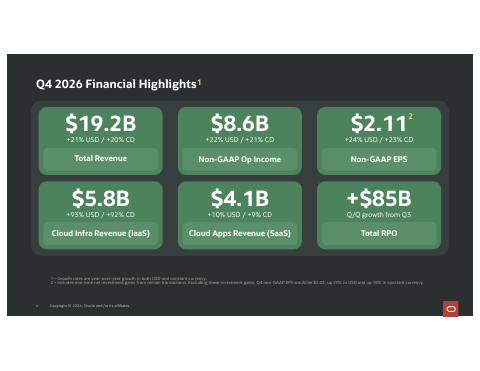
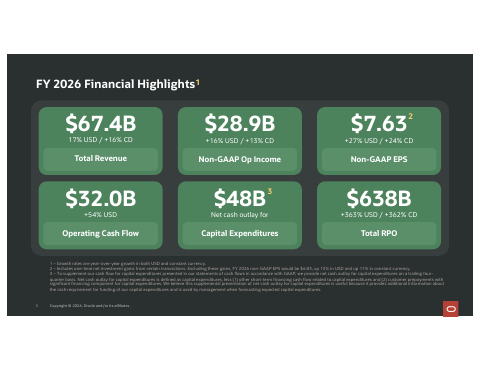
Oracle reported record Q4 total revenues of $19.2 billion, up 21% USD, with GAAP EPS of $1.45, non-GAAP EPS of $2.111 and Remaining Performance Obligations of $638 billion.
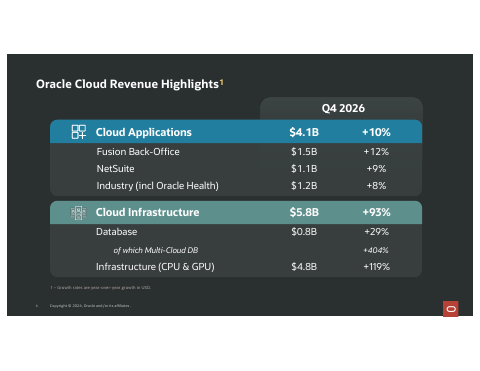
Oracle had a record fourth quarter. Total revenues were $19.2 billion, up 21%. Cloud Infrastructure (IaaS) revenue was $5.8 billion, up 93%, while Cloud Applications (SaaS) revenue was $4.1 billion, up 10%. Software revenues fell 2% as customers moved to the cloud. GAAP EPS was $1.45 and non-GAAP EPS was $2.111. Remaining Performance Obligations (contracted future revenue) rose $85 billion in the quarter to $638 billion, much of it from AI contracts that customers prepaid or supplied hardware for.
For Q1 FY 2027, management expects total revenues to grow 27% to 29% and non-GAAP EPS of $1.72 to $1.76 in USD. For the full fiscal year it confirmed $90 billion of revenue and raised non-GAAP EPS to $8.05. The main tension is funding the data center build. Free cash flow was negative $23.7 billion in FY 2026, and Oracle plans to raise about $40 billion in FY 2027. Gross margins are also expected to step down.
Open the slide deck (PDF, 20 pages) ↗
Showing the first 6 of 20 pages.
From Oracle investor relations
SEC filing
up 21% USD, and up 20% constant currency
up 23%
up 21% USD
up 24% USD
up 20%
up 22%
up 54%
| Segment or metric | Value | Change |
|---|---|---|
| Cloud Infrastructure (IaaS) revenue | $5.8 billion | up 93% USD, and up 92% constant currency |
| Cloud Applications (SaaS) revenue | $4.1 billion | up 10% USD, and up 9% constant currency |
| Total cloud revenues | $9.9 billion | up 47% |
| Software revenues | $6.8 billion | down 2% |
| Services revenues | $1.5 billion | up 13% |
| Hardware revenues | $0.9 billion | up 9% |
| Oracle Multicloud AI Database growth | 404% | |
| Global GPU utilization rate | 97.5% |
Copied from the press release ↗ and other documents in the SEC filing ↗. A figure is published only if its sentence is in the filing.
| From the filing | Q4 FY2026 | vs year ago | vs last quarter |
|---|---|---|---|
| Revenue | $19.2B | +20.6% | +11.6% |
| Operating income | $6.1B | +20.0% | +12.2% |
| Net income | $4.3B | +25.6% | +15.7% |
| Free cash flow | -$1.9B | +35.9% | +83.7% |
| Operating margin | 32.0% | −0.1 pts | +0.2 pts |
Calculated by code from XBRL, not by the model.
| Metric | Outlook given with Q3 FY2026 | Reported | Result |
|---|---|---|---|
| EPS (non-GAAP) | between $1.96 and $2.00 in USD | $2.11 | above the range |
Compared with the company's own guidance, not analyst estimates, and only where the outlook and the reported figure are the same measure on the same basis. Ranges are worked out by code from the company's wording. How this works.
| Metric | Period | Outlook |
|---|---|---|
| Total revenue growth | Q1 FY 2027 | 27% to 29% |
| Total cloud revenue growth (USD) | Q1 FY 2027 | between 58% and 64% |
| Non-GAAP EPS (USD) | Q1 FY 2027 | between $1.72 and $1.76 |
| Total revenue | fiscal year 2027 | $90 billion |
| Non-GAAP EPS | fiscal year 2027 | $8.05 |
| Net cash outlay for capital expenditures | fiscal year 2027 | around $70 billion |
| Debt and equity financing to be raised | fiscal year 2027 | approximately $40 billion |
Cloud Infra (IaaS) revenue was $5.8 billion, up 93% USD, while Cloud Apps (SaaS) grew 10% to $4.1 billion. Software revenues were down 2% to $6.8 billion.
RPO grew $85 billion in Q4. The prepaid and customer supplied hardware portions of large AI contracts now total $75 billion, which reduces the capital Oracle must raise.
FY 2026 operating cash flow was $32.0 billion, up 54%, but free cash flow was negative $23.7 billion. Capital expenditures were $55,663 million.
Oracle confirmed its $90 billion revenue guidance and raised non-GAAP EPS guidance to $8.05. Q1 revenue is guided to grow 27% to 29%.
Oracle expects to raise approximately $40 billion in FY 2027 through debt and equity, including a $20 billion at-the-market equity issuance. It does not expect to issue additional debt in calendar year 2026.
Fourth quarter worked out from the annual figure.
| Q2 FY25 | $14.1B |
| Q3 FY25 | $14.1B |
| Q4 FY25 | $15.9B * |
| Q1 FY26 | $14.9B |
| Q2 FY26 | $16.1B |
| Q3 FY26 | $17.2B |
| Q4 FY26 | $19.2B * |
| Q1 FY27 | $19.3B |
| Q2 FY25 | $1.10 |
| Q3 FY25 | $1.02 |
| Q1 FY26 | $1.01 |
| Q2 FY26 | $2.10 |
| Q3 FY26 | $1.27 |
| Q1 FY27 | $1.56 |
Fourth-quarter EPS appears once the press release is read; filings report it only for the full year.
| Q2 FY25 | 30.0% |
| Q3 FY25 | 30.8% |
| Q4 FY25 | 32.1% |
| Q1 FY26 | 28.7% |
| Q2 FY26 | 29.5% |
| Q3 FY26 | 31.8% |
| Q4 FY26 | 32.0% |
| Q1 FY27 | 34.8% |
| Q2 FY25 | -$2.7B |
| Q3 FY25 | $71.0M |
| Q4 FY25 | -$2.9B |
| Q1 FY26 | -$362.0M |
| Q2 FY26 | -$10.0B |
| Q3 FY26 | -$11.5B |
| Q4 FY26 | -$1.9B |
| Q1 FY27 | -$5.4B |
Operating cash flow minus capital expenditure, from cash flow statements.
Each quote matches the transcript word for word.
“We signed $67 billion to an AI infrastructure contract this quarter, the majority of which with either bring your own hardware or prepaid.”
It shows how much of the record RPO growth came from customers funding the hardware themselves.
“Q4 finalizes an impressive FY26 where we delivered more than 1.2 gigawatt to customers. Our pace of delivery continues to accelerate, with our FY27Q1 delivery approaching one gigawatt”
It shows how quickly Oracle is bringing data center capacity online to turn RPO into revenue.
“While these investments are creating pressure on the near term to gross margins in our infrastructure business, we expect margin performance in infrastructure to improve rapidly as we reach full contractual revenue levels at our data centers.”
Management acknowledges near-term gross margin pressure and ties its recovery to data center ramp-up.
“To support our capital investments program, we expect to raise around $40 billion in debt and equity in our fiscal year 27, and that includes our already announced $20 billion at-the-market equity issuance.”
It sizes the external funding needed for the build-out, including dilution from equity issuance.
“And what we see is return on invested capital in the high 20s at a steady state.”
The CFO gives investors a return metric for the AI infrastructure business.
“when the costs do go up, we have, I think, a very robust set of mechanisms that ensure that Oracle is not sitting there with reduced margins.”
It addresses the risk of rising memory and component prices on long-term contracts.
Clay said the capex increase was timing rather than component prices, and that Oracle uses fixed-price contracts when costs are known and floating mechanisms when they are not. — Clay
Hillary fully reconfirmed the long-term targets and pointed to the growing RPO as support. — Hillary Maxson
Hillary said she sees return on invested capital in the high 20s at steady state at the project level, and higher for bring-your-own-hardware structures. — Hillary Maxson
Clay said Oracle focuses on customer satisfaction and cited high utilization and quick re-sale of capacity coming up for renewal as evidence of strong demand. — Clay
Mike said outcome-based pricing is being expanded across all applications, along with token bundles, and he expects it to help growth. — Mike
Mike said applications grew double digits with deferred revenue up 16%, and the database grew 29% with multicloud revenue up 404%. — Mike
Clay said the mix will keep evolving, and Hillary said the $70 billion net cash outlay excludes $20 to $25 billion that sums to reported capex. — Clay, Hillary Maxson
Total revenues were $19.2 billion, up 21% in USD, with GAAP EPS of $1.45 and non-GAAP EPS of $2.111. Cloud revenues were $9.9 billion, up 47%.
Remaining Performance Obligations were $638 billion, up $85 billion from Q3. Most of the increase came from large AI contracts where customers prepaid or supplied the GPUs.
For Q1 FY 2027, Oracle expects total revenues to grow 27% to 29% and non-GAAP EPS of $1.72 to $1.76 in USD. For FY 2027 it confirmed $90 billion of revenue and raised non-GAAP EPS guidance to $8.05.
FY 2026 operating cash flow was $32.0 billion, but free cash flow was negative $23.7 billion because of data center spending. Oracle raised $43 billion in debt and $5 billion in equity in FY 2026 and plans to raise about $40 billion in FY 2027.
Cloud Applications revenue grew 10% to $4.1 billion, while Software revenues fell 2% to $6.8 billion as customers migrate to the cloud. Management said the Multicloud AI Database grew 404%.
Call recording on YouTube ↗. Official replay ↗. Timestamps jump to the moment.
26 earnings call. Just a reminder, this call is being recorded. If you have a question today, please press star 1 on your telephone keypad. Please limit your questions to 1. I would now like to hand the conference over to Mr. Ken Bond. Please go ahead, sir.
Thank you, Lisa, and good afternoon, everyone. Welcome to Oracle's fourth quarter and fiscal year 2026 earnings conference call. On the call today are Chief Executive Officer Mike Cecilia, Chief Executive Officer Clay McGirt and Chief Financial Officer Hillary Maxson.
A copy of the press release, including financial results, tables, supplemental financial metrics, and guidance are now available from the Investor Relations website. Also is a slide deck being introduced this quarter, which you'll see momentarily, a gap to non-gap reconciliation, other supplemental financial information, and list of many customers who purchased Oracle Cloud services or went live on Oracle Cloud recently. These items will be available after today's call. As a reminder, today's discussion will include forward-looking statements and we will make some important comments around factors relating to our business.
These forward-looking statements are also subject to risks and uncertainties that may cause actual results to differ materially from statements being made today. As a result, we caution you against placing undue reliance on these forward-looking statements and we encourage you to review our most recent reports including our 10-K and 10-Q and any applicable amendments and finally we are not obligating ourselves to revise our results or these forward-looking statements in light of new information or future events.
Before taking any questions we'll begin with a few prepared remarks and with that I'll turn the call to Hillary.
Thanks Ken. Hi everyone great to be here with you today and as new CFO I thought I'd start with a few thoughts on why I'm so excited to join Oracle at this time. I've spent my career all around the world at companies that use technology and data to drive transformation, both internally and for customers. And I believe that the most valuable transformational change sits at the juxtaposition of the physical and virtual worlds across business models, from infrastructure to enterprise software.
Oracle understands that intersection and is now uniquely positioned for one of the most significant technology transitions we've seen in decades. Very few companies can help customers across the entire technology stack from the cloud infrastructure that powers AI workloads to the mission critical applications that run their businesses. Oracle can do both. Plus, this is a company with deep technical expertise, differentiated technology, and a long history of helping customers turn technology innovation into tangible business value. And now I've only been here for two months, everything I've seen has reinforced my confidence in the company's strategy, execution, and opportunity ahead.
I'm excited to be part of the team and look forward to helping Oracle capitalize on the opportunities in front of us to drive return on investment and shareholder value. And as we pursue these opportunities, we'll remain focused on disciplined capital allocation, maintaining a strong balance sheet, and preserving our investment-grade credit rating. With that, let me turn to our Q4 and fiscal year 26 results. And like Ken said, we've introduced a short presentation to accompany our earnings call, so you can follow along with the numbers and key comments we'll make today.
In terms of Q4, it was a record quarter, driven by strengths in both our cloud infrastructure and cloud apps businesses. Revenue was $19.2 billion, up 21 % in U .S. dollars. Cloud infrastructure revenue grew 93%, reflecting strong demand for both AI workloads and our database services, and CloudX was up double-digit at plus 10%. And Michael Clay will give more detail on these businesses in just a moment. Our non-GAF operating income increased 22 % in US dollars to $8.6 billion, driven by our strong revenue progression.
Our operating margin increased slightly with our gross margin declining driven by impacts from ramping up our data centers and the acceleration in our infrastructure revenue. This was more than offset in the quarter by a reduction in operating costs and for us that's the lines in our P &L starting with sales and marketing due to efficiency actions in our cost structure. Our non-GAAP EPS reached $2.11, an increase of 24 % in U .S. dollars for the quarter, partly due to a one-time net gain on investment.
Excluding this, our non-GAAP EPS increased by 20%. Turning to the full year, we surpassed revenues of $67 million for the first time, which translated into strong non-GAAP operating income of $29 billion, up 16 % in U .S. dollars for the year. Our non-GAAP EPS was up 27 % in U .S. dollars to $7.63, including one-time gains on investment. Excluding these gains, our non-GAAP EPS was $6.83. For the full year, our gross margin stepped down around five points, as expected, as we start to see the impacts from the build-out of our infrastructure business and the acceleration in its revenues, primarily offset by lower operating costs as a percentage of revenue driven by operating
efficiencies. All of this translated into strong cash flow from operations of $32 billion, up 54%. We did continue with our program of capital investments tied to unlocking the strong growth opportunities in front of us. Our net cash outlay for capital expenditures for the full year was $48 billion, taking into account free payments and timing impacts of around $8 billion. You can see the table showing the details of net cash outlay for CapEx in our press release.
We think this measure is important to better understand our funding needs. And our remaining performance obligations, or RPO, finished at $638 billion of 363%. This unprecedented level of RPO provides exceptional visibility into our future revenue growth, all supported by long-term contractual customer commitments and reflects the strong customer demand we see across both AI infrastructure and cloud services. To give a bit more detail on our RPO, we expect 12 % to be recognized in the next 12 months and another...
Wright County Sheriff's Office went live with our public safety suite. Westfield Insurance implemented Fusion ERP, and Piraeus Bank went live with the Oracle Banking, just to name a few. All of these customers are upgrading to a better and modern applications platform that also comes with AI built right in. In Q4, we also continue our electronic health record deployment at the United States Department of Veterans Affairs. In Q4, we added four VA medical centers in Michigan, and in early June, added another four VA medical centers in Ohio.
Oracle now supports 14 VA medical centers, serving 29 ,000 clinicians and 500 ,000 veterans across the United States. And while not part of our Q4 bookings, the United States Government Office of Personnel Management today announced an agency-wide award to Oracle for Fusion HCM. So this is obviously a strong start for us in our FY27 applications business. In addition to discussions around AI within our applications, I'm also having very interesting conversations with our customers around leveraging their own proprietary data sets with AI.
Much of this data already sits in an Oracle database or is generated by Oracle applications. For many enterprises, inferencing against decades of rich operations data is where the benefits of AI compound exponentially. Oracle's full-stack offerings allow customers to get up and running quickly, leveraging AI together with their private data sets. This is why Claro, a major telecommunications provider in Latin America, chose OCI, field services applications, and our AI data platform to automate customer service for their 30 million subscribers this quarter.
UK National Health Services share business services. OLSS, the Brazilian retailer, and QXO, the fastest-growing building products distributor in the United States, combine AI-ready Oracle infrastructure or database products with Oracle applications to move their businesses forward. Again, just to name a few. last quarter we also released a long list of major new AI functionality in the Oracle database here are just two examples the Oracle AI agent memory is a library that helps developers build agents that can remember reason and act with enterprise context Oracle deep data security has data access rules at the database level this protects against both unauthorized access it limits precisely what data a user and any AI agent acting on their behalf can see or
act upon. All of these innovations I've just described and many more are available in our cloud, our partners' clouds, and in our customers' environments. In Q4, our cloud database business revenue grew by 29%, with multi-cloud growing much faster. Multi-cloud revenue was up 404 % year-over-year, and bookings were up 325 % year-over-year. One example of an enterprise using a wide range of Oracle technologies and Vodafone would turn to us in Q4 to consolidate and modernize their operations.
Vodafone selected OCI-dedicated region and their data centers, our multi-cloud database offering, and a partner cloud, and our applications to reduce costs and run their processes faster, or in some cases up to 60 % faster. Finally, we are working with our customers to deliver quick ROI within their AI budgets. To do so, we are simplifying how customers consume and pay for agentic capabilities. Our new agentic pricing aligns with customer value. Now, much of our AI innovation in our core applications continues to be included at no extra charge.
However, customers can also purchase additional agentic capacity in a simple, predictable way by purchasing bundles of tokens that can be used across their application suites. We're also introducing outcome-based commercial models that align pricing directly to the value derived. For example, interview agents that are priced based on the number of candidates screened, or hospitality upsell agents priced on the percentage of end consumer upsell transactions. In Q4, we started a limited rollout of our token bundles and had 33 customers, like Aon Services Corporation and Liberty Energy, free purchase tokens that have access to more advanced reasoning and models.
All of this helps our customers control their costs and align their spending with the value being generated. And with that, I will turn it over to Clay. Clay Higginhoff
Thanks, Mike. Okay, you just heard from Mike about our applications and database businesses. Oracle has been in these businesses for decades, and they continue to impress us because of their ability to continually grow aggregate margin dollars through a combination of durable differentiation and increasing market size. I want to share how we see our infrastructure business in that same category and the evidence that enforces that belief.
Okay, differentiation comes in many forms. Technological innovation, supply chain execution, operational ability, and more. We created OCI as the most highly secure, highest performance, most flexible, lowest cost infrastructure available anywhere. We deliver that through innovation across all layers, from deploying the smallest and the largest clouds to inventing technologies like Celeron that provide the highest performance and lowest cost networks we combine the power of oci and fusion applications to implement an incredibly efficient and flexible supply chain we architect across data center design power distribution data hall layout and networking to deliver the most efficient and the most flexible infrastructure available anywhere oracle had a long track record of durable differentiation this is because we know the real differentiator is the organization
the people the company itself that can adapt to new requirements and best solutions and deliver than to customers wrapped. OCI has been the fastest growing cloud provider for years, and now with AI infrastructure, we've shown to everyone the power of the organization we've built, the technology we've created, and the value we're delivering to customers. OCI is continually releasing new services, hardware, networks, and cloud regions to ensure we are always the best place for our customers' infrastructure workloads.
Cloud infrastructure has become a very large market because of the ever-growing demand for server-side computing. AI infrastructure makes the existing cloud infrastructure market look small. Everything we see shows this market size is trillions of dollars per year. Combined with our previously outlined 30 to 40% margin profile, OCI should grow into an extremely large and extremely profitable business. These beliefs are supported by compelling and multiplying amounts of evidence. We signed $67 billion to an AI infrastructure contract this quarter, the majority of which with either bring your own hardware or prepaid.
This increases our combination of bring your own hardware or prepaid customer contracts at $75 billion, with those contracts having no degradation in margin compared to our other contracts. Customers are showing that they chose OCI to deliver their infrastructure, even when they are bringing the capital themselves. Design, delivery, and operation of this large-scale infrastructure is extremely demanding. Q4 finalizes an impressive FY26 where we delivered more than 1.2 gigawatt to customers. Our pace of delivery continues to accelerate, with our FY27Q1 delivery approaching one gigawatt, nearly the same capacity as we've delivered in the previous four quarters combined.
There will be many winners in AIM, and our strategy is to have them all as customers. We continue to diversify across our largest customers, with four customers contracting for more than $8 billion this quarter. Our infrastructure is fundamentally multi-tenant, and we continually allocate capacity between customers. In Q4, 35 ,000 GPUs from 59 separate customers were up for renewal. 49 % of those customers renewed for 92 % of those GPUs. That doesn't mean, though, that 8 % of those GPUs are idle.
Most of those GPUs themselves were subsequently sold to other customers in the same order. Our global GPU utilization rate is 97.5%. It's also clear that AI is here to stay. AI is delivering value on multiple fronts, but the most clear and obvious is agentic coding. This is an area where we have a front-row seat as both a provider and a consumer. Agentic coding tools have completely changed how Oracle operates, and we've seen no slowdown in our own demand for such capabilities.
The same is true for all the customers and partners we work with. The demand for AI infrastructure in this domain alone is enormous, ignoring the many, many other growth areas. Okay, now before I end, let's look at a summary of our five largest sites and the significant progress we're seeing across all of them. To begin, let's look at Abilene, Texas. and plus 28 % EPS CAGR through our fiscal year 2030.
In order to unlock this unique growth opportunity, we started a program of capital investments. We'll continue those investments in our fiscal year 2027 with an expected net cash outlay for capital expenditures of around $70 billion. This includes customer prepayments and timing impacts expected at around $20 to $25 billion, so our reported CapEx will be higher by this amount. Importantly, these investments are being driven by committed customer demand reflected in our record RPO, giving us confidence in our long-term outlook as well as strong returns on the capital we're deploying.
As Clay already mentioned, this demand is allowing us to garner customer prepayments and bring your own hardware at similar or better margins than the rest of our contracts. To support our capital investments program, we expect to raise around $40 billion in debt and equity in our fiscal year 27, and that includes our already announced $20 billion at-the-market equity issuance. We don't anticipate raising additional debt funding in calendar year 2026. To our fiscal year 2027 guidance, you can start to see the strong translation of our RPO into revenues, with expected growth in our total revenues of plus 34 % in constant currency, surpassing the five-year revenue CAGR included in our long-term outlook.
Our fiscal year 2027 gross margins will step down due to timing for the ramp-up of our data center projects into their full revenue contribution, both impacts from mix. While these investments are creating pressure on the near term to gross margins in our infrastructure business, we expect margin performance in infrastructure to improve rapidly as we reach full contractual revenue levels at our data centers. Operating costs we expect to be slightly negative year over year in dollar terms due to efficiency actions, driving improved operating leverage.
Net-net, we expect our non-GAAP EPS for the year to be $8.05, up 18 % in constant currency, excluding the net one-time investment gains we booked in fiscal year 26 from Ampere and Bloom Energy. I'll finish with guidance for our Q1 2027. In Q1, we'd expect growth in total revenues of between 27 and 29 percent in U .S. dollars. Of that, we expect growth in cloud revenues of between 58 and 64 percent. In non-GAAP ETS, we expect between $1.72 and $1.76, up between 17 and 20 percent in U .S.
dollars. And we anticipate revenues and earnings will accelerate in the second half of the year as we bring further megawatts online at our data centers to fulfill customer demand. I look forward to speaking further with all of you over the next few weeks and months leading into our Q1 and at our next Oracle Investor Day scheduled for October 28th in Las Vegas. With that, I'll turn the call back to Ken for the Q &A. Thank you, Hillary.
Lisa, if you'd please poll the audience for any questions they might have.
Absolutely. And ladies and gentlemen, once again, that is star one. If you have a question, we ask that you limit your questions to one. The first question comes from John DeFucci from Guggenheim Securities.
So my question is a question that I've dealt with all this quarter. And Clay, that was a ton of information you gave, which is helpful, really helpful. But there's one little nuance here.
You spent a little bit more this quarter on CapEx than we expected. and that's sort of the topic a little bit adds into it. We know, we all know that component costs have gone up a lot, especially memory. It's grown significantly, right? And even though you said that most 3Q and 4Q contracts are large-scale AI contracts that were prepaid for GPUs, you have a lot of other contracts. You know, this has been an issue for a lot of software companies and large cloud companies.
I don't think it's as much of an issue for you, given my understanding of how you construct your contracts. But can you explain that to investors when it comes to these very long-term contracts, like between you and the end customer and the suppliers?
Sure. Yeah. Good question, John. Good to talk to you again, as always. Look, I'll answer, I think, that in two parts. In terms of the capital expenditures, at least from what we're seeing in q4 uh any increase in capex that is is not due to component prices from our perspective um that's largely around timing um right i mean part of my job is to figure out ways to actually accelerate capex you know it's tiller has
a tough life my job is to try to spend the money a little bit faster so i can get ramp revenue sometimes um so so i don't see that as a as related to component prices now talking about component prices in general look i think everyone knows that uh you know memory prices have definitely gone up ssd prices hard drive prices etc so one of the things that we do john is it's actually quite simple when we're selling stuff at a time period where we have certainty whether that be certainty because the capacity is already deployed or we have certainty because we have lost prices across the spectrum whether it be you know space and power costs energy costs people
costs component costs when we know those costs we will then do fixed price contracts. Sometimes we don't know those costs because it's out too far in the future or we have too much supply chain risk, whether that be due to, you know, just the way the world works or a lack of things being locked in. We then do not do fixed price contracts with our customers and we have a mechanism whereby those costs end up being floating.
So, So, you know, I don't like it when costs go up. Our customers don't like it when costs go up. And honestly, I don't think our suppliers do. I think they'd love to be able to give us everything we want. But when the costs do go up, we have, I think, a very robust set of mechanisms that ensure that Oracle is not sitting there with reduced margins.
That is really helpful. It makes a ton of sense.
And if I could, just a quick one. Hillary kind of alluded to what I'm going to ask. but this is a second question I get a ton of questions on. You have long-term targets out there. You're a new CFO, right? And congrats. It's great to have you on the line. But can you just comment on those long-term targets at all? I know you've only been there a couple of months.
Yeah, no, I think, and that was the intention of putting in this slide, I think that we're reconfirming those long-term targets in the sense of the CAGRs that we put into the slide today.
So we feel comfortable with that. And you can see the RPO building to the level that you can start to have a lot of beliefs, I think, in those long-term targets exactly. So full reconfirmation from my side on the long-term targets.
All very clear. Thank you very much. Nice job, you guys.
The next question comes from Brad DeSellnick, Deutsche Bank.
Great. Thank you so much for taking the question. And Hilary, welcome to Oracle. Hilary, as you come to Oracle from a capital-intensive business in another industry, how would you suggest that investors evaluate Oracle's progress and returns during this period of heavy investment?
Yeah, so the way I think about it, and as we said in the earnings call, we feel the returns for the infrastructure business, so that CPU and GPU business are quite strong. Probably from a back envelope standpoint, the way I think about return from that business model is in return on invested capital. And what we see is return on invested capital in the high 20s at a steady state. So once the revenues have ramped for large projects at the project level.
And that doesn't take into account upsides like who knows if, you know, the GPUs don't need to be replaced over the long term and things like that, just purely in the steady state when we're at the steady state of the contracts that we have. And as we're generally able to preserve and improve margins, in the case of things like bring your own hardware, the ROIC structures, the ROIC for those types of structures will be even higher.
And again, that back of envelope, I'm just calculating return on invested capital is after-tax operating margin plus depreciation divided by gross investment, so total gross CapEx at the project level. Maybe that gives you a little bit of an idea. And of course, we're happy to talk more about that over the next couple quarters.
That's really helpful, Hilary. Thank you. And congrats to the whole team on the execution this quarter. Nice job to everybody. Thank you.
Up next, we'll take a question from Mark Mordler from Bernstein.
Thank you very much for taking my question and also congrats on the quarter. And Hilary, welcome, and we're really looking forward to working with you. Clay and Hillary, with so many vendors entering the market to deliver AI data centers, including the NeoCloud, SpaceX, which is now going to build data centers in space, et cetera, where does Oracle see itself in the competitive landscape? And how do you see that increase in capacity impacting your ability to, one, retain customers, renew contracts, two, capture new customers, and three, maintain or improve margins?
yeah thanks thanks Mark um look I think that first I think it's very important that we stay focused on customers so um the nice thing is that I think whether you see it from existing RPE you know or increased contracts that we're getting yes there's a lot of a lot of things happening in the market but we have a large diverse set of customers both very large and also smaller customers and what i spend all of my time doing is i wake up every day and i go how do i make sure those customers are as happy as possible with us um and and that's you know when when i shared the numbers for example in my in the in
the prepared remarks about the extremely high utilization rate uh even when things come back for renewal they're instantly snapped up Those are all indicators that we have great customer relationships. They're happy with the products and they're very satisfied with the prices that we're charging for them. But I think there's going to be a lot of people who enter the space. I think there's clearly, you know, So why?
And more specifically on the commercial, outcome based commercial pricing models, how do you think this reduces friction? And what is this related to what modules? In other words, assume this is the SAS portfolio, ERP, ATM, what models might this relate to? And then finally, how do you think this might impact growth? That's it for me. Many thanks.
Sure. Yeah. Thanks for the question, Keith. So outcomes-based pricing is not entirely new for us. So this is something we've been doing in our construction business based upon construction value under management uh subcontract subcontractor a general contractor a subcontractor uh cash flow and payments also leo's as i mentioned in my prepared marks with with hospitality and even in healthcare uh in
our in our new ai based automated agents where we're automating doctor's notes we're automating lab orders we're able to measure and actually price based on patient throughput which is uh which is what the providers uh what one of the things providers fear about is how many people can we get through a healthcare system, reduce waiting queues, a better service to patients. What is new is that we're now expanding that offering across our entire fleet, as you mentioned, across all of our applications, including our infusion fees.
Now, the sort of difficult thing is if you're not creating the outcome in the first place, that's a tricky thing to press in. But since we've made this full-stack investment, and since we're able to very easily take the best of the output from the large language models to our customers, pair that with both our horizontal applications and our industry applications, we have a very easy way to measure outcomes for our customers. And as I mentioned, one of the things we're increasingly hearing from customers is how much are we going to spend on AI and how do I get ROI very quickly?
So I think we have a very unique advantage since we're in the infrastructure business. We have large LLM vendors training on there. We've got all of our applications that are both horizontal and vertical distances. We are naturally generating these outcomes for customers, and it really gives us the ability to help them understand their own AI budgets, as well as align that to the value, again, which is really easy to measure. So I think it's a unique offering.
It relies on the full stack investment that we made. and as I mentioned early days, early days, but certainly resonating very, very low, very round with customers. They appreciate the transparency, they appreciate being able to align outcomes to AI spec. I also mentioned the token models. If customers want this again, a lot of what we're doing on fusion applications, on our industry applications, we continue to add at no additional charts. If customers want access to advanced reasoning, they want essentially for more tokens at the models, we have prepackaged bundles to allow them to do that.
So we're allowing as much flexibility and as much alignment of value in our pricing models across our entire application suite as we possibly can. And I expect that that will continue to resonate well with customers as it did in the quarter. and as we roll it out across our entire fleet, certainly should be helpful for our growth story as well. Thanks, Mike.
Your next question is from Remo Lenshaw from Barclays.
Hey, perfect. And welcome to the team as well from me.
The question I had was, we talked a lot about like AI and the great momentum you have today, but you still have like the classic Oracle business that we all grew up with um and you know there's a lot of kind of noise in the market at the moment especially on investor side what's happening to software etc can you kind of address a little bit what you're seeing on the database side you know there's oci at azure etc and and overall database momentum and then on the application side um the growth rate kicked down a little bit but then you also mentioned on the call some very nice customer wins can you see what you see can you talk to
what you see in the classic business. Thank you.
Yeah, sure. It's Mike. So I'll take a stab here and then ask Clay to jump in as well. So on the applications business, we think double-digit growth on an in-quarter run rate of $4.1 billion is pretty good. And we're certainly happy with our continued double-digit growth. As I mentioned, our deferred position in the quarter grew by 16%. So when our our preferred position is going faster than our in-quarter revenue.
It gives us confidence. As far as impact of SaaSpocalypse, I would say maybe a couple quarters ago, there were some delayed decision cycles out there as customers saw through that. But really, particularly in the mission-critical system space, which is where we play at Oracle, people have quickly moved on to that and realized that enterprise software, particularly when you have AI built into our SaaS solutions, is certainly a very good approach and is necessary to move forward for the modernization and protection of their businesses.
So I expect that our applications business will continue to be a healthy contributor to Oracle as it has been. As far as the database, they've caught an innovation with 29 % in the quarter with multi-cloud revenue growing, multi-cloud revenue growing at 4X, focusing growing at 3.25X in the quarter. And here's the really good news on database. We're in early innings, very early days on multi cloud database. We continue to unlock new regions and unlock new partnerships.
In some cases with our competitor clouds, we expect that business to continue to be, you know, an outsized engine for or going forward. And I'll say that the final piece is that in addition to multi cloud, you can be innovation in the database. I mentioned a couple of the data security and agent memory that we put in the database. You know, things like vector database search and features that we've been adding into the database are part and parcel to companies' AI strategies.
So data strategy matters, data architecture matters, and as the emerging markets start to take hold, which is, again, also in early days, a lot of that data is just in the Oracle database across the world, and we expect to see continued investment and growth in our database business as a result. you know all facets of database oracle cloud multi-cloud uh as an underpinning support pillar for all of our applications and all the spoke workloads in the world that are running Oracle database uh
for our list this is very good perfect thank you
and our last question today comes from Kirk Matern from Evercore ISI
Yeah, thanks very much for taking the question.
I had one, maybe sort of two-parter around the bring your own hardware and prepaid dynamics, maybe for Clay and then for Hillary. I guess, Clay, for you, about 12 % of RPOs now related to these type of deals. When you look at the pipeline, where do you think that split could ultimately go? And when you go into these type of deals, especially on the bring your own hardware side, you know, what's the value differentiation that maybe those deals have that, you know, some of the ones that include use, you know, I guess, how does that differ versus the, you know, the GPU type deals?
And then, Hillary, just to clarify on the CapEx guide, I think you said $70 billion in CapEx, but that was excluding, I think, $25 billion from some of these prepaid deals. So could you just, I guess, talk about this dynamic as it relates to, sir, your CapEx outlook? Thanks.
Yeah, so I'll start and then hand it to Hilary. Look, I mean, I would like to tell you that we have – we know all about how things are going to change in the future.
I can't say that today. The reality is that what's driving, I think, the mixed change is an evolving business model. Right? You have a lot of different types of accelerators. You have a lot of different customers. You have a lot of different business arrangements. And so, you know, ultimately, one of the things that Oracle can provide to our customers is that we can go out and put up front capital and then depreciate that over a period of time and help finance the customer's uses of that.
But that's not the only thing we provide. And for a lot of customers, it's not even the most important thing to provide. what they contract with us for is the ability to go out and get these data centers constructed design them properly secure them design networks that go inside of them install a cloud give the complementary set of services around this specific hardware because it turns out that a set of these accelerators on their own is not functioning clouds you need uh general purpose compute you need general purpose storage you need load balancers you need security functions engineering identity.
You need all of that to actually make this stuff usable, and Oracle provides all of that. And then anyone that thinks that these things are easy to operate is very confused. You're not just buying a single rack and putting it into your data hall. These are extremely complex clusters that require constant care and feeding, constant maintenance across the network and the hardware itself. And so when you add all that together, I think that what you're seeing is that you've got different entrants in the market around accelerators that are helping customers find ways to procure their accelerators, and you've got different customers who have different ways of thinking about that.
And so I can't tell you exactly the mixture of when we do bring your own hardware versus when we do prepay versus when we bring the capital, but what I can say is that I think you'll continue to see innovation and evolution in this model given the rapid changes that are happening across this entire ecosystem. Hillary?
So let me just start. We said on the call a couple of times that we also see the margins in those structures either at or better than the prior contracts that we have.
So that's good news in terms of economics. We did introduce this quarter this net cash outlay for capital expenditures, which I think is pretty important to understand our funding requirements. So indeed for For 2027, fiscal year 2027, we expect around $70 billion in net cash outlay for capital expenditures. That does exclude the $20 to $25 billion in repayments that we will collect. Or there's some timing difference in there, but it's just associated with third-party manufacturers, not vendor financing, just third-party manufacturers.
So $20 to $25 billion, the sum of those is our reported CapEx. But from a funding standpoint, what's happening here is that these structures are enabling us to have a lower cash CapEx requirement when we look at how we plan our business. and also from an economic standpoint, of course, because we're collecting money up front. So in normal cases, we would put out the CapEx amount and then later we would collect money from customers. Here we collect money from customers up front and actually, so that doesn't come out of our funding to pay for the CapEx or not 100 % of it.
Therefore, the return