“We currently expect commodities, memory, and logistics costs to represent a year-over-year headwind of about $2 billion at Ford.”
It sizes the main cost pressure management says it must offset to keep 2027 profit flat.

Ford (F) · Automotive
Results filed 28 Oct 2026 · Quarter ended 30 Sep 2026 · Call 60 min · Jim Farley (CEO), Sherry House (CFO)
Read the transcriptSlides (34 pages)Official transcript (PDF) ↗Press release ↗Investor relations ↗
Summaries and transcripts are machine-generated and can contain errors.
Third-quarter revenue of $49.5 billion; net income of $2 billion; adjusted EBIT of $2.7 billion
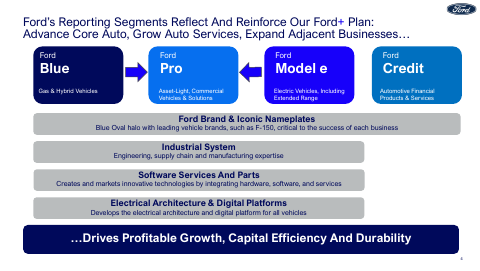
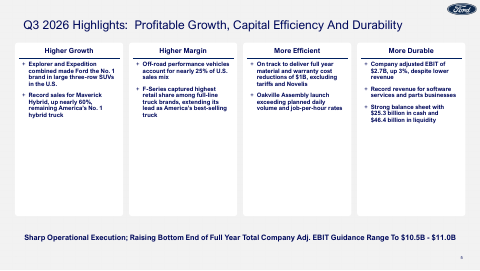
Ford took in $49.5 billion in revenue in the third quarter, 2% below a year ago, as it ended older models like Escape and Corsair. Net income was $2 billion and adjusted EBIT was $2.7 billion, up 3%. Adjusted free cash flow was $4.7 billion. Ford Blue (gas and hybrid vehicles) and Ford Pro (commercial vehicles) earned less, while Ford Credit and the Model e loss both improved. Software services and parts set revenue records.
Ford raised the low end of its 2026 adjusted EBIT guidance to $10.5 billion to $11 billion. Management expects 2027 profit to be roughly in line with 2026. Commodity, memory and logistics costs add about $2 billion of headwind, and spending on the Universal Electric Vehicle platform and Ford Energy rises. The company is aiming for an 8% adjusted EBIT margin by 2029. Management said the Model e path to breakeven will not be linear.
Open the slide deck (PDF, 34 pages) ↗
Showing the first 6 of 34 pages.
From Ford investor relations
SEC filing
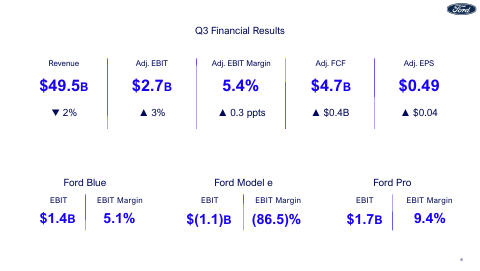
down 2% from a year ago
down $0.4 billion from a year ago
down from $0.60 a year ago
up $0.04 from a year ago
down from 1,558 a year ago
up 0.3 ppts from a year ago
down $2.0 billion from a year ago
up $0.4 billion from a year ago
| Segment or metric | Value | Change |
|---|---|---|
| Ford Blue EBIT | $1.4 billion | down 10% |
| Ford Model e EBIT loss | $1.1 billion | an improvement of 25% year over year |
| Ford Pro EBIT | $1.7 billion | down 16% |
| Ford Credit EBT | $803 million | up 27% compared to a year ago |
| Total wholesale units (000) | $1.0M | down 9% |
Copied from the press release ↗ and other documents in the SEC filing ↗. A figure is published only if its sentence is in the filing.
| From the filing | Q3 2026 | vs year ago | vs last quarter |
|---|---|---|---|
| Revenue | $49.5B | −2.0% | +2.5% |
| Operating income | $1.5B | −6.7% | +127.9% |
| Net income | $2.0B | −16.3% | — |
| Diluted EPS | $0.50 | −16.7% | — |
| Free cash flow | $3.1B | −40.5% | +60.1% |
| Operating margin | 2.9% | −0.2 pts | +1.6 pts |
Calculated by code from XBRL, not by the model.
| Metric | Period | Outlook |
|---|---|---|
| Adjusted EBIT | full-year 2026 adjusted EBIT | between $10.5 billion and $11 billion |
| Adjusted free cash flow | full-year 2026 adjusted free cash flow | $6 billion to $7 billion |
| Capital expenditures | full-year 2026 | $9.5 billion to $10.5 billion |
| Ford Blue EBIT | full-year 2026 Ford Blue EBIT | about $5.5 billion |
| Ford Pro EBIT | full-year 2026 Ford Pro EBIT | about $7 billion |
| Ford Model e loss | full-year 2026 Ford Model e loss | about $4 billion |
| Ford Credit EBT | full-year 2026 Ford Credit EBT | about $2.8 billion |
| Adjusted EBIT margin target | by 2029 | 8 % |
Revenue was $49.5 billion, down 2%, while adjusted EBIT was $2.7 billion, up 3%. Adjusted EBIT margin was 5.4%, up 0.3 ppts.
Full-year adjusted EBIT is now expected between $10.5 billion and $11 billion, from $10 billion to $11 billion. Adjusted free cash flow stays at $6 billion to $7 billion.
Ford Blue EBIT was $1.4 billion, down 10%, and Ford Pro EBIT was $1.7 billion, down 16%. Higher commodity costs hit both, and Ford Pro also absorbed Super Duty launch costs at Oakville.
Management is targeting profitability next year roughly in line with this year. It expects a year-over-year headwind of about $2 billion from commodities, memory and logistics costs, plus higher Model e expenses.
Model e lost $1.1 billion, an improvement of 25%, with breakeven still targeted by 2029. Executed contracts and late-stage negotiations account for more than 80 % of Ford Energy's 2028 capacity.
Fourth quarter worked out from the annual figure.
| Q4 2024 | $48.2B * |
| Q1 2025 | $40.7B |
| Q2 2025 | $50.2B |
| Q3 2025 | $50.5B |
| Q4 2025 | $45.9B * |
| Q1 2026 | $43.3B |
| Q2 2026 | $48.3B |
| Q3 2026 | $49.5B |
| Q1 2025 | $0.12 |
| Q2 2025 | -$0.01 |
| Q3 2025 | $0.60 |
| Q1 2026 | $0.63 |
| Q2 2026 | -$0.33 |
| Q3 2026 | $0.50 |
Fourth-quarter EPS appears once the press release is read; filings report it only for the full year.
| Q4 2024 | 2.6% |
| Q1 2025 | 0.8% |
| Q2 2025 | 1.0% |
| Q3 2025 | 3.1% |
| Q4 2025 | -25.2% |
| Q1 2026 | 5.4% |
| Q2 2026 | 1.3% |
| Q3 2026 | 2.9% |
| Q4 2024 | $530.0M |
| Q1 2025 | $1.9B |
| Q2 2025 | $4.2B |
| Q3 2025 | $5.3B |
| Q4 2025 | $1.1B |
| Q1 2026 | -$1.1B |
| Q2 2026 | $2.0B |
| Q3 2026 | $3.1B |
Operating cash flow minus capital expenditure, from cash flow statements.
Each quote matches the transcript word for word.
“We currently expect commodities, memory, and logistics costs to represent a year-over-year headwind of about $2 billion at Ford.”
It sizes the main cost pressure management says it must offset to keep 2027 profit flat.
“The progress isn't going to be linear and we're now expecting higher expenses in 2027 as the plan's coming into focus.”
It warns that Model e spending rises in 2027 before profitability improves.
“Executed contracts and late-stage negotiations together already currently account for more than 80 % of Ford Energy's 2028 capacity.”
It is the main evidence of customer demand for the new battery storage business.
“These auto-adjacent businesses were significant drivers of the quarter's strong performance, contributing approximately 10 % of the quarter's revenue at strong margins.”
It shows software services and parts are now a meaningful, higher-margin share of revenue.
“commodity headwinds approaching $2.5 billion year over year, an increase of about 500 million as we continue to see increasing pressure from input costs.”
It shows input-cost pressure grew during the year even as the profit guidance was raised.
Management pointed to revenue optimization, growing software services and parts, and structural cost savings as controllable, and said it is already planning 2027 through 2029 actions. — Sherry House, Jim Farley
Executives said 90% of validation testing is done and the main remaining risk is the supply base running at rate, while the revenue picture is strengthening. — Kumar Ghoultra, Andrew Frick, Jim Farley
The CFO said Model e expenses will be higher in 2027 and the next step change in profitability should come in the first half of 2028 as UEV and Ford Energy ramp. — Sherry House
The CEO said the low-capital partnerships will replace unprofitable EVs and committed to a profitable European business, without giving details on capacity. — Jim Farley
Executives said F-150 stock was 49 days at September and will end the year at the low end of the target range, without building much higher. — Andrew Frick, Sherry House, Jim Farley
Ford Energy's president said the company is not disclosing backlog yet, plans to start next year, and customer discussions are ahead of expectations. — Dave Carroll, Jim Farley
The CEO said Ford has held up well internationally, competition is most intense in Latin America and Southeast Asia, and the real pressure is in Europe. — Jim Farley
Executives said pricing is strong at about a percentage point this year, fleet pricing is up over 1%, and 2027 model-year fleet orders are on target. — Andrew Frick, Alicia Bowler-Davis
Ford Energy's president said the team is evaluating expansion but has nothing to announce, and the CFO said about a third of the roughly $2 billion investment is spent this year and about two-thirds next year. — Dave Carroll, Sherry House
The CEO said Geely offers lower landed costs and faster development, and Fathom cost comes from in-house electronics, large unit castings, lower labor content and efficient motors. — Jim Farley, Kumar Ghoultra
Ford reported revenue of $49.5 billion, net income of $2 billion and adjusted EBIT of $2.7 billion. Diluted EPS was $0.50 and adjusted EPS was $0.49.
Ford raised the low end of full-year adjusted EBIT guidance to $10.5 billion to $11 billion, from $10 billion to $11 billion. Adjusted free cash flow stays at $6 billion to $7 billion and capital expenditures at $9.5 billion to $10.5 billion.
Ford Blue earned $1.4 billion in EBIT, down 10%, and Ford Pro earned $1.7 billion, down 16%. Ford Model e lost $1.1 billion, an improvement of 25% year over year.
Management is targeting profitability next year roughly in line with 2026. It expects a headwind of about $2 billion from commodities, memory and logistics costs and plans to offset it with efficiency, pricing and software and parts growth.
Ford generated $5.4 billion of operating cash flow and $4.7 billion of adjusted free cash flow in the quarter. It ended with $25.3 billion in cash and $46.4 billion in liquidity, and declared a 15 cent fourth-quarter dividend.
Call recording on YouTube ↗. Official replay ↗. Timestamps jump to the moment.
Ford also publishes its official transcript (PDF) ↗.
Good day everyone. My name is Ronnie and I will be your conference operator today. At this time, I would like to welcome you to the Ford Motor Company third quarter 2026 earnings conference call. All lines have been placed on mute to prevent any background noise. After the speaker's remarks, there will be a question and answer session. If you would like to ask a question during this time, please use the raised hand function which can be found on the black bar at the bottom of your screen.
At this time, I would like to turn the call over to Maria Ricciardone, Chief Investment Relations Officer.
Thank you, Ronnie, and welcome to Ford Motor Company's third quarter 2026 earnings call. I'm Maria Ricciardone, Ford Chief Investor Relations Officer. With me today are Jim Farley, President and CEO, and Sherry House, CFO. Joining us for Q &A are Andrew Frick, President of Ford Blue and Model E, Alicia Bowler-Davis, President of Ford Pro, Kumar Ghoultra, Chief Operating Officer, Kathy O 'Callaghan, CEO of Ford Credit, and Dave Carroll, President of Ford Energy.
Jim will give a high-level overview of the business, and Sherry will provide added texture on the financials and guidance. We will be referencing non-GAAP measures today. These are reconciled to the most comparable U .S. GAAP measures in the appendix of our earnings deck. You can find the deck at shareholder .ford .com. Our discussion also includes forward-looking statements. Our actual results may differ. The most significant risk factors are included on page 20 of our deck.
Unless otherwise noted, all comparisons are year-over-year. Company EBIT, EPS, and free cash flow are on an adjusted basis. Upcoming IR engagements include Sherry House at the Barclays Global Auto and Mobility Tech Conference in New York on November 18th. Now I'll turn the call over to Jim.
Thanks, Maria. The board delivered another strong quarter thanks to our great products our services and execution i want to thank our employees and our dealers all of our suppliers for this progress and for their commitment to ford plus in the third car quarter as you know we generated 2.7 $1 billion in adjusted ebit we're raising our low end of our previous full year adjusted ebit guidance and now expect to earn
between 10.5 billion and 11 billion dollars our strategy is clear number one grow our auto business with a whole new generation of vehicles focused on north america focused on transforming our ev business and global products with much less capital number two aggressively expand our auto adjacencies software services and parts while strengthening our financing capability and third Third, diversifying with Ford Energy. The objective is a more profitable, capital efficient, and resilient Ford. One that achieves 8 % adjusted EBIT margins by 2029 and delivers sustained earnings, cash flow, and returns to our shareholders over time.
Let's start with our vehicles. In the third quarter, we continue to focus on a portfolio that leads into our strengths, trucks, vans, and utilities. Our pickup lineup gives customers an unmatched breadth of choice between vehicles, prices, trims, and powertrains. In Q3, F-Series captured the highest retail share among all full-size truck brands and is on pace for the 50th straight year as America's best-selling truck. Maverick is America's best-selling hybrid pickup. Internationally, Ranger leads in many markets including Australia and Europe.
Early demand for the Ranger Super Duty is very strong, already number one in the heavy-duty medium-sized truck market in Australia in its first year, opening a very profitable opportunity for us. Transit continues to be the best-selling van in the U .S. Ford also leads in three-row SUVs in the U .S. with the Expedition and Explorer. We're also expanding access to customers through Ford Blue Oval Advantage, our certified pre-owned program, making Ford now the number one certified pre-owned brand in the U .S.
This program builds customer loyalty and positions Ford for our affordable new vehicles that will be coming in the next couple of years to our showrooms, and it really helps our resale values. In fact, we found that these used customers are 50 % more likely than typical used car buyers to purchase a new Ford. The foundation of our sustained growth is world-class quality. Of course, topping the J .D. Powers 2026 IQS study and reduction we've seen in warranty coverages is encouraging to all of us.
Excluding Novelis and tariffs, we reduce warranty and material costs by $1.5 billion in 2025 and are on track to reduce another $1 billion this year. But we have much more to do, especially on long-term durability and the ownership experience. We are accelerating our industrial system, including very aggressive next-generation vehicle cost reduction targets. The goal is a world-class industrial system, one that makes cost competitiveness and quality repeatable. Our SuperDeed launch in Oakville, Ontario, is an important example of this discipline.
The production ramp is already exceeding planned daily volume and jobs per hour rates. We reached OK to buy last week and began shipping trucks to dealerships. and the quality we're seeing is fully competitive with our existing super duty plant which is number one in jd powers the added capacity will give us flexibility for future plant changeovers and support profitable growth in retail rental and upfitter channels we're bringing the same discipline to the next generation f-150 prototypes begin builds are beginning in first quarter 27 just a couple months away.
We have an incredible powertrain durability testing, which is now a five-fold increase to meet our bulletproof powertrain target at Ford. We're doubling endurance and strength testing and increasing full vehicle test mileage by nearly 60 % to almost 4 million miles. The F-150 will be the most extensively tested truck ever at Ford, and we will apply this exact same approach across our company. Alongside strengthening our best franchises, we're opening new paths to grow at more affordable price points.
Next year, we will be launching our affordable mid-size pickup for international markets. We expect the base material cost for this truck to be 20 % lower than today's Ranger. Just as Maverick has done in the U .S., this truck is designed to bring new customers into the Ford truck lineup internationally at a cost structure that allows us to compete in this case with the Chinese. And at Louisville, we are preparing the launch of the Fathom, our first vehicle off the UEV platform.
Rigorous testing and early supplier preparation are central to that effort. The launch remains on track for fourth quarter of next year. Yet yesterday I had the opportunity to drive our prototype. Wow. It completely blew me away. The zero to 60, huge room inside, and the hands-free ADAS experience was like something I've never experienced. Fathom is really a breakthrough product. It's highly capable, innovative, affordable. and that EV product will be available to more Americans way ahead of our competition.
This will require high-level execution by our team to deliver on time and at cost. And the MSRP under $30 ,000 and the low cost of ownership is perfect for today's market. Fathom will offer something brand new for U .S. EV customers. and advanced zonal electrical architecture for its first 48 volt low voltage system along with a sophisticated advanced driver assist capability such as hand street driving an incredible real drive performance feel and a lot of fun to drive and bi-directional charging so you can power your home with a fathom when rates are high or during an outage and there's so much more to this product that we're exciting to share with you.
Switching gears to our growing auto services business, software services, parts, and financing. Now, these auto adjacencies deepen our customers' relationship with us and create downstream value by enabling us to earn more over the life of each vehicle. Both software services and parts businesses achieved record revenue in the third quarter at highly accretive margins. An important linkage exists here between software and parts. Connected services help us anticipate maintenance over time, including a whole new software product called Prognostics at Ford, bringing customers to our remote service vans, almost 5 ,000 of them now, and our dealer network to keep their vehicles running 24-7.
We found that when a retail customer combines a software subscription with regular service. The retention of the customer, especially for parts, is about nine points higher. In parts specifically, we grew our U .S. wholesale business to third-party independent repair shops, and we've expanded a lot in Europe. A broader motorcraft catalog also allows us to serve fleet customers of competitive brands and owners of much older Ford vehicles. And Ford Credit has had a great third quarter.
Notably, together with Ford Pro, Credit launched Ford Pro leasing in the third quarter. It's a big deal for Pro. Adding commercial leasing to our fleet management, software and maintenance offerings will help us grow our Pro Digital Fleet Management portfolio, which we will expect to be over 100 ,000 units by year-end. Many of those are non-Ford vehicles. Turning to Ford Energy, the investment thesis is very clear. Ford is going to solve a meaningful customer problem, build on Ford's advantage, and offer a credible path to material earnings with attractive returns in the short term.
Our starting point is U .S. manufactured grid-scale battery storage for companies building America's new power infrastructure and data centers. These customers need a domestic partner with the manufacturing know-how and scale and staying power to support them throughout the product's life. We are progressing on two fronts, preparing our manufacturing capacity and securing customers. At our battery plant in Kentucky, we have met every single operating milestone so far. We have completed trial runs of electrode mixing, the first step in producing prismatic LFP battery cells.
Using the exact same process as our battery plant in Marshall, Michigan, we remain on track to bring 20 gigawatt hours of annual capacity online by the end of next year. Commercial progress is encouraging and demand remains very strong. Executed contracts and late-stage negotiations together already currently account for more than 80 % of Ford Energy's 2028 capacity. We are building a diverse customer base across solar, grid support, and data centers, and we expect our 2028 capacity to be fully committed by Q1 of next year.
Pricing signals remain consistent with our investment assumptions. Negotiation for 29 and 30 capacity are already advancing, with customers engaged way ahead of our initial expectations. The DC block gives us a practical starting point to build a broader capability. We expect attractive returns with short payback period, as I said. Sherry, now is going to take you through our financial performance.
Thank you, Jim, and hello, everyone. Our third quarter results reflect the deliberate actions we're taking to improve profitability and deliver consistent financial returns.
Our increasingly fit industrial system coupled with strong vehicle sales and auto adjacency performance enable adjusted EBIT growth of 3 % despite 2 % lower revenue as we sunset products like Escape and Corsair to transition the Louisville assembly plant for the all new Fathom. Sequentially, revenue at $49.5 billion and adjusted EBIT at $2.7 billion were both higher, despite being impacted by a short-term supplier disruption late in the quarter. We also generated $4.7 billion in company-adjusted free cash flow in Q3 and ended the quarter with $25.3 billion in cash and $46.4 billion in total liquidity, maintaining our commitment to a strong investment grade rating and to returning capital to shareholders.
Today, we announced a fourth quarter regular dividend of $0.15 per share. This strong performance reflects the underlying quality of the sales accomplishments Jim mentioned, as well as our progress toward a leaner, more fit industrial system. We continue to see mixed strength in trucks and three-row SUVs. Our higher margin off-road passion products accounted for about a quarter of our U .S. sales in Q3, up almost four points from a year ago. And our customers have been resilient amid higher fuel prices, interest rates, and inflation.
We also continue to deliver efficiencies across the business, including the use of AI in our business segments and throughout our operations. These actions, together with our industrial improvements, have helped us absorb the vast majority of headwinds from the Middle East conflict and rising commodity costs. It is this discipline and operational rigor that is taking root across board. In fact, it is directly benefiting our next generation product pipeline where we're making real progress in improving the cost base across our products.
In addition, the traction and warranty of material cost improvement is strong again this year. Both were lower in the quarter and year to date, keeping us firmly on plan towards reducing these costs by $1 billion this year, excluding no balance and tariffs. And we are leveraging these reductions to fund our investments in the universal EV platform and Ford Energy. On Novelis, operationally, the recovery is largely behind us. Financially, we have incurred about $1 billion in Novelis-related temporary costs year-to-date with some more to go in Q4.
And we are still tracking to a net tailwind of about $1 billion in 2026. Now let's turn to our segment results. In Ford Blue, we delivered $27.1 billion of revenue and $1.4 billion in EBIT, down 3 % and 10 % respectively. Our performance primarily reflects lower volume, driven by product discontinuations and the impact of the Middle East conflict within the region and higher commodity costs. Our underlying business continues to benefit from favorable mix. We saw significant year-to-date demand in the U .S.
for Explorer, with the higher margin Tremor and Platinum Series increasing sales by nearly 60%. F-Series performed well as we executed a disciplined, go-to-market approach that yielded the highest share of revenue and lowest incentive spend in the third quarter. Lincoln also had an impressive quarter with both Nautilus and Aviator experiencing double-digit sales growth in the U .S. Our stock bubbles are healthy. We ended the quarter slightly below our target range of 55 to 65 retail days supply, and we increased growth stocks by about 6 % versus Q2 2026.
Our F-150 inventory improved quarter over quarter to 49 retail days supply, though is still below our ideal range, which provides us with upside as we work to restock to target levels. Overall, we expect stocks to return within our targeted levels by year-end. For Model E, we improved EBIT by 25 % year over year in the quarter. We reported an EBIT loss of $1.1 billion on revenue of $1.2 billion. These results reflect our focus on capital efficiency and structural cost reductions as we realize the benefits from right-sizing our Gen 1 volumes while we continue to invest in our UEV platform and Ford Energy.
We are on track to improve Gen 1 EBIT by approximately 40 % year-over-year in 2026 as we balance production and pricing with natural demand. In fact, in Q3, Mustang Mach-E had the lowest incentive spend since 2023. Importantly, we are still targeting breakeven by 2029. mind. Ford Pro delivered another solid quarter with $17.8 billion of revenue, up 2%, despite wholesale volumes being down 4%. Pro EBIT was $1.7 billion, down 16%, primarily due to higher commodities and temporary costs associated with the Oakville launch.
Lower tariffs and favorable product mix driven by higher truck production as we recover from Novelis partially offset these headwinds. 2027 model year signals are favorable as most commercial agreements are complete with both fleet demand and pricing in line with our expectations. Ford Credit delivered a great quarter with EBT of $803 million up $172 million. These results reflect favorable performance on our derivatives, healthy financing margins, and a supportive used vehicle pricing environment. Our high quality portfolio of offerings across Ford Credit remains resilient and we maintain a consistent, disciplined approach to risk management.
Jim talked earlier about the record quarter for software services and parts. I'd like to double click on that. These auto-adjacent businesses were significant drivers of the quarter's strong performance, contributing approximately 10 % of the quarter's revenue at strong margins. The largest contributors to software services revenue growth in the quarter and year to date were Blue Cruise and connectivity and we continue to see momentum in Ford Pro Intelligence. Parts revenue growth this year has been driven by double-digit growth in our U .S.
wholesale channel and the expansion of our retail and wholesale businesses in Europe. We are also increasing dealer service retention with digital and uptime tools to drive organic parts growth. We are excited about the prospects these auto adjacencies offer for continued accretive growth. Now looking ahead to our full year 2026 outlook. We are confident in our full year trajectory in our planned investment cadence and now expect full year adjusted even between 10.5 billion to $11 billion.
Adjusted free cash flow and capital expenditures are unchanged at 6 billion to 7,000,000,009.5 billion to 10.5 billion respectively. Our guidance does not include potential impacts of a significant escalation in the Middle East or a material downturn in the U .S. economy, which if either or both occurred could have a substantial impact on industry demand. For our full year segment outlook, we expect Ford Blue EBIT of about $5.5 billion, Ford Pro EBIT of about $7 billion, Model E losses remain unchanged at about $4 billion, and Ford Credit EBT updated to about $2.8 billion.
dollars. Our guidance now assumes a U .S. SAR of 16.5 million units, commodity headwinds approaching $2.5 billion year over year, an increase of about 500 million as we continue to see increasing pressure from input costs. In addition, higher fuel prices are impacting our freight and energy costs, but notably we are not seeing it impact customer demand for trucks and fleet vehicles at this point. We now expect full-year U .S. industry pricing to be about 100 basis points higher year over year, which is a half point higher than our previous assumption.
And lastly, we continue to target $1 billion in material and warranty cost reductions, excluding Novelis and tariffs. In summary, our ability to increase profits in Q3 reflects the actions we have taken to optimize our product portfolio and create a business that is more efficient and agile in the face of increasing cost pressures, intensified global competition, in an uncertain macroeconomic environment. I'll now turn it back over to Jim to provide some commentary on 2027. Thank you Sherry.
At this point we're targeting profitability next year to be roughly in line with this year with an even stronger automotive business that enables us to invest in our future. Our outlook reflects three things investing in future growth, substantial external cost pressures, and continued operational operating improvements. Next year will be a foundational year on our journey to 8%. When we will have refreshed 70% of our global portfolio of vehicles by volume, we are allocating a majority of that investment to North America where we will be expanding our truck and utility lineup.
Additionally, Ford Pro will be expanding their global lineup for Transit and Ranger with all new price points. Additionally, we are investing in our plants for our new F-150, which will require planned production downtime next year. We expect the added super duty capacity at Oakville to largely offset the impact of that downtime. We will also continue to grow our investments in the universal electric vehicle platform ahead of Fathom's launch and bring Ford Energy's 20 gigawatt hours of capacity online, both of which are key to the Model E turnaround by 2029.
In auto adjacencies, we expect continued growth in software services and parts to increase the contribution from reoccurring and counter-cyclical revenues. This accretive growth should help offset certain macro headwinds we expect at Ford Credit. We currently expect commodities, memory, and logistics costs to represent a year-over-year headwind of about $2 billion at Ford. Our current plan is that the improved reliability and capability of our industrial system, together with revenue optimization and a company-wide efficiency on cost will allow us to offset the expected headwinds that i just walked through we intend to finish this year strong executed 27 with great profitability investments and with discipline to build towards that target of 8% adjust to ebit by 29.
we'd like to take your questions now If you would like to ask a question, please use the raise hand function, which can be found on the black bar at the bottom of your screen. Leave time for as many questions as possible. Please limit to one question. Your first question comes from the line of Rajya Gupta with JP Morgan. Please unmute and ask your question.
Great. Thanks for taking the questions and appreciate all the color on 2027.
I mean, assuming, you know, the commodities, logistics, you know, the memory headwinds, you know, stay where they are right now, you know, at the 2 billion guide. Just curious, you know, how much of the 2027 offset stack, you know, that you have pointed to is within your control today? How much of that you still need to work on just because a lot of the inflation has happened in the last three, four months? I'm just curious to get your thoughts on that and like how comfortable you are with that 27 guide and what more needs to be done to get there and have a quick follow up.
Thanks.
Yeah, sure. Thank you so much for your question. I would say that, you know, the areas that we see more in our control would be the areas of revenue optimization, continued software in parts growth, and also continued savings as well. and I can give you a little bit more color on that too if that would be helpful. I mean on the market equation side as you know mix optimization is something where we have made huge progress this year and we expect that progress to continue into next year.
We have transformed our sales and operating plan and are now leveraging AI tools that are enabling us to match demand sensing to capacity planning and that's leading to more production stability which leads to real savings. We also have better inventory and pricing models for both vehicles and parts, and that's leading to faster turn rates and leaner stocks in just an overall disciplined approach and management of our market equation. So that is going to be an area that's in our control.
We're continuing to get better through tech modernization. On the structural cost side, we're already working plans. We've been at this for six months already going into 2027. And in fact, we're already looking ahead in populating profit improvement actions for both 28 and 29 as well. And then, as I said, we're going to continue to see, we believe, increased revenues in both the software and the parts growth area. And as I just mentioned in my comments here a moment ago, we've now seen those combined, you know, representing 10 % of our revenues at accretive growth margins.
So this is an area that is in our control areas that we're focused on, and we're seeing the benefits of that to stabilize our returns in the face of things like commodities in an uncertain macro environment.
I would only add that our day supply on F-150 and Super Duty is a major accomplishment compared to our competitors. It's real, we're going into 27, as Sherry said in her speech, in a really good situation in our truck business.
Understood. That's very helpful, caller. And then just on UEV, with the deliveries expected next year, I'm just curious what remains to be de-risked between now and launch when it comes to supplier readiness, software validation, you know, just battery costs. How much of the path to the modeling break even depends on UEV hitting its volume and cost targets on schedule? Thanks.
Hi, this is Kumar. Let me give you some color on the status of the launch.
It's progressing very well. 90 % of the validation testing has been completed. We've built our first production line vehicles at the Louisville assembly plant. So we're starting to prove out our production processes. One of the key new technologies for Fathom is unicastings. We've already produced 5 ,000 of them. So we're proving out our capability to run at rate, and that's gone really well. And to be specific about your question on what risk remains to be mitigated, It's primarily in the supply base.
We need to make sure that the supply base can run at rate with high quality parts. And that's very normal at this stage of the launch. And that's what we're going to be working on for the next few months. The other element of the Fathom launch is critical, is the revenue picture, which actually seems to be strengthening. Andrew, do you want to highlight the change in the U .S. EV market and how that relates to the profitability modeling?
Yeah, I mean, the market, as we've learned over the last couple of years, is definitely in the U .S. specifically is not acting as a monolith, especially when it comes to the affordable EVs. We've actually seen EV prices go up about 10%, which has priced a lot of new vehicles out of the affordable market. So the customer is very limited with their new vehicle options. In fact, a lot of them are looking to the used market.
So we're now looking at the EV market as new and used. We're about over half now of the vehicles sold under 40 ,000 are used vehicles. That's really important because, as you said, Jim, the Fathom starting MSRP is at 28 ,350. That's going to be right in the heart of the market. And it's not just the EV market. It's actually opening us up to a massive total addressable market. if you know that nearly 50 % of the U .S.
new vehicle industry transacts under $40 ,000. So not only do we expect Fathom for the reasons you mentioned earlier to attract new and used EV buyers, but also ICE hybrid customers, especially because we're going to have much lower operating costs than even a mainstream hybrid vehicle. So the customer response on what we've shared so far has been really strong. we're preparing for the launch and we'll be launching our pre-order program in the first quarter and we'll have more to share with everyone at that time as we get close feeling pretty good about the industrial preparation and the revenue picture
it's impressive to me to see that the used the EV market is above 8 % of US industry now
and that's that's including all the issues that Andrew just highlighted in the lack of affordability options so um i think we're you know it's a lot of work to be still be done we have a year to go but i think we're positioned really well which will be one of the two big drivers turning around model e the vehicle side of model
thank you as a reminder we ask that you limit yourself to one question Your next question will come from Emmanuel Rosner with Wolf Research.
Please unmute and ask your question.
Great, thank you so much. Maybe just following up here on Model E. So I know for 2027 overall for the company's stable results versus 2026, are you still looking to improve Model E within that EBIT? And maybe what are the moving pieces within that? Are you planning similar or higher investments into this uev and bss and then you know what um what are the drivers of uh improvement on the uh on the car side of the business
great manuel thank you so much for your questions so you just heard about the model e operational steps that we're taking in the milestones there from a financial perspective as i said in my comments we're working
towards our target for model e to reach break even by 2029 The progress isn't going to be linear and we're now expecting higher expenses in 2027 as the plan's coming into focus. So let me give you a little bit of what we're seeing. We think that the next step function change in profitability is going to happen in the first half of 2028 as UEV and Ford Energy both ramp with revenue on both. So if you break that down a bit, you're going to see Fathom launching towards the end of the year with the first derivative off the platform.
Then you're going to have that full year of production in 2028. Then we're going to be escalating the Ford Energy business with investment, full year of production also by 2028. And then new is the launch of the European Partnership products by 2028. So there will be investment in that in 2027. And the full year of production on those will be by 2029. So you're going to have those investments that are happening through 27 with the unlock really starting to unleash as you get into 2028 and nine.
Your next question comes from Tom Narion with RBC. Please unmute and ask your question.
Hi, yeah, thanks for taking the question. My question has to do with Ford Blue in Europe. You know, China has about 60 million vehicles of auto production capacity. It's consuming about 20 million a year and exporting 10 million, a decent portion going to Europe. And then this has been worsened by weakening domestic sales in China. And you have a JV with Gigli in Valencia, the partnerships with Renault and BW.
Are these enough to right-size your capacity in Europe, or do you need further actions from the EU to halt Chinese exports?
Thanks for your question. Europe is quite different than what's happening in Southeast Asia and Latam for the China competition. So I appreciate your question specific to Europe. you know in the the situation europe is very different because the eu has such a strong ev mandate and as you said there's a lot of open capacity in europe not just to export it from china we do feel like we we know we have the right plan to right the ship in terms of our passenger car profitability with renault and julie as you mentioned those are very low capital investments
with really great cost levels, especially for the EV portion of our lineup that will allow us to replace unprofitable EVs with much better profit outlooks on EV. The commercial side is also under pressure in Europe. And we have a pretty exciting lineup, especially around the EV requirements for the commercial business, the pro business. there's a lot of negative profit pressure but we have a really good solution coming next year that we're really excited about i think the combination of both will make sense as far as the capacity utilization that you mentioned your specific question at this point i don't want to get into the details other than working through you know the opportunity Valencia and Romania and Turkey.
So thank you. You know, we are completely committed to building a profitable European business with these actions. We've been on it for several years and we have a really aggressive plan.
Your next question comes from the line of Joseph Spock with UBS. Please unmute your audio and ask your question.
Thanks, good afternoon everyone. I guess I just want to start with some of your comments around the F-150 and not to sort of get, you know, just sort of really buckle down on this.
You mentioned that F-150 stock, you expect to recover to target levels by the end of the year. And I want to be clear on this because you've talked about stock in terms of days historically, and I think even in your prepared remarks, but, you know, seasonally, we always see end of year December is much lower than September. So when you say recover to correct levels, are you talking back to that days level? Because that would mean a pretty significant increase in absolute inventory.
Thanks, Joe. It's Andrew. No, I think when we talk specifically to our F-150 stock, we're running at 49 days coming out of September. That is below our range. As we look at towards the year end, we will be running probably on the low end of that. But we'll continue to run on the low end of that. And as Jim mentioned, below our competitive set, we've seen really high days to turn on our units that we have in stock.
In fact, we just came out of the third quarter where we had the fastest turn rates of the year and they were faster than any of our competitors in the segment. And that's really helping us manage our overall market equation, as we mentioned. But we do not expect to see our stocks building to a much higher level at the end of this year.
I just want to reinforce and be specific to your question. You said dig in.
I think that's great. You know, for me, over the last many years, you know, a normal stocking level for F-150 could have been 80 to 100-day supply in the past. I just want to reinforce what Sherry said. Our target is that 50, low 60-day supply. And I think by the end of this year, we're going to be in that range. that is substantially lower than Ford's operated and it's really allowed us to build that disciplined full-size truck business while we watch our competitors play a very different game and our in our dealers are very anxious for more stock our mix is good and our turn rates is really what we're focused on now as Andrew said
so I would say to answer your question simply that 55 to 60 day range that um that sherry talked about is historically much lower than we normally run our truck business
your next question comes from the line of james piccariello with bnp part of us please unmute your audio and ask your question
hi everybody um yeah just follow on joe's question uh on the on the f series recovery and inventory Tori, is the 150 ,000 units recovery target still cleanly intact, or is that number lower and there's something else to favorably offset and keep that net $1 billion in the guide intact?
Is it better price mix, or is that volume target still the guide?
So here's how I answer that. on the Novelis recovery it has been going as planned operationally and we're now running at rate and most um the vast majority of the materials have been validated and we're going to continue to run at rate in q4 is our plan when you get to the financial side of it um we have seen costs coming in a little bit lower and the volumes have been proportionally a little bit lower too and so that's going to enable us to continue to keep with the guide that we said at the outset of the year which is $1 billion of a net tailwind by
the end of 2026 as it relates to this set of products.
Your next question comes from Andrew Prococo with Morgan Stanley. Please unmute your audio and ask your question.
Great. Thanks for taking the questions. So I guess to start out a two part question here. First, I want to ask a follow up on on energy storage. You know, I think you guys provided a great update in your prepared remarks. It sounds like you're 80 % contracted for 2028.
So I guess that would imply about 16 gigawatt hours kind of in the backlog. But I think you also said that that included contracted backlog as well as late stage negotiations. So I guess, did I get that right? And is there any other information or color you can kind of provide in terms of what needs to happen to maybe get that full 16 gigawatt hours, you know, fully contracted versus late stage? Just kind of curious what the final steps are there.
And then my second question, you know, coming back to what Tom asked about in terms of China, you know, obviously exports are continuing to increase pretty substantially. out of the region, the domestic market feels fairly saturated. Can you just talk to how you expect that to impact your business at a higher level, not just in Europe, but just globally, and what you think needs to be done to make sure that that's not going to create a bigger disruption for you guys going forward?
Thank you.
Dave, I want you to handle Ford Energy.
Yeah. So Andrew, this is Dave Carroll. First, just to cover your first question, we're actually not talking about backlog today. We were going to start disclosing that next year. And what Jim had indicated in his remarks is that we're actually ahead of expectations where we are with our customers. And we see that primarily Ford Energy is very excited about the quality of the product that we have on the market.
We believe it's one of the highest quality products out there on the market that you can buy. And we're seeing that from our customers. And we believe that's what's bringing the customers to us as we're moving forward. In fact, last week, we had one of our customers out at our Marshall manufacturing facility where they toured where we're producing LFP prismatic cells right now and they toured that factory and came came out saying it's top tier of all the factories they've seen globally so we're very excited that we have the highest quality product in the market and we believe that's what's driving the customers to us
yeah and I think for backlog that would be something we'll probably give more transparency
see on next next year right yes that's correct okay um so thanks for your question and uh we have a lot to do with ford energy but really promising start and we're going to open the aperture for all the investors uh more and more as time goes on as far as the china's concerned thank you for your question you know frankly we've held up really well internationally as the chinese who gain more and more share in open and closed markets where we see the competition the most intense is latam in southeast asia where we have a large ranger business and in both cases ranger is still doing very well because it competes at a much higher price point and as
i said we're going to be going into their price point uh next year with this new affordable truck so we'll see how that plays out but we're confident in addition i think ford is the number one traditional oem exporting from china it's been our strategy for several years now uh the territory is our second most profitable vehicle globally and um it is really uh successful for us and i think the exports are up i don't like 60 it's it's a really big improvement um and we expect to continue to take advantage of that for the open markets especially.
I kind of try to give a view on Europe so I won't be repetitive, but that's where we, for Ford, that's where we see the real pressure on our business with the Chinese. It's really in Europe. It's not just the Chinese. It's the EV mandates by the EU, which we expect them to address over time, as well as the UK, and all the overcapacity in Europe. It's been there for many, many years. As far as the rest of the world.
I think we're well positioned not only now, but with our new lineup and our global partnerships will give us a lot of opportunity. We have learned so much exporting from China. It's been really a very successful exercise for Ford with very low capital. And we've learned a lot about China cost as well as China cost in places where it needs to be localized like Thailand in Europe over time. So I think we're well positioned. The issue for us in the short term is really Europe.
Your next question will come from Jairam Nathan with Daiwa. Please unmute your audio and ask your question.
Yeah, hi. Thanks for taking my question here. So I just wanted to understand the ability to upsell on the Fathom. and the starting point of below 30 ,000 is pretty good, but I just wanted to understand how would you, what ways you can upsell that?
Do you mean, just so we understand the question, you mean, how do we get to a point where it's profitable at that price point?
Is that what you mean by the offset?
No, no, no, not offset, upsell the vehicle, kind of by offering like getting a bit of mix on the vehicle beyond that 30 ,000.
I see. I see. Okay, thank you. Yeah. Yeah. Great question. I think we're already pretty deep in a lot of intelligence. A lot of customers have shown interest in the vehicle, so we're learning a lot. There's a lot to that strategy at Ford to offer customers a lot of options beyond the $28 ,000.
Andrew, I'll let you highlight the three or four key points.
Yeah, I think what one, and we'll get more into this when we do a full reveal of the product, you'll learn a lot more about our positioning strategy. But the starting price of the $28 ,350 is just that. We'll have a range that goes to the high $30 ,000 range. And we'll have a couple different offerings within that. So I would say we will give you a lot more detail around this, the offerings themselves as we get closer.
It's probably too soon to share more at this point.
The big breakthrough conceptually for us about customers buying nicer Fathoms are really on the digital side. We put in an advanced electrical architecture in a 48-volt system so we can offer at an incredibly low cost, very advanced ADAS, as well as digital camera dashboard. I won't go into all the details Andrew said, but the digital suite, including the embedded Apple Maps, is really a game changer for any EV, let alone at this price.
I think for me personally, that is going to be the most exciting upsell opportunity. It's really the long-term subscription and digital experience for the customer.
Our next question will come from Mark Delaney with Goldman Sachs. Please unmute your audio and ask your question.
Yes, good afternoon. Thank you very much for taking my question. I was hoping you could give a bit more color on what Ford is seeing for pricing. The company took up its view of U .S.
industry pricing by a little bit for 2026. Maybe you can share a bit more on what's driving that. And then also on this topic more broadly, any early views on pricing for 2027, including what you're seeing in pro with the annual negotiations, which I think are now well underway?
That's a big question. Thank you for asking. So, Andrew and Alicia, I think you should bring up the question.
Yeah, maybe I'll start with the retail side. Thanks, Mark.
Yeah, we're seeing a very strong pricing environment right now. We expect pricing to be up about a percentage point this year. And, you know, as we looked into next year, we think there's a lot of different levers that we'll be able to work with with our product mix and net pricing, both the top line, but also our variable marketing as well. Just very similar to how we approach this year. The industry remains really strong. We're seeing the segmentation remain strong.
Very, really big resilience. with customer base, especially in trucks and utilities, which is really playing to our advantage. And we expect that to continue into next year. And Alicia, do you want to comment on what you're seeing in the early part of the commercial side?
Yeah, I can just also on pricing for fleet. We're also seeing strong pricing year over year over 1%. But as Sherry mentioned, our fleet demand orders for 27 model year are one target.
We're excited about Oakville and that capacity because that's going to allow us to really grow our truck rental sales. We can return to our pre-pandemic levels where the economics are really favorable for us. We are also able to take a larger share of wallet for our large commercial customers. And then we were able to supply more chassis cab units to the body modifiers. And we are very competitive in that space and we had been constrained.
And so we're excited about the ability to really meet this unmet demand and the strong order take that we're seeing so far gives us confidence that we'll continue to grow there
the upside for next year for pro is pretty meaningful between old phil and getting past Novelis yes it's really a great opportunity for us at ford
your next question comes from the line of john seger with evercore isi please unmute your audio and ask your question Dawn, your line is open.
Please unmute and ask your question.
Hey, thanks. Sorry about that. Yeah, I just wanted to take one more shot at BESS. You had mentioned the discussions for 29 and 30 advancing kind of ahead of your prior expectations. What do you need to see in terms of commitment capacity to start to think about expanding beyond that first 20 gigawatt hours? And then what does incremental CapEx look like for that? And then maybe if I could ask a follow up on just the impact to earnings as we go through the course of the year, as you go through the ramp to get towards the fourth quarter of 20 gigawatt hours of capacity.
Could you just maybe give us some puts and takes there?
Yes, so John, so obviously the team is really, this is Dave, the team is really focused on launching the initial 20 gigawatt hours that we have to bring online and ramp up in 2028. That being said, we are already evaluating scenarios, how we could best expand capacity, expand our offerings to our customers because we do see the real demand out there. But when we're doing so, we do consider the returns on our investment, we consider the customer demand, the tax treatment, and other strategic uses of capital.
So we do see upside at our Kentucky One facility. We're excited for the potential growth, but we don't have anything to announce today in that regards. Sherry, any text you want to give on the spending for an energy next year?
The only thing I would give is that we had talked about around $2 billion of investment, and we're going to spend about a third of that this year and about two-thirds next year. So that gives you a little bit more understanding.
Your next question comes from the line of Dan Levy with Barclays. Please unmute your audio and ask your question.
Hi, good evening. Thank you for taking the questions. Wanted to ask about the partnership with GLE. I believe part of the partnership is to establish learnings from them. Maybe you could just be a bit more concrete, what you hope to learn within supply base and designing the vehicle. I'll just extend that question to how you plan to achieve profitability on Fathom, which I think you've talked about indexing or benchmarking against the Chinese, some of the supply chain opportunities there.
So maybe you can talk about what you're doing with Chili and maybe how some of that potentially extends to how you're going to achieve the right cost that you need.
So let me break it down into two pieces. It's cost and it's quality. We are already learning that they can offer a certain percentage lower cost landed in Europe for us. So we're going through part by part understanding each system. On speed, we're learning there are a few months faster than this.
And we're going through each part of the product development system to understand how they are faster than us and a combination of both of those items is being institutionalized into our own global product development system on the uev you know we we always set our target even four years ago with imagining what a byd could do in mexico not because we knew not because we counted on that happened but because we knew that ultimately that platform is going to be competitive we had to make sure even in the u .s would be fully competitive so that's why we took such a big swing at the innovation because we had to uh the big breakthroughs you know in general on the
cost for for that product is is really a couple of things in general. The first is the e-box and the whole electronics and electrical architecture and ADAS is much, much lower cost than supply chain. We did that all in-house, and the big benefit would be the cost and the design cost of that. Number two is we radically resimplified the parts. So the two large unit castings that Kumar talked about, de-risking, the 5 ,000 we've already built, that is a radical enabler for much lower part count in the vehicle.
And then obviously the labor content is much lower in the vehicle by intention. But there's another area that we really found to be quite advantage relative to, you know, a BYD. And that is the efficiency of our motors gearbox and inverters which are about 30% more efficient than theirs and allows us to design a battery that's much less um and so that i think that's really critical um the lfp cell and marshall is another big enabler and i think you get the point which is like every part of this project had to be world-class chinese cost efficiency in order to convince ourselves we would be fully competitive but it also introduced a lot of new technology and frankly
a lot of new suppliers um and so what we learned from UEV and what we're learning from gili and what we want to keep strategically in the company are all getting captured at the same moment for kumar and his team is now curating how that all is going to work along with our ai tools that Sherry mentioned. And that's why we mentioned the heart and soul of our company is going to be this new industrial system enabled by all that benchmarking, including suppliers, manufacturing efficiency, all the way to how fast we create the vehicle.
That's exciting for us because it's quite a big change for Ford.
Yeah, a real concrete example is the the mortars and the patient system that you mentioned, Jim, are being now being transported into our hybrid systems for the rest of our portfolio. And we're putting a lot of pressure in ourselves to make sure that whether it's UEV or GLE or JMC, we, or AI tools, we are going to move that into the core part of the company as fast as we can.
This concludes the Ford Motor Company third quarter 2026 earnings conference call. Thank you for your participation. You may now disconnect.