Summaries and transcripts are machine-generated and can contain errors.
In brief
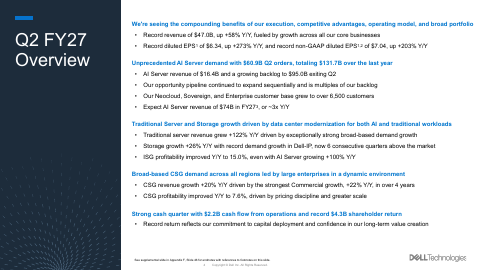
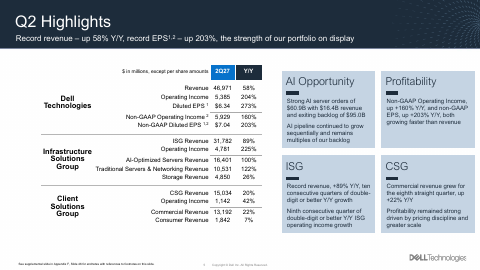
Dell Technologies delivered record revenue of $47.0 billion, up 58% year over year, and record diluted earnings per share (EPS) of $6.34, up 273% year over year, and record non-GAAP diluted EPS of $7.04, up 203%.
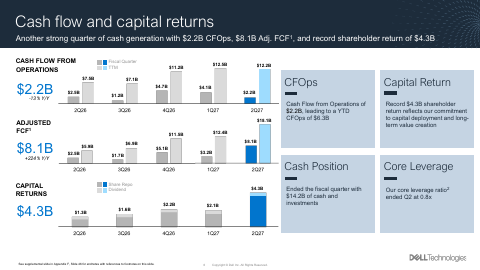
Dell had a record second quarter. Revenue rose 58% to $47.0 billion and non-GAAP diluted EPS rose 203% to $7.04. AI servers drove much of it: $60.9 billion in orders, $16.4 billion in revenue and a $95 billion backlog. Traditional servers and networking grew 122%, storage 26% and PCs 20%. Cash flow from operations was $2.2 billion, and Dell returned a record $4.3 billion to shareholders.
Management raised full-year FY27 revenue guidance by $25 billion to $192.0 billion and non-GAAP EPS to $25.50. It guided third-quarter revenue to $49.0 billion and non-GAAP EPS to $6.50. The tension is margin: the CFO said not every benefit this quarter will continue at this level, CSG operating margin is expected to moderate to roughly 6%, and management said demand is outpacing supply.
Traditional Servers and Networking revenue: “Record Traditional Servers and Networking revenue: $10.5 billion, up 122% year over year”
Storage revenue: “Record second-quarter Storage revenue: $4.9 billion, up 26% year over year”
ISG revenue: “Record revenue: $31.8 billion, up 89% year over year •Record AI-Optimized Servers revenue”
ISG operating income: “Record operating income: $4.8 billion, up 225% year over year Client Solutions Group (CSG)”
CSG revenue: “Client Solutions Group (CSG) •Revenue: $15.0 billion, up 20% year over year •Record Commercial Client revenue”
Commercial Client revenue: “Record Commercial Client revenue: $13.2 billion, up 22% year over year •Consumer revenue: $1.8 billion”
AI backlog: “we booked a record $60.9 billion in orders, recognized a record $16.4 billion in revenue and exited the quarter with a record $95 billion backlog”
Compared with the company's own guidance, not analyst estimates, and only where the outlook and the reported figure are the same measure on the same basis. Ranges are worked out by code from the company's wording. How this works.
Outlook
Metric
Period
Outlook
Q3 revenue
third quarter of fiscal 2027
$49 billion
Q3 non-GAAP diluted EPS
third quarter of fiscal 2027
$6.50
Q3 GAAP diluted EPS
third quarter of fiscal 2027
$6.10
Q3 AI server revenue
third quarter of fiscal 2027
$19 billion
FY27 revenue
fiscal 2027
$192 billion
FY27 non-GAAP diluted EPS
fiscal 2027
$25.50
FY27 GAAP diluted EPS
fiscal 2027
$24.37
FY27 AI server revenue
fiscal 2027
$74 billion
FY27 non-GAAP operating expenses as share of revenue
fiscal 2027
approximately 8 % of revenue
FY27 interest and other expense
fiscal 2027
between $1.4 and $1.5 billion
Key takeaways
AI servers drive record orders and backlog
Dell booked $60.9 billion of AI orders, recognized $16.4 billion of AI server revenue and exited with a $95 billion backlog. Over the past 12 months it converted $131.7 billion into orders.
Traditional servers grew faster than AI servers
Traditional Servers and Networking revenue rose 122% to $10.5 billion, versus 100% for AI-Optimized Servers. Management cited data center modernization and said demand outpaces supply.
Profit grew much faster than revenue
Non-GAAP operating income rose 160% on 58% revenue growth, and non-GAAP operating margin reached 12.6%. ISG operating margin was 15.0%, up from 8.8% a year ago.
Full-year revenue guidance raised by $25 billion
FY27 revenue guidance rose to $192.0 billion from $167.0 billion, and non-GAAP EPS guidance rose to $25.50 from $17.90. AI server revenue guidance rose to $74.0 billion from $60.0 billion.
Cash conversion was weak despite record returns
Cash flow from operations was $2.2 billion, down 13%, and free cash flow was $986 million, down 47%. Inventories rose to $21,290 million, while Dell returned a record $4.3 billion to shareholders.
Charts
Revenue$47.0B+57.7% y/yQ2 FY27
Fourth quarter worked out from the annual figure.
Data
Q3 FY25
$24.4B
Q4 FY25
$23.9B
Q1 FY26
$23.4B
Q2 FY26
$29.8B
Q3 FY26
$27.0B
Q4 FY26
$33.4B *
Q1 FY27
$43.8B
Q2 FY27
$47.0B
Diluted EPS (GAAP)$6.34+272.9% y/yQ2 FY27Data
Q3 FY25
$1.64
Q4 FY25
$2.15
Q1 FY26
$1.37
Q2 FY26
$1.70
Q3 FY26
$2.28
Q1 FY27
$5.24
Q2 FY27
$6.34
Fourth-quarter EPS appears once the press release is read; filings report it only for the full year.
Operating margin11.5%+5.5 pts y/yQ2 FY27Data
Q3 FY25
7.1%
Q4 FY25
9.0%
Q1 FY26
5.0%
Q2 FY26
6.0%
Q3 FY26
7.8%
Q4 FY26
9.3%
Q1 FY27
8.3%
Q2 FY27
11.5%
Free cash flow$986.0M−47.2% y/yQ2 FY27Data
Q3 FY25
$914.0M
Q4 FY25
-$150.0M
Q1 FY26
$2.2B
Q2 FY26
$1.9B
Q3 FY26
$503.0M
Q4 FY26
$4.0B
Q1 FY27
$3.1B
Q2 FY27
$986.0M
Operating cash flow minus capital expenditure, from cash flow statements.
What management said
Each quote matches the transcript word for word.
“We exited the quarter with a record $95 billion of AI backlog, and our pipeline continued to grow sequentially and remains multiples of our backlog, even after converting $131.7 billion into orders over the past 12 months.”
It shows the scale of contracted AI demand behind the raised full-year outlook.
“While we would not expect every benefit to continue at this level, the quarter also reflects meaningful structural improvements in the business, which is reflected in our second half guidance.”
The CFO signals that some of the quarter's margin strength may not repeat.
“Our full-year operating expense rate guidance of approximately 8 % of revenue is the lowest in our company's 42-year history, demonstrates the operating leverage this model can deliver.”
It explains how earnings are growing faster than revenue.
0:23:42 · Amit Dhariani, Evercore · Traditional demand
Is the 122% traditional server growth and 26% storage growth real demand or just pricing and pre-buys, and how durable is it?
Jeff Clarke attributed it to data center modernization, security-driven refresh of 1.2 million 14G-or-older assets, and AI workloads, while David Kennedy said the second-half guide maintains first-half growth rates. — Jeff Clarke, David Kennedy
Is traditional server demand still mostly enterprise, and how is the AI server customer mix shifting between enterprise and larger customers?
Jeff Clarke said traditional growth is primarily historical enterprise customers and the AI mix is little changed across neoclouds and sovereigns, while enterprise AI customers, now part of 6,500 total, are growing. — Jeff Clarke
Questions
What were Dell's headline results for the second quarter of fiscal 2027?
Revenue was a record $47.0 billion, up 58% year over year. Diluted EPS was $6.34, up 273%, and non-GAAP diluted EPS was $7.04, up 203%.
How big is Dell's AI server business now?
AI-Optimized Servers revenue was $16.4 billion, up 100%. Orders were a record $60.9 billion, and the backlog was $95 billion at quarter end.
What is Dell guiding to for the third quarter and full year?
Q3 revenue guidance is $49.0 billion with non-GAAP EPS of $6.50. Full-year FY27 guidance is revenue of $192.0 billion, up from $167.0 billion previously, and non-GAAP EPS of $25.50, up from $17.90.
How did the PC and storage businesses do?
Client Solutions Group revenue rose 20% to $15.0 billion, with Commercial up 22% and Consumer up 7%. Storage revenue rose 26% to $4.9 billion.
What are the main risks or cautions in the quarter?
Cash flow from operations fell 13% to $2.2 billion and free cash flow fell 47% to $986 million. The CFO said not every margin benefit would continue at this level, and CSG operating margin is expected to moderate to roughly 6%.
Please stand by. Good afternoon, and welcome to the Fiscal Year 2027 Second Quarter Financial Results Conference Call for Dell Technologies, Inc. I'd like to inform all participants this call is being recorded at the request of Dell Technologies. This broadcast is the copyrighted property of Dell Technologies, Inc. Any rebroadcast of this information in whole or part without the prior written permission of Dell Technologies is prohibited. Following prepared remarks, we will conduct a question and answer session. If you have a question, simply press star, then one, on your telephone keypad at any time during the presentation.
Thanks, everyone, for joining us. With me today are Jeff Clarke, David Kennedy, and Tyler Johnson. Our earnings materials are available on our IR website, and I encourage you to review these materials. Also, please take some time to review the presentation, which includes additional content, to complement our discussion this afternoon. During this call, unless otherwise indicated, all references to financial measures refer to non-GAAP financial measures, including non-GAAP gross margin, operating expenses, operating income, net income, diluted earnings per share, free cash flow, and adjusted free cash flow.
A reconciliation of these measures to their most directly comparable GAAP measures can be found in our web deck and our press release. Growth percentages refer to year-over-year change unless otherwise specified. Statements made during this call that relate to future results and events are forward-looking statements based on current expectations. Actual results and events could differ materially from those projected due to a number of risks and uncertainties which are discussed in our WebDeck and our SEC filings.
Thanks, Paul, and thanks, everyone, for joining us. Another outstanding quarter. I am proud of how our team executed across the business, delivering record revenue and record earnings per share. Revenue was $47 billion, up 58%, and earnings per share was $7.04, up 203%. These results reflect the compounding benefits of our competitive advantages, the breadth of our portfolio, and the strength of our operating model.
Our modernization efforts are driving greater efficiency and significant operating leverage, enabling us to grow earnings faster than revenue. Customers no longer see IT environments simply as cost centers, but as value drivers that enable growth, productivity, and competitive advantage. As a result, they are expanding and reallocating budgets to support continued investment. This is creating opportunities across our portfolio from infrastructure to client devices. Our world-class supply chain and ability to serve customers across their IT environments are helping us meet more of their needs and gain share.
Our deployment and service capabilities are helping customers integrate solutions across their IT environments and capture more value quickly. The proof is in our results. Over the past 12 months, we have booked more than $130 billion in AI server orders. In just the past two quarters, we have generated almost as much revenue from traditional servers and networking as we have in any prior full year in company history. Storage returned to growth and share gain with strong demand for Dell IP storage products, and CSG revenue is growing at the fastest rate in five years.
It is clear why demand for our solutions is exceeding available supply. Our results and guidance demonstrate the strength of our position as customers enter a new era of infrastructure modernization. Customers are modernizing their data centers for both AI and non-AI workloads, and the benefits are meaningful. AI is an important catalyst, but the opportunity extends well beyond AI-optimized infrastructure. AI requires modern, disaggregated architectures that keep data accessible and in motion across compute, storage, and networking.
It is also accelerating investment across traditional IT environments as customers seek greater performance, efficiency, and resiliency. Our AI server momentum continues to accelerate. We booked $60.9 billion of AI orders in this quarter, the most in our history. We are also seeing AI-related tailwinds in traditional servers and networking, along with early signs of increased storage demand as customers prepare, manage, and protect growing volumes of data. Deployment methods are evolving as well. On-prem and edge infrastructure offers attractive token economics for the right workloads while giving customers greater control over their data and intellectual property.
Our portfolio, global reach, and deep customer relationships position us to help customers design, deploy the right solutions for their performance, cost, and security requirements. Together, these trends are expanding our addressable market and driving demand across compute, networking, storage, and PCs. This represents a significant long-term opportunity for us. It plays directly to our strengths and expands the value we can deliver across the entire IT environment. Now on to the results. Starting with ISG, revenue increased 89 % to a record $31.8 billion with operating income of $4.8 billion and an operating income rate of 15%.
In AI, demand continues to accelerate. In Q2, we booked a record $60.9 billion in AI orders and recognized $16.4 billion in AI server revenue. We exited the quarter with a record $95 billion of AI backlog, and our pipeline continued to grow sequentially and remains multiples of our backlog, even after converting $131.7 billion into orders over the past 12 months. Demand is broadening across neoclouds, sovereigns, and enterprise customers, and our customer count has surpassed 6 ,500.
The scale and complexity of these deployments reinforce why customers choose us. AI infrastructure requires much more than assembling and delivering components. These opportunities demand significant engineering, design, and deployment expertise, with some engagements requiring upwards of 50 unique designs as customers optimize for workload performance, power, cooling, and the data center environment. This complexity plays to our strength. Our engineering capabilities, broad portfolio, global supply chain, and ability to deploy and support infrastructure at scale globally differentiate us, enable customers to move from design to production more quickly.
We demonstrated those capabilities again by becoming the first to ship RAC systems engineered on the NVIDIA Verirubin platform. The AI market is evolving rapidly, and we are focused on expanding our platforms and capabilities, solving increasingly complex customer challenges, and innovating across the infrastructure stack. With accelerating demand and a growing pipeline and differentiated capabilities, we are well positioned to capture the opportunity ahead. Moving to traditional servers, revenue was up 122 % as demand remains exceptionally strong, supported by multiple vectors of growth.
First, a majority of our growth is coming from existing customers as they continue to refresh and modernize their data centers to support traditional workloads. Heightened security and resiliency requirements are also creating incremental demand as customers modernize their infrastructure. Second, we are seeing a growing trend of customers that require meaningful CPU compute capacity to support AI and agentic workflows. These workloads are creating incremental demand for traditional servers. We are executing very well against both opportunities in gaining share.
Over the past two quarters, we have gained more than 10 points of traditional server share, and we expect to gain share again this quarter. With the majority of the install base still on 14th generation or older servers, we see a significant and durable refresh opportunity ahead. The strength and breadth of demand, combined with our continued share gains, demonstrate the competitiveness of our portfolio and the consistency of our execution. Turning to storage, revenue is up 26 % as strong demand for our Dell IP portfolio translated into revenue growth and improved storage profitability.
Dell IP delivered another record demand growth quarter, making this our sixth consecutive quarter of demand growth above market. Demand remains broad-based. Enterprises continue to modernize their storage environments as data growth increases the importance of keeping data available and secure. At the same time, we are beginning to see incremental demand from AI workloads, which require customers to prepare, manage, and move increasingly large volumes of data. We saw strong growth across PowerFlex, PowerStore, PowerProtect, and PowerVault, with PowerStore posting double-digit demand growth for the ninth consecutive quarter.
PowerScale and ObjectScale also drove another exceptional quarter in unstructured storage, which has now grown at double-digit or better for three consecutive quarters. Storage is becoming a more meaningful contributor to our growth and profitability. Dell IP continues to increase as a percentage of our storage mix, and margins continue to improve, supporting overall ISG profitability. Our share gains, expanding Dell IP mix, and accelerating pace of product development give us confidence in the opportunity ahead. Turning to CSG, revenue grew 20 % with demand growth across all regions and verticals.
Commercial revenue grew 22%, our eighth consecutive quarter of growth, with demand up for the 10th quarter. Large enterprise customers continue to refresh their PC install base, driving double-digit growth across all regions. More cost-sensitive customers are extending their upgrade cycles. This is increasing the number of older devices in the install base and expanding the long-term refresh opportunity for CSG. Consumer revenue is up 7%, the fourth consecutive quarter of demand growth. CSG profitability remained strong, benefiting from price discipline and greater scale.
In closing, we delivered record revenue and EPS with continued strong cash flow and record capital returned to shareholders. Our results reflect several reinforcing factors. First, infrastructure demand is growing structurally, driven by data center modernization, AI adoption, and attractive economics of deploying workloads on-prem. Second, our broad-based portfolio across AI infrastructure, traditional servers and networking, storage and PCs enable us to serve the full range of our customers' needs. And lastly, we delivered value at scale through our engineering and deployment expertise, supply chain scale, and fast discipline operating model.
Our full-year operating expense rate guidance of approximately 8 % of revenue is the lowest in our company's 42-year history, demonstrates the operating leverage this model can deliver. These advantages reinforce one another. They are driving growth, share gains, profitability, and cash generation. By creating more value for our customers, we compound our advantages and create durable cash flow and long-term value for our shareholders. I am proud of our team's performance. We enter the second half a strong momentum and confidence in our position.
Thanks, Jeff. We delivered another record quarter, capping a very strong first half of the year. The team executed exceptionally well, driving record revenue, record EPS, and record shareholder returns. Total revenue was up 58 % to $47 billion. Gross margin dollars grew 78 % to $9.9 billion. Gross margin rate was 21.1%, driven by an improvement in ISG margin rate and a higher mix of ISG revenue.
Operating expenses were up 22 % to $4 billion, primarily from variable compensation tied to our outperformance. Building on last quarter, we continued to drive significant scale in the P &L, with OPEX down 250 basis points to 8.5 % of revenue. Operating income grew 160 % to $5.9 billion, or 12.6 % of revenue, driven by higher revenue, scale, and price discipline across servers, storage, and CSG. Net income was up 189 % to $4.6 billion, primarily driven by strong operating income.
Diluted EPS increased 203 % to $7.04, a record. Moving to ISG. ISG delivered record revenue of $31.8 billion, up 89%, marking the tenth consecutive quarter of double-digit or better revenue growth. AI server momentum accelerated, and we set records across the board, including $60.9 billion in orders, $16.4 billion in revenue, and $95 billion in ending backlog. Traditional server networking revenue was $10.5 billion, up 122%, as demand continued to outpace supply. Storage revenue was $4.9 billion, up 26%, with strong demand across the Dell IP portfolio, driving revenue growth and significant margin contribution.
Dell IP storage demand has grown above market for six consecutive quarters. Unstructured storage remained one of our fastest growing solutions with broader strength across the rest of the portfolio. ISG operating income was a record $4.8 billion, up 225%, marking the ninth consecutive quarter of double-digit or better growth, primarily driven by higher revenue across the business. Operating margin was 15%, up 620 basis points. Looking at the key drivers of margin performance, a number of factors came together and went our way this quarter.
The demand environment was strong, mix and rates were favorable, and the team executed with discipline. While we would not expect every benefit to continue at this level, the quarter also reflects meaningful structural improvements in the business, which is reflected in our second half guidance. Looking more closely at the drivers, first, we are realizing the benefits of our multi-year modernization journey. That work is driving greater efficiency and strong operating leverage, resulting in significant scale. Second, storage profitability was up with a higher mix of Dell IT and rate expansion across the solutions.
And third, we maintain strong operational and price discipline in a dynamic environment. reflecting our team's strong execution and continued focus on supporting our customers. Turning to CSG, CSG revenue was up 20 % to $15 billion. Commercial revenue grew for the eighth consecutive quarter up 22 % to $13.2 billion, and consumer revenue increased 7 % to $1.8 billion. dollars. CSG operating income was 1.1 $1 billion or 7.6 percent of revenue driven by pricing discipline and the benefits of scale in the P &L.
We will continue to balance customer demand with availability of supply to drive profitable share gain. CSG remains an integral part of the business. It provides scale across our supply chain and manufacturing, completes our end-to-end portfolio with the essential productivity device and is our most capitally efficient business. Together, these strengths make CSG a significant source of cash generation and helps fund growth across Dell and capital returns to our shareholders. Moving to cash and the balance sheet, we delivered another strong cash quarter with cash flow from operations of $2.2 billion and adjusted free cash flow of $8.1 billion.
This is primarily driven by sequential revenue growth and higher profitability. We returned an all-time record $4.3 billion to shareholders this quarter, including repurchasing 9.5 million shares at an average price of $401 per share and paying a dividend of approximately 63 cents per share. This acceleration in shareholder return, up $2.2 billion quarter-on-quarter, reflects our agility and commitment to capital deployment as we generate more significant adjust to pre-cash flow as well as our confidence in our long-term value creation.
We ended the quarter with $14.2 billion in cash and investments, up $0.2 billion sequentially, and our core leverage ratio is at 0.8x. Overall, our strong cash generation and healthy balance sheet, further validated by positive credit rating actions during the quarter provides significant flexibility to invest in the business and continue returning capital to shareholders. Turning to guidance, we've had a strong first half of the year, and we expect the second half to be stronger.
The momentum we've seen continues, and we are raising our expectations across every line of business. Our second half gross margin rate outlook has improved over the past 90 days, and we continue to drive significant operating leverage and scale. For Q3, we expect revenue to be $49 billion at the midpoint, up roughly 80 % year-on-year. We expect ISG to grow roughly 145%, supported by $19 billion in AI server revenue. CSG revenue is expected to be up roughly 15%.
Operating expenses are expected to be down low single digits sequentially. Operating income is expected to grow roughly 120%. We expect ISG operating income rate to be up just over a point year over year, even as AI server revenue more than triples year over year. We expect CSG operating income rate to moderate to roughly 6 % as we balance demand, share, and profitability. We anticipate a diluted share count of approximately 651 million shares. Diluted non-GAAP earnings per share is expected to be $6.50, up over 150 % at the midpoint.
For the full year, we are raising our revenue guide by $25 billion to $192 billion at the midpoint, up roughly 70%, with diluted non-GAAP EPS of $25.50, up approximately 150%. We expect ISG to grow roughly 120%, driven by AI server revenue up 3x year-over-year to $74 billion. We expect traditional servers to grow just over 100%, storage up in the mid-teens, and CSG revenue to grow in the mid-teens. Excluding the mixed impact of AI servers, gross margin rates are up year over year.
Our modernization efforts are paying off, simplifying, standardizing, automating, and enhancing our operating model with AI, delivering significant operating leverage with operating expenses to be approximately 8 % of revenue, the lowest level in the company's 42-year history. With gross margin improvement and the benefits of significant scale, operating income is expected to grow approximately 120%, with over two points of rate improvement year-over-year. I &O is expected to be between $1.4 and $1.5 billion.
Diluted non-GAAP earnings per share is expected to be $25.50, up approximately 150 % at the midpoint. In closing, we've delivered another exceptional quarter, capping a record first half of the year. Over the past two quarters, revenue was $90.8 billion, up 71%. EPS grew 208 % to $11.90. We generated record cash flow from operations of $6.3 billion and returned an all-time record $6.3 billion to shareholders. The team executed exceptionally well across the business.
The second quarter provided further evidence that AI momentum is accelerating, with $60.9 billion in orders, $16.4 billion in revenue, and a backlog approaching $100 billion. At the same time, traditional servers, storage, and CSG all contributed, reinforcing the breadth and balance of our portfolio. Beyond the numbers, I would highlight the operating discipline. The modernization work we've invested in over several years is showing up in scale, in margin structure, and in our ability to execute in a dynamic supply environment.
We're entering the second half from a position of strength and will continue to balance growth with discipline to drive long-term shareholder value. You are seeing the compounding benefits of our durable competitive advantages, differentiated operating model, and operational discipline. We're excited about the second half and confident in our long-term value creation. Thank you to the team for their execution, and thank you all for your time today. Now I'll turn it back to Paul to begin Q &A.
Thanks, David, and let's get to Q &A. In order to ensure we get to as many of you as possible, please ask one concise question. Let's go with the first question. Our first question will come from Amit Dhariani with Evercore.
Thanks a lot. Good afternoon, everyone, and congrats on a really nice sprint here. I want to spend some time on the non-AI part of ISG. And if I look at it, traditional server growth of 122 % was actually faster than AI compute, and storage grew 26 % as well.
I think a worry folks will have is, is this driven by a combination of pricing and pre-buys rather than real demand? So I don't know if you can spend some time just talking about, you know, what do you think is driving this demand? And if there's a way to think about pricing versus demand versus share gains, and really any cut on what workloads or use cases that you've seen this infrastructure going into and the durability of it would be helpful.
Sure, Amit. Let me try a little bit. So if you look at traditional servers and what we're seeing, which is the vast majority of the growth that we saw in the quarter, it's a consistent theme that I think we talked about last quarter. One, there's a modernization in the data center. That modernization continues to drive consolidation. It is increasing space, driving power efficiency, cooling, and it's obviously driving demand. And demand for new servers that have more cores, new servers that have more DRAM, and new servers that have more storage in them as we consolidate an aged install base.
Secondly, that's probably the next big opportunity for us. As much as we've modernized, and to give you a sense that it's not an end, near, or it's a one-time thing, we still have 1.2 million assets that are 14G or older in the install base. They have to be upgraded. They're going to have to be consolidated with new technology, whether it's our 17G and the consolidation ratios are 6 to 8 to 1, or our new 18G that will begin shipping next month where we see consolidation rates in the 12 to 14 servers per new 18G server.
That is going to happen. And a forcing function is going to be the security environment that we live in today. So we think about what's happening in the world of security and driving increased resilience and new requirements like post-quantum cryptography coming online. Old infrastructure has to be updated. And then increasingly, we're seeing enterprises drive AI workloads, specifically authentic workloads. I know your question was specifically the non-ones, but it's complemented by growth there. In storage, we see a very similar dynamic.
And we have the dynamic of our products are very, very competitive in the marketplace. Data continues to grow. So regardless of the inflationary environment that exists, more data is being created on the planet at the edge and data centers in the cloud. And that data has to be stored. It has to be encrypted and protected. and those are the opportunities that we see, which is why we believe our Dell IP portfolio has a pretty significant tailwind.
Think about it. I think if we blend Q1 and Q2 together, we grew storage 17 % in the first half of the year. We continue to see our Dell IP storage growing ahead of the market for six consecutive quarters on a demand basis. We could run off a bunch of fun numbers. PowerStore has now grown 10 consecutive quarters in a row. We have power scale five quarters in a row, object scale four quarters in a row, data domain three quarters in a row.
Our old flash arrays have grown now ten quarters in a row. So there is inherent demand. Our products are more competitive. And we're seeing that play out in the marketplace from the largest enterprise customers down to small and medium-sized businesses. And then there, there's also the opportunity to grow with AI, which is driven by agents and KV cash and new techniques in the AI world. I hope that helps.
Again, we see as part of our guide, our second half growth rates, maintaining what you've seen in the first half. So Jeff mentioned the 17 % growth in storage. execute a strong second half, continue that great momentum as we go through the second half of the year, I think we'll be in a great position at that point and we'll continue to look for the growth going forward.
And then maybe some more context around that. Our five quarter pipeline grew sequentially. That's after booking $131.7 billion of orders over the past four quarters. I think that gives you a sense of what's happening today. And then if I look at the longer term trends, I know you're a believer of this, but as we see it, Ingentic demand is reshaping the data center and the underlying infrastructure. Inference is past training and is pure demand in our industry.
We think the tokens that Inference drives is going to grow 87 times the 3 ,600 quadrillion tokens by 2030. Training demand grows 5x to 850 Zetaflops by 2030. Enterprise Egentic is expected to be the single largest workload by 2028. We're expecting AI to be 75 % of all data center demand by 2030, adding 200 gigawatts of power over that same time frame. And half of that, we believe, is right in our sweet spot with our customers, the NeoCloud sovereigns and enterprises.
And if you look at that math, we think the opportunity in front of us is more than $1 1 trillion over that time frame. And we believe we're well positioned. We believe that our model is differentiated, that our engineering is differentiating ourselves with every customer that we interact with. The scale of our deployment capabilities is unmatched globally. We believe what we're doing on the support side is equally important, helping customers ramp getting to that first token faster than anyone else and then keeping it running.
And then the DFS component that we have to help customers in that bridge point from an order to that first token is something that we believe is differentiating us, and we're going to continue to focus on that. And then if you believe that demand is there, it drives more servers in the agentic workload, and it drives more data around that agentic workload, growing each of those areas for us as well.
Thanks very much. Congrats again on the fantastic numbers. A few more details on the huge strength you're seeing in both traditional and AI servers. First of all, for traditional servers, this has been traditionally almost all enterprise customers. And I believe you're lumping in these CPU racks, the authentic AI servers that are CPU racks in there, I believe. is this traditional server category still almost all enterprise or are you seeing a portion of that from say NeoClouds or CSP CSPs?
and then similarly for the AI server customer mix, both revenue and orders, I know majority in the past has been near clouds or tier two CSPs. Is that still the same? I wondered if you could give us any hints in terms of the relative growth rate between enterprise versus other larger customers in the AI server mix? Because previously you said enterprise had been growing faster, and I just wondered if that is still the case given the huge step up, particularly in the orders.
You bet. Mark, traditional server, the 122 % growth, it's primarily our historical enterprise customers. I'd stress demand outstrips supply. Demand was even greater than the results that we published there. We are supply constrained. But demand is from our traditional enterprise customers. That's where the vast majority of the workloads are. That's where the modernization is occurring. That's where the aged install base is. That's where the heightened awareness around security and resiliency has been driving demand.
I introduced last quarter that we are beginning to see AI servers. And when I talked about that, and it would be the same that happened this past quarter, that there are neoclouds buying that. Some of our high-frequency trader customers are buying those types of servers, as well as very advanced in their AI deployments, our largest and most sophisticated enterprise customers. So vast majority of that 122 % growth are traditional customers across all segments, all geos.
AI servers are beginning to show up with that set of customers, which is exciting to see. That grew quarter over quarter. It grew across NeoClouds. It grew across our HFT customers as well as our enterprise customers. So that's exciting to see. And then the mix inside our traditional AI business is exciting. Something that we've talked about and I think we mentioned in our remarks, we now have more than 6 ,500 customers buying Dell AI Factory. 3 ,300 of them have happened in the last three quarters.
It took us eight quarters to get to the first 3 ,200. That acceleration is enterprise. Enterprise customers grew quarter over quarter, year over year. Repeat buyers grew quarter over quarter and year over year. Enterprise revenue grew quarter over quarter and year over year. And the pipeline of enterprise customers grew sequentially as well. So we are seeing more enterprise customers. The mix didn't necessarily change because we are still winning on the sovereign side as well as the large neocloud side.
But the momentum with enterprise, that's measured by a number of customers. The number of customers that are buying repeatedly is all up and the indicators are strong. And they tend to buy more storage and they tend to buy more networking when they engage with us, a more complete solution. I hope that helped.