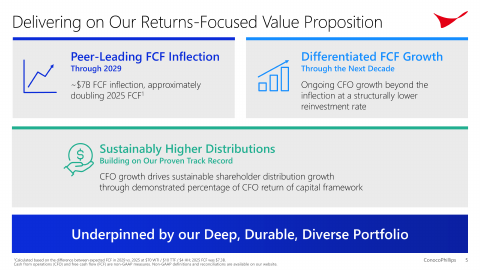
“First, as I mentioned a moment ago, we're well underway towards a peer leading free cash flow inflection of $7 billion by 2029.”
It restates the central long-term free cash flow target behind management's value proposition.

ConocoPhillips (COP) · Energy
Results filed 5 Nov 2026 · Quarter ended 30 Sep 2026 · Call 61 min · Andy O'Brien (CEO), Connie Haynes-Welsh (CFO)
Read the transcriptSlides (11 pages)Press release ↗Investor relations ↗
Summaries and transcripts are machine-generated and can contain errors.
ConocoPhillips reported third-quarter 2026 earnings of $4.0 billion, or $3.34 per share, adjusted earnings per share of $3.27, and cash provided by operating activities of $7.2 billion, and raised its quarterly ordinary dividend by 11% to $0.93 per share.
ConocoPhillips earned $4.0 billion, or $3.34 per share, in the third quarter, up from $1.7 billion, or $1.38 per share, a year earlier. Adjusted earnings were $3.27 per share. The main driver was a total average realized price of $61.40 per BOE, 32% higher than a year ago. Production of 2,302 MBOED was 97 MBOED lower than a year ago. The company returned $3.4 billion to shareholders, including $2.4 billion of buybacks.
Management expects fourth-quarter production of 2.32 to 2.36 million barrels of oil equivalent per day and says full-year capital and adjusted operating cost guidance are unchanged. It also expects modestly lower 2027 capital and low single-digit underlying production growth. The main uncertainties are the Middle East conflict, which still limits Qatar output, and inflation. Management says efficiencies are offsetting inflation so far. Willow remains on track for first oil in early 2029.
Open the slide deck (PDF, 11 pages) ↗
Showing the first 6 of 11 pages.
From ConocoPhillips investor relations
SEC filing
compared with 15,031 in the third quarter of 2025
compared with $1.7 billion in third-quarter 2025
compared with $1.38 in third-quarter 2025
compared with $1.61 in third-quarter 2025
| Segment or metric | Value | Change |
|---|---|---|
| Total production | 2,302 MBOED | a decrease of 97 MBOED from the same period a year ago |
| Lower 48 production | 1,517 MBOED | |
| Total average realized price | $61.40 per BOE | 32% higher than the $46.44 per BOE realized in the third quarter of 2025 |
| Commercial LNG offtake portfolio | 13 MTPA |
Copied from the press release ↗ and other documents in the SEC filing ↗. A figure is published only if its sentence is in the filing.
| From the filing | Q3 2026 | vs year ago | vs last quarter |
|---|---|---|---|
| Revenue | $19.4B | +29.3% | +1.4% |
| Net income | $4.0B | +131.8% | +1.8% |
| Diluted EPS | $3.34 | +142.0% | +3.4% |
Calculated by code from XBRL, not by the model.
| Metric | Period | Outlook |
|---|---|---|
| Production | fourth quarter of 2026 | 2.32 to 2.36 million barrels of oil equivalent per day |
| Full-year production | full year 2026 | 2.3 million barrels of oil equivalent per day |
| Return of CFO to shareholders | 2026 | 45% |
| Free cash flow inflection | by 2029 | $7 billion |
Earnings were $4.0 billion, or $3.34 per share, versus $1.7 billion, or $1.38 per share, a year earlier. The total average realized price was $61.40 per BOE, 32% higher than the $46.44 per BOE realized in the third quarter of 2025.
This included $2.4 billion of share repurchases and $1.0 billion of ordinary dividends. The quarterly ordinary dividend rises 11% to $0.93 per share, and buybacks are expected to trend higher in the fourth quarter.
Production was 2,302 MBOED, down 97 MBOED from a year ago. Adjusted for acquisitions and dispositions, it fell 40 MBOED, or 2%, as Lower 48 growth was more than offset by the Middle East conflict's impact on Qatar and higher Surmont royalties.
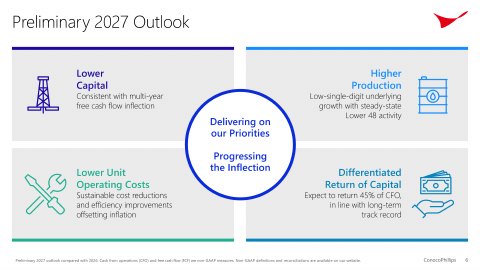
For 2027, management expects modestly lower capital, low single-digit underlying production growth, lower per-unit operating costs and a 45% CFO return. It also reiterated a $7 billion free cash flow inflection by 2029 and growth beyond it.
Fourth-quarter guidance covers a range of Qatar outcomes, and production there remains below pre-conflict levels. Inflation in fuel, logistics and chemicals has been double digits in some cases, but management says efficiencies more than offset it.
Fourth quarter worked out from the annual figure.
| Q4 2024 | $14.2B * |
| Q1 2025 | $16.5B |
| Q2 2025 | $14.0B |
| Q3 2025 | $15.0B |
| Q4 2025 | $13.4B * |
| Q1 2026 | $15.8B |
| Q2 2026 | $19.2B |
| Q3 2026 | $19.4B |
| Q1 2025 | $2.23 |
| Q2 2025 | $1.56 |
| Q3 2025 | $1.38 |
| Q1 2026 | $1.78 |
| Q2 2026 | $3.23 |
| Q3 2026 | $3.34 |
Fourth-quarter EPS appears once the press release is read; filings report it only for the full year.
Each quote matches the transcript word for word.
“First, as I mentioned a moment ago, we're well underway towards a peer leading free cash flow inflection of $7 billion by 2029.”
It restates the central long-term free cash flow target behind management's value proposition.
“We anticipate capital spending to be modestly lower year-on-year, consistent with the multi-year decline we outlined.”
It gives early direction on 2027 capital spending.
“And over this period of time as we approach 2029 and beyond, that will improve to the low 30s.”
It says the pre-dividend free cash flow break-even is expected to fall from the mid-40s WTI to the low 30s.
“So we're in the low 60s now, and we'd be well below 50 % reinvestment rate when we get into the 2030s.”
It quantifies the structurally lower reinvestment rate management expects.
“And, you know, just to be clear, if we don't receive an offer that exceeds our expectations, you know, we're happy to keep the asset.”
It clarifies management's stance on a possible Norway sale.
“we've been very clear that we based that off of a $10 TTF and a $4 Henry Hub. And I think last time I looked, TTF was closer to $30.”
It shows how current LNG pricing compares with the assumptions behind the free cash flow outlook.
Andy O'Brien said growth continues at a structurally lower reinvestment rate, supported by Lower 48 inventory, Willow satellite tie-ins, Surmont and international assets. — Andy O'Brien
Andy O'Brien said the framework is a percentage of CFO, so distributions grow as CFO grows, and the 45% decade average is a reasonable guide. — Andy O'Brien
Andy O'Brien said Lower 48 efficiencies and growth from Surmont and LNG support lower capital, while Kirk Johnson said inflation is low single digit and more than offset by efficiencies. — Andy O'Brien, Kirk Johnson
Kirk Johnson said the project is past halfway, module fabrication is over 75% complete, and first oil remains on track for early 2029. — Kirk Johnson, Andy O'Brien
Andy O'Brien said the post-2029 growth is already in the portfolio, and any new Middle East opportunity must offer attractive fiscals and fit the low reinvestment framework. — Andy O'Brien
Nick Olds said treated wells show a 20% oil productivity uplift with a range of outcomes, and 2027 will see more treatments at a measured pace without a large capital increase. — Nick Olds
Andy O'Brien said the reinvestment rate is in the low 60s now and would be well below 50% in the 2030s, and Connie Haynes-Welsh said break-even falls from the mid-40s to the low 30s. — Andy O'Brien, Connie Haynes-Welsh
Andy O'Brien said the approach is unchanged, that no decisions have been made on Norway, and that the company is happy to keep it unless an offer exceeds expectations. — Andy O'Brien
Nick Olds said proven primary zones remain the vast majority of activity, with the Woodford and Barnett treated as upside rather than a replacement. — Nick Olds, Andy O'Brien
Kirk Johnson said Qatar output rose from the second quarter but remains below pre-conflict levels, fourth-quarter guidance includes that uncertainty, and North Field East is expected online in the first half of 2027. — Kirk Johnson
Kirk Johnson said Surmont is low-decline and low-capital with a growth option, and the company is positive on the fiscal incentives in the trilateral MOU, which are not yet formalized. — Kirk Johnson
Kirk Johnson said about four exploration wells were drilled last winter and another four are planned, aiming to tie satellite pads into Willow infrastructure in a capital-advantaged way. — Kirk Johnson
Andy O'Brien said Port Arthur Phase 1 volumes are the main 2027 addition, and the company's plan assumed a $10 TTF and $4 Henry Hub, with TTF now much higher and Henry Hub lower. — Andy O'Brien
Andy O'Brien said investing would require a real pathway to recovering the $12 billion owed and the investment would have to compete within the portfolio, with Citgo sale outcomes still subject to appeals and OFAC approvals. — Andy O'Brien
Earnings were $4.0 billion, or $3.34 per share, compared with $1.7 billion, or $1.38 per share, in the third quarter of 2025. Adjusted earnings were $3.27 per share, and special items primarily reflected the reversal of a tax reserve.
Cash provided by operating activities and CFO were $7.2 billion, and free cash flow was $4,039 million. The company returned $3.4 billion, made up of $2.4 billion of share repurchases and $1.0 billion of ordinary dividends.
ConocoPhillips raised its quarterly ordinary dividend by 11% to $0.93 per share, effective with the fourth-quarter dividend payable Dec. 1, 2026, to holders of record on Nov. 16, 2026.
Fourth-quarter 2026 production is expected to be 2.32 to 2.36 million barrels of oil equivalent per day, after third-quarter production of 2,302 MBOED. Full-year production should be right around 2.3 million barrels of oil equivalent per day.
For 2027, management expects modestly lower capital, low single-digit underlying production growth, lower per-unit operating costs and a 45% CFO return. It reiterated a $7 billion free cash flow inflection by 2029 and growth beyond it.
Call recording on YouTube ↗. Official replay ↗. Timestamps jump to the moment.
Welcome to the third quarter 2026 ConocoPhillips Earnings Conference Call. My name is Liz, and I will be your operator for today's call. At this time, all participants are in a listen-only mode. Later, we will conduct the question and answer session. During the question and answer session, if you have a question, please press star 11 on your touchtone phone. I will now turn the call over to Guy Baber, Vice President, Investor Relations. Sir, you may begin.
Thank you, Liz, and welcome everyone to our third quarter 2026 earnings conference call. On the call today are several members of the ConocoPhillips leadership team, including Andy O 'Brien, president and CEO, Connie Haynes-Welsh, CFO and senior vice president of digital and transformation, Nick Olds, executive vice president of lower 48 and global HSE, and Kirk Johnson, executive vice president of global operations and technical functions. Andy and Connie will kick off the call today with opening remarks, after which the team will be available for your questions.
For the Q &A, we will be taking one question per caller consistent with our normal practice. A few quick reminders. First, along with today's release, we published supplemental financial materials and a slide presentation, which you can find on the Investor Relations website. Second, during this call, we will make forward-looking statements based on current expectations. actual results may differ due to factors noted in today's release and in our periodic SEC filings. Finally, we will make reference to some non-GAAP financial measures today.
Reconciliations to the nearest corresponding GAAP measure can be found in today's release and on our website. With that, I'll turn the call over to Andy.
Thank you, Guy, and thank you to everyone for joining our third quarter 2026 earnings conference call. For today's prepared remarks, I want to put our strong third quarter results in perspective and describe how we're uniquely positioned to create long-term value. Connie will then recap a few third quarter highlights, cover fourth quarter and full year guidance items, and provide some early directional color on 2027.
As you all know, we're in the midst of a compelling inflection. The way we demonstrate progress towards this inflection is by delivering results quarter after quarter, which serve as proof points for the trajectory that we're on. And our third quarter results were just that, another strong proof point, both financially and operationally. Financially, we again exceeded expectations on both earnings and cash flows. We returned 3.4 $1 billion to shareholders and today we announced an 11 % increase in our quarterly dividend.
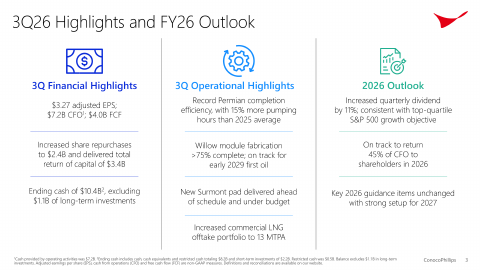
Operationally, the lower 48 continues to deliver and and we continue to capture meaningful improvements across our best-in-class position, including record permanent completion efficiency. At Willow, we're progressing critical path items and remain on track for an early 2029 startup. In Canada, we bought another pad online at Surmont, ahead of schedule and under budget. Finally, in our commercial LNG portfolio, we expanded our offtake to 13 million tons per annum. In addition to this being a strong quarter, these results reflect our continued commitment to ConocoPhillips' value proposition and the priorities that are foundational to our company.
Since becoming CEO, I've been clear that our value proposition and our priorities aren't changing. I believe in them and helped shape them over the last decade. They are clear, consistent, and durable, and they've served us well. But I've been equally clear, consistency must not be confused with complacency. Our focus is on raising the bar on our execution. We have the most talented employees and the highest quality portfolio in the industry. These are the foundations upon which we expect to deliver even stronger performance.
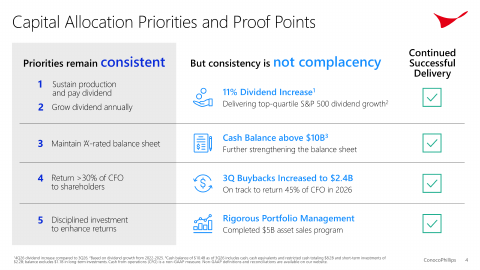
And we're already seeing the proof points with clear delivery against each of our five capital allocation priorities. Priority one and two are to pay and grow the dividend at a rate competitive with the top quartile of the S &P 500. Our 11 % dividend increase this quarter continues to demonstrate our commitment. Priority three is to maintain an A-rated balance sheet. We ended the quarter with over $10 billion of cash and short-term investments, as well as over $1 billion of liquid long-term investments.
Priority four is to return a significant percentage of our CFO to shareholders. We returned $3.4 billion this quarter, including $2.4 billion of buybacks, and we remain on track to return 45 % this year. You should expect buybacks to trend higher in the fourth quarter as we deliver on this annual objective. And priority five is to enhance underlying returns through rigorous portfolio management and investing in our Advantage portfolio. We recently completed our $5 billion divestment program, including $1.6 billion of proceeds this quarter.
And of course, we'll remain guided by our low cost of supply framework as we invest with discipline to improve returns. Our focus this year and beyond is to stay true to our priorities and raise the bar on execution as we deliver on our compelling returns focus value proposition. That value proposition for ConocoPhillips features three distinct pillars. First, as I mentioned a moment ago, we're well underway towards a peer leading free cash flow inflection of $7 billion by 2029.
That would approximately double our 2025 free cash flow at a $70 a barrel WTI price. And between now and then, we retain significant upside from higher prices and wider LNG spreads, given the unhedged oil and LNG talk in our portfolio. But 2029 isn't the final destination. The depth, diversity, and quality of our portfolio supports continued CFO and free cash flow growth well beyond 2029, doing so at a structurally lower reinvestment rate. That's the second pillar of our value proposition, differentiated, capital-efficient free cash flow growth well into the next decade.
And the third pillar is that our CFO and free cash flow growth translates directly to sustainable growth in our shareholder distributions via our percentage of CFO returns of capital framework, which has averaged 45 % over the last decade. This pillar ensures investors participate in the upside through a combination of top quartile S &P 500 dividend growth and through the cycle share buybacks. Bottom line on what's ahead, a peer-leading free cash flow inflection with differentiated long-term growth thereafter and a sustainably higher distributions.
That adds up to a truly distinct value proposition and one that is not easily replicated because it's underpinned by the deepest, most durable upstream portfolio in the sector, with over 20 years of low-cost supply inventory in the lower 48, complemented by our deep, diverse, and high-quality Alaska and international portfolio. With that, I'd like to welcome Connie to the call to cover some third-quarter highlights, cover fourth-quarter and full-year guidance items, and provides some early directional color on 2027.
Thank you, Andy. I will begin with highlights from our third quarter performance. We produced 2 ,302 ,000 barrels of oil equivalent per day. We reported $3.27 per share in adjusted earnings and $7.2 billion of cash from operations. After $3.1 billion of capital expenditures, That translated to approximately $4 billion of free cash flow generation. Share repurchases stepped up again this quarter to $2.4 billion. With $1 billion of ordinary dividends, that brought our total third quarter shareholder distribution to $3.4 billion.
We ended the quarter with $10.4 billion of cash and an additional $1.1 billion of liquid long-term investment. Our net debt to CFO ratio improved to 0.5 times, underscoring the strength of our A-rated balance sheet. In short, we delivered on every front, proof that we are raising the bar on execution. Turning to our outlook, our key full-year guidance items remain unchanged. For the fourth quarter, we expect production to average between 2 ,320 ,000 and 2 ,360 ,000 barrels of oil equivalent per day.
That would put our full-year production right around 2.3 million barrels of oil equivalent per day. We expect another quarter of sequential growth in our lower 48 production. Impacts from turnarounds are expected to be flat versus the third quarter, and our guidance accounts for a range of potential outcomes in Qatar where production remains dependent on conditions in that region. For capital, we expect modestly higher sequential investment in the fourth quarter. This reflects the spending profile we previously outlined for the lower 48 and our typical ramp in Alaska ahead of our winter construction season and exploration campaign.
Across the company, structural cost reductions continue to drive improvements in our adjusted operating costs. And we see the benefit of those reductions as they are fully offsetting the impacts from inflation in a higher commodity price environment. Finally, we remain on track to return 45 % of our CFO to shareholders this year, with buybacks expected to trend higher in the fourth quarter. Let me turn now to a preliminary 2027 outlook. While it's still too early for detailed guidance, our high-level framework is fully aligned with the priorities Andy just laid out.
We anticipate capital spending to be modestly lower year-on-year, consistent with the multi-year decline we outlined. Importantly, that lower capital delivers growth. We expect to see another year of low single-digit underlying production growth driven by the lower 48. Per-unit operating costs will trend lower again as our sustainable cost reductions and ongoing efficiency improvements continue to offset inflation. And again, our objective will be to return 45 % of CFO to shareholders, extending our long-term track record.
This 2027 outlook is another step forward as we continue to deliver on our value proposition. A peer-leading free cash flow inflection, differentiated long-term free cash flow growth beyond the inflection, and sustainably higher shareholder distribution, all of which is underpinned by our deep, durable, and diverse portfolio. That concludes our prepared remarks. I'll now turn it back to the operator to begin the Q &A.
We will now begin the question and answer session. In the interest of time, we ask that you limit yourself to one question.
If you have a question, please press star 1-1 on your touchtone phone. If you wish to be removed from the queue, please press star 1-1 again. If you're using a speakerphone, you may need to pick up the handset first before pressing the numbers. Once again, if you have a question, please press star 1-1 on your touchtone phone. Our first question comes from Betty Jiang from Barclays. Your line is now open.
Betty Jiang Hi, good morning.
Thank you for taking my question. Andy, your comment earlier about the free cash flow outlook through the end of the decade really stood out. And in the last few years, we have heard a lot about the $7 billion inflection by 2029. But the visibility of the portfolio gives you a much longer duration beyond that. So can you just walk us through what that looks like, how you think about that durability and visibility of that growth, and what part of the portfolio is really driving it?
Good morning, Betty, and thanks for the question. I thought it was important today to sort of put a bit more meat on the bone of sort of what does come after 2029. As I said in our prepared remarks, you know, I think it's well understood sort of the first pillar in terms of our inflection of $7 billion to 2029. But what I wanted to really lay out with that second pillar is probably the question that I've been asked the most since becoming CEO.
What happens after the inflection? What I wanted to try and make sure was very clear to everybody is that our free cash flow growth doesn't stop at that inflection. The longer-term opportunities in our portfolio really give us, I think, a really unique value proposition. And that was the second pillar I was trying to describe, that differentiated CFO and free cash flow growth through the next decade. but I can't emphasize this enough, at a structurally lower reinvestment rate than where we are today, then you ask sort of what's driving that.
It really is underpinned by the unique sort of strength of our portfolio. And it does all start with our lower 48 position, where we are clearly the US unconventional inventory leader. We've got over two decades of high quality tier one inventory across our lower 48 portfolio. That's headlined by over 20 years of low-cost supply Permian inventory. We have core positions of scale across the four liquids-rich unconventional basins. Again, we think that's a power that nobody else has.
And then when we combine that together with our deep, diverse, high-quality Alaska and international positions, it really complements that. And I use Alaska as one of my examples. If you just fast forward to 2030, we'll have Willow online, we'll have built a new hub, and then we'll be in a position where we'll be looking to tie satellites back into Willow. That's the whole point. When you have a hub, we can bring more back into it.
And those tie-ins back to Willow will be some of the most capital-efficient and low-cost supply opportunities in our portfolio. So that's one example. Another example would be Surmont and Motney in Canada. We have a tremendous resource base there that's only going to increase in value over time. It's already one of the more capital-efficient assets we have with sermons. And with some of the new fiscals up in Canada, some incremental investment there may start to look more attractive.
Again, with the Middle East and Libya, that's another good example of high-quality, long-duration opportunities that we have with, again, a low-cost supply. So this isn't meant to be an exhaustive list, Betty, but it sort of highlights the diverse set of opportunities we already have captured in our portfolio. And I thought it was really important to emphasize to everybody that those opportunities can support growth through the next decade. And again, it's at a structurally lower reinvestment rate.
Our next question comes from Devin McDermott from Morgan Stanley. Your line is now open.
Great. Hey, good morning. Thanks for taking my question. So I wanted to shift over to, Andy, some of your comments on shareholder returns. And it's great to see the large dividend increase. And I wanted to think through how you're looking at the outlook, given the free cash flow inflection, and also your comments just now on the durability of the portfolio. And I guess specifically, when you think about your point and commitment to sustainably higher distributions, Does that include keeping returns well above the 30 % CFO baseline?
That's question one. And question two is, like, how do you think about the mix between dividends and buybacks evolving over time? It would seem like you have plenty of runway to get to push that dividend payout higher, especially as your breakeven and reinvestment rate falls. So how are you thinking about the mix there over time?
Yeah, good morning, Devin. And that really is sort of a perfect segue from sort of where I was just chatting with Betty on, you know, really the third pillar I was trying to outline, you know, is that differentiated return of capital framework.
You know, it's really important to us that, you know, our framework is a percentage of CFO. So as we grow our CFO, our distributions grow. And, you know, specifically, you know, I described how we can do that. The fact that we're going to be at a lower reinvestment rate, so we'll have a lower reinvestment rate. Our balance sheet is in a great position. So we've already got a really strong balance sheet. We're going to grow our CFO.
And then that gives us all the flexibility to, as you say, think about our dividend and the growth in our dividend. You saw the evidence of that again this quarter with the 11 % increase. We're a firm believer in a track record of top quartile S &P 500 growth. that has credibility, and that's the key word. It has to have credibility behind it that people see as being affordable. And we think that the cash flow generation of our company demonstrates just how affordable that is.
And then as we go forward, it's, you know, I apologize for the cliche here, but it's about making the pie bigger. You know, as we make the CFO pie bigger, there's more for distributions, and especially if we're at a low reinvestment rate. And, you know, as I said in my prepared remarks, you know, we've averaged now 45%, you know, distribution over the last decade. And, you know, I see no reason why we wouldn't be looking, you know, for the similar kind of thing going forward, particularly as our reinvestment rate comes down.
Our next question comes from Scott Hanold from RBC Capital Markets. Your line is now open.
Thanks. I appreciate the early context around 2027 in the capital. I was wondering, with the understanding that you all will get more fulsome updates next year, can you give us a sense of how are you able to offset and what do you think about inflation right now in the next year? And if you could give any kind of high level view on how to think about the changes in major capital spending next year and maybe into 2028.
So, yes, I'll touch on sort of most of the questions here and good morning. And then I'll ask Kirk maybe to jump in specifically on the inflation side of it. But, you know, I think how we do this is really important. You know, as we lay down our prepared remarks, you know, we're giving sort of, you know, some high level framework for you that's pretty consistent with the framework we've been outlining, you know, as part of our free cash flow inflection.
But, you know, I don't want to get lost in sort of what we're saying here. We're saying lower capital, low single digit underlying production growth, lower unit costs and about 45% CFO return to shareholders. And I think what's really important is, you know, how can we do that? And again, a lot of it comes back to our position in the lower 48. Our track record shows year in, year out that as we drive steady state activity, we're able to show production growth with less capital.
And we expect the exact same thing in 2027. And the way we do that is because we're working with our tier one inventory and we're combining that with the continued D &C efficiencies we're seeing. I think that's a huge advantage that we have over some others. And then when you add with that, you look at things that I described in my prepared remarks, like Surmont. We just bought another pad on at Surmont. That should basically continue to drive growth for us next year in Canada.
Again, very, very efficiently. That pad's just coming on. We'll start to see LNG coming from NFE next year. We'll also see LNG coming from Port Arthur. Now, that one won't count towards production, obviously, but it certainly counts towards the cash flows. So, you know, they're the kind of things when you combine our lower 48 and then the things that we have in our Alaskan international portfolio that allows us to drive that production growth off of lower capital, all consistent with the inflection we've been talking about.
And I do want to take a moment as well to also just highlight on our operating costs. You know, we fully expect another year of lower unit operating costs next year. And that's even with some of the inflation that we're seeing from higher commodity prices. And the way we're doing that is we're remaining focused on capturing additional efficiencies, and we're driving structural cost changes. Now, to your specifics around sort of can I give a bit more color around sort of breakdowns of where it is, I think that's probably a conversation for a later date when we give the actual guidance out.
But today, I wanted to just sort of shape for you sort of how we can deliver sort of that production growth off of a lower capital. And then the other part of your question on inflation, maybe Kurt can just touch on that one for us.
Yeah, good morning, Scott. Certainly, as we've been all watching, the ongoing Middle East conflict continues to disrupt energy as well as the better part of the global trade flows. And that's continued to drive inflation across what we describe as many of the flow through consumables into our business.
The obvious are fuel, logistics and chemicals. And so while inflation in these categories is pretty noteworthy, it's been double digits in some cases. It's been a small component of our total cost structure. And so as a result, in aggregate, we're seeing pretty modest read into that low single digit inflation. But again, I think it's really important that I point out it's being more than offset by the amount of efficiencies that we're realizing in the development, the drilling and completions, as well as operationally within that entire space.
And clearly Andy was addressing that in how we're able to accomplish much of this. It's in the lower 48. Naturally, we're seeing increased activity. Much of that's concentrated in some of the smaller operators, and that is, in fact, tightening capacity, especially across the oil field services space. You know, super spec rigs as well as frack equipment, you know, utilizations have been really quite high, you know, better than 90% or 75%, respectively, across those two.
But again, hear from us here, bottom line, we're watching inflationary trends here pretty closely. But we've been really pleased with the fact that across our portfolio, we've been able to offset that through improvements in the company.
Our next question comes from Neil Mehta from Goldman Sachs. Your line is now open.
Yeah, good morning, Andy. Good morning, Connie. and congratulations to you both on your first calls in these new capacities. I was wondering, Andy, if you can really dig in to Willow.
This is such an important year for the project, particularly with the vessels and corpus. So how we track in on both scope and on cost, and maybe you can give us a mark to mark it on how it's going.
Yeah, morning, Neil, and thank you. And I should have done welcoming Connie to her first call too. So I appreciate you doing that, Neil. Maybe I'll ask Kirk to get us started on Willow, and I can maybe add a bit after Kirk has just stepped through the details.
Hi, Neil. Certainly, we continue to be pleased with the progress that we're seeing on the Willow project. We're, as you know, past the halfway point in the overall aggregate of the project, and we remain steadfast in our confidence here on First Oil in early part of 2029. Also, as you heard from me in the last quarterly call, we were able to successfully wrap up all the critical infrastructure, civil scope specifically there on the North Slope here in this last winter season.
And so, of course, naturally now we're turning our focus to the next set of milestones in front of us. And if I stay on the North Slope, what we're looking at is continued progress and ultimately completion on the infrastructure that's critical for us to begin drilling operations as early as next year. And then, of course, in this upcoming winter construction season, we'll also be progressing the production necessary pipeline construction, again, on a pretty rapidly approaching winter season here for us.
Of high importance to it, though, is our process module fabrication. Of course, that's occurring on the Gulf Coast. and we've just exceeded the 75 % completion mark. And that's an important one for us as we're looking down a pathway here to wrap up that fabrication in the second quarter. And that's important because in the summer months, we'll be sea lifting those modules from Gulf Coast to Alaska. And then of course, we've got to make sure we're ready to receive those in Alaska in the summer and the fall.
So again, I'll just, you know, I'll close by acknowledging, In fact, we do start drilling next year, and that's important to build a production-ready inventory so that we can have a strong ramp-up in the early part of 2029 and across that full year. So, again, confident in what we've described in the past as far as capital and our schedule looks. So really quite pleased with how that project continues to progress.
Thanks, Kirk. And I would just emphasize, Neil, everything is on track for early 2029 first production.
Our next question comes from Philip Youngworth with BMO Capital Markets. Your line is now open.
Morning, and thanks for taking the question. You closed some incremental divestitures in the quarter and completed the $5 billion. I know you're never done, so how are you thinking about portfolio management going forward beyond just the Norway reports? And then on the growth side, are most of the organic opportunities you're assessing kind of focused in the MENA region, like what you've done with Iraq, that are Libya fiscals and Syria?
And how do you assess overall risk profile when entering a new country, given that ConocoPhillips's portfolio is more OECD-weighted than peers who have a global footprint?
Okay. Yes, thanks for the question, Philip. Let me sort of just try to take a step back here and sort of describe sort of, first of all, I want to be clear, everything we talked about in terms of the pillar two and the opportunities to grow our free cash flow, that's already captured in our portfolio.
It's not reliant on any additional things coming into our portfolio. So I think that's a very important point just to clarify. And then as we look at additional opportunities, and we have been looking at a fair bit in the Middle East recently, and I'll just put that in context. There's a number of Middle East governments that are actively seeking capable partners. And we really are one of the very few U .S. companies that have the technical capabilities and the operational experience to consider those opportunities.
But I want to be clear that any new opportunity that we may pursue must fit within that framework I described. It must offer attractive fiscals. It must give us competitive, risk-adjusted cost of supply. And to your point around we've got a portfolio that's a heavy weighting to the OECD, that's absolutely true, and we really like that. But what that does when we're managing a portfolio, it does give us the opportunity to basically look at putting a bit more Middle East into the portfolio as we are so weighted OECD.
But again, we're only going to do that in a way where it's basically complementing what we have with our lower 48 unconventional portfolio, what we already have in Alaska and international. and it's got to be really clear on this. It's got to be consistent with the framework that we have. We've got to do this in a way where we're still delivering the consistent long-term CFO growth and anything we're doing is basically still working within that framework of a lower reinvestment rate.
So I look at these as things that if the opportunities are right, It's a way of adding some very, very, very good long life resources to the portfolio if we can get the right fiscals. And we're a company that's in the position to look at doing that. And it's really, it's not about making our company bigger. It's about making our company better. And these are the kind of things that I think will make our company better if we can structure them the right way within our framework.
And it's just really just part of our active portfolio management.
Our next question comes from Chris Baker with Evercore ISI.
Thanks. I wanted to circle back on the capital efficiency discussion, a lot of great comments earlier. But specifically, last quarter you all talked about a significant uplift from surfactant treated Permian wells. I guess now that you have more time with those wells, how's the uplift holding up? And I guess how are you approaching the decision around a potential broader rollout?
Could that be a further tailwind to 27 capital efficiency?
All right, Chris. Good morning. This is Nick. Chris, I'm going to step back a little bit on capital efficiency and then dive into the surfactants and some other technologies that we're deploying within lower 48. But as a reminder, you know, we are a leader in capital efficiency in each of our lower 48 basins, and that's measured by total well cap, capex per barrel of oil, and EOR basins.
And you can see that in the public data. It all starts with the quality of rocks. As Andy mentioned, we are advantaged with core acreages in each of those basins. And if you look at the well productivity trends, you know, we have been the stronger and more consistent than pretty much any operator in the basins we operate in. And that's, again, a testament of the quality of rock, and it's a testament of the team's relentless focus on driving that capital efficiency and minimizing our operational costs.
A couple key drivers for 2026 is we continue to extend lateral links across the portfolio, you know, 15 % improvement compared to 2026, and we're doubling the number of three-mile laterals or greater across the lower 48. And then secondly, we expect to continuously drive improvement in DSC efficiencies following the 15 % improvement we achieve in 2025. And that's coming roughly from like continuous pumping and Simulfrac. And that leads me to what Andy mentioned in his prepared remarks is that we delivered record completion performance in the third quarter across our crews as pump hours were up 15 % from where we were in 2025.
And one of our crews pumped 23 hours per day in August. And that was a record for us as well as the vendor. And that was achieved by completing more wells simultaneously across the Permian using Simulfrac. And that was combined with longer laterals. And with that increased pump hours, this also delivered a record-setting 20 % improvement simulated footage per day. And we continue to see that in Q4. Now, we continue to test the real-time frac optimization using advanced subsurface diagnostics like using fiber optics.
and that will allow us to make sure we're not over capitalizing our completions, but also ensuring that fracks are placed in most effective areas. Now, switching gears to the technology, and I'm coming up on the surfactant here, you know, we're testing a range of technologies looking at how do we improve recovery, but also how do we improve capital efficiency out there. Now, first, I want to talk a little bit about application of far field diverters, which keeps the frack energy in the targeted wellbore in Eagleford.
That technology has greatly mitigated frack kits with child wells, which immediately improves the capital efficiency. Now we're scaling that technology into Eagleford over the entire program and ramping that deployment in the Bakken and seeing really encouraging results. Now, Chris, to your point, surfactants, we've shown a 20 % uplift in oil productivity for treated wells. Now we have about a year and a half of data on several groups of wells, and we're testing that both in new and existing wells, and we're seeing a range of outcomes.
We're also applying new surfactants on untested reservoir benches, and I guess the bottom line, you know, that opportunity has got a lot of space. And so to your question, we will be seeing additional applications of treatments across the portfolio in 2027, but don't think that is a large capital increase out there. It's going to be a very measured pace application. And then I'll end on is, you know, we've got a large non-operated program. So we roughly see one out of every six wells drilled in those basins.
So we have real-time visibility that's what's happening in the industry, which is a great opportunity to leverage that information. And then I'll just end on, you know, the biggest driver for productivity talked a lot about it, but it's really been back to the rock. And that's where we're most differentiated in our lower 48 portfolio with the two decades in inventory.
Our next question comes from Doug Leggett with Wolf Research. Your line is now open.
Thank you for taking my question.
Andy, you've laid out a pretty compelling long-term, I guess, dividend growth story. My question is about the growth beyond 2029 and the capital that goes along with that. I don't know how much detail you can go into at this point, but 2023 was a few years ago now, and you had a 10-year plan laid out then. But I guess my question is, the sustaining capital and the growth capital are two elements of that. How do you see the spending level as it relates to supporting that growth you've suggested today, well, free cash flow growth that will go beyond 2029?
Thanks.
Yeah, morning, Doug. Maybe I'll start this one off, And then I think Connie can sort of help fit in a bit of details on sort of how it comes together with our break evens. But probably, you know, obviously I'm not going to get into sort of which asset dollars specifically go to in the 2030s. But I will put a bit of color on it for you to try to sort of make this sort of come together.
You know, as you know, we're successfully moving now through the, you know, our pre-productive CapEx. where we're at a point where our underlying CFO is growing, our costs are coming down, projects are coming online, and capital is starting to decline. And I've said the term, a couple of times now, that's going to result in us having a structurally lower reinvestment rate. So what do I mean by structurally lower reinvestment rate? And that's probably getting to the heart of your question.
Now, obviously, in the commodity prices today, it's easy to say we have our reinvestment rate is down in the low 40s right now. But that's the wrong way, I think, to look at it. You need to be, or the way we look at it is, if you look at what our reinvestment rate would have been over the last couple of years, say at a $70 price deck, we would have been running a reinvestment rate with a pre-productive CapEx, probably something close to 60%.
And if you just fast forward as we get into the next decade, all of the things I I described when I think it was the first question that Betty asked in terms of all the things organically in our portfolio that allow us to keep growing. I can't emphasize enough that when I say a structural reinvestment rate, what I specifically mean is that we'll be able to invest in all of the things, you know, the exact order of which one in which year, you know, that's what we have to work out and plans in the 2030s.
but the depth of the inventory we have, we'll be investing at a reinvestment rate in the future that is basically well below 50%. So we're in the low 60s now, and we'd be well below 50 % reinvestment rate when we get into the 2030s. And when you combine that with the inventory running room we have, the balance sheet strength we have, a lower reinvestment rate, growing CFO, To me, that's sort of one of the most compelling things about our value proposition is how we'll be able to grow that CFO and then grow the distributions on of that.
And probably the last proof point that I'll let just Connie cover for us is that, yes, it's a reinvestment rate comes down, but our break-even comes down too. And maybe just touch on the break-even for us, Connie.
Yeah, absolutely. Good morning, Doug. Good to have you on the call. So just to give a couple of proof points on our break-even, right now our pre-dividend free cash flow break-even is in the mid-40s, WTI.
And over this period of time as we approach 2029 and beyond, that will improve to the low 30s. That is really a main component of what lets us continue to grow the dividend and add a top quartile rate for the long term. But as Andy has mentioned before, the dividend has to work in all areas of the cycle. So what I want to do is also take this to kind of our return of capital framework and how we think about buybacks.
So buybacks are also how we flex with price to deliver on that annual commitment that is so important to us. And right now, buybacks also, we retire about four to 5% of our shares each year. So that is another way that over the long term, our dividend growth is supported on a per share basis.
Our next question comes from Arun Jayaram with J .P. Morton. Your line is now open.
Yeah, good morning, good afternoon, Andy and team.
Andy, I wanted to delve a little bit deeper in Priority 5 and portfolio management. And I was wondering if you could maybe elaborate on your approach to portfolio management. Should we expect a more muscular approach to the portfolio under your regime? And perhaps I wanted to get maybe in detail how you think about more mature parts of the portfolio, places like Norway versus your more caught advantage assets in parts of the lower 48 LNG. et cetera.
Yeah, yeah, yeah. Thanks for the question. I'm not sure muscular would be the word I would pick to describe it, but, you know, the way we think about portfolio management has been very consistent at ConocoPhillips for a long time. You know, we've always said that we basically have a rigorous process to evaluate our assets. You know, we should never think of anything as being static. Assets do mature over time. So I'll start with that. And then, so we're always looking to what we should, what competes in our portfolio.
And, you know, as assets basically become a little less competitive in the portfolio, you know, we have conversations with our teams about what the options are to make them more competitive. But ultimately, you know, we, I think the term I've used in the past is, you know, we need to make sure that we don't sort of just, you know, get enamored with the asset and, you know, not sell it at the right point. But specifically to Norway, I want to address this one head on.
So, you know, as I've previously communicated, we received an unsolicited offer for Norway. We typically wouldn't be being public about an asset this early in sort of something like an unsolicited offer. But the way the rules work in Norway, we needed to go public with that and be very transparent. And we wanted to be very transparent with our employees that we'd received an offer. And we're now looking at offers for the asset. But just to be clear, we've made no decisions on Norway.
We have a very long history in Norway. It is a great asset. It's a great cash engine for the company. And, you know, just to be clear, if we don't receive an offer that exceeds our expectations, you know, we're happy to keep the asset. So I would say, you know, it's a bit more public than I would ideally like. We're not normally talking about them this early in the cycle, but this is how the process works.
This is, you know, we identify assets or we get approached about assets. We evaluate them and we decide what the best long term value option is. And that's exactly what's happening with Norway. And sort of, you know, out of respect to our employees and all of our stakeholders, you know, we'll quietly work that. And when we have something to say and announce, we'll do that. So I wouldn't describe Norway as being more muscular in what we're doing.
I think it's just the timing of when something's happened. I think we'll continue to look at our portfolio this way. I think it's healthy. I had the question earlier about assets coming into the portfolio and things we might be looking at in the Middle East. It's just part of the cycle. but it's part of what we do to maintain our portfolio and to make sure our portfolio is sort of, in my view, the most competitive out there.
So I think you, you know, a bit of a broken record here, but I think you can expect sort of more of the same from Chronicle Foot-Ups and how we evaluate assets and, you know, how we add things and subtract things from the portfolio.
Our next question comes from Neil Dingman from William Blair. Your line is now open.
Morning. Thanks for the time. And my question is likely for Nick on the Permian. Could you speak to how you're looking and thinking about the Permian development plan next year, specifically maybe on targeting various formations?
You know, it seems like zones like the Woodford and Barnett have gotten a lot of attention recently. And I know, I mean, I'm sure you've got a lot of prospectivity there. So we'd just love how you're sort of thinking about the overall development plan.
Yeah, sure, Neil. Well, stepping back, as a reminder, we have the deepest tier one inventory in the Permian. So if you look at our proven and our primary zones, that remains the vast majority of our ongoing development program this year and for many years to come.
So as the secondary zones that you just mentioned, like the Woodford and the Barnett, we look at that as really upside on top of that inventory depth, really not a replacement for it. So I can give you a little insight related to the results so far with those benches. So, for example, in the Delaware Woodford, we brought that number online this year. They're performing at or above expectations, and they're probably low $30 or $40 cost to supply.
Now, we expect to further drive improvement with those opportunities as we move to longer three-mile development and optimize completion designs. Now, in the Midland Barnett, you know, it's still early days, Neil, and delimiting that play will take some time. So we're seeing some pretty early encouraging results with the Barnett, and those opportunities are in line with core Midland Basin Wells. But just to reiterate, you know, as a reminder, the deep, you know, Tier 1 inventory is going to be our main primary focus for years to come.
And as we continue, we'll delineate these further as we drive the learning curve down over time.
Yeah, I would just add, as Nick said, you know, tier one primary zones is where, you know, most of our focus is. Of course, we're, you know, we're staying abreast and aware of sort of some of the secondary zones. And we have all of that acreage, too. But when we've got such a deep tier one, as Nick said, that's where you'll see the vast, vast majority of our dollars being spent.
We also benefit, as Nick said in a previous answer, that we see a lot of the wells as a non-op that are drilled across the basin. So, we will continue to learn about the primary zones and sort of which ones are more attractive as the secondary zones, which ones become more attractive. But it won't distract us from our Tier 1 inventory that we have years and years of primary zones to get after.
Our next question comes from Sam Margolin from Wells Fargo.
Your line is now open.
Hi, thank you for taking the question. Maybe we could pay a visit to Qatar for an update. You mentioned NFE contributing next year in a base case, but obviously there's a lot of variables and different scenarios. And so I guess the question is, we know that the security considerations to ship LNG out of the straighter formulas are different than oil, and we can see that in flows today. And so, you know, in a base case, in a ceasefire scenario, what do you think has to happen for NFE to, you know, ramp towards full rates and for the remainder of the Qatar footprint to be at 100 % sort of unencumbered?
Yeah, morning, Sam. This is Kirk. Yeah, certainly appreciate the question in context of certainly what we're all seeing and feeling there in the Middle East right now, especially with our own teams and operations there in Doha. As you saw, maybe I'll just start with operationally, because I think that's a bit of a good lead in here to your question specifically on NFB. You saw from our earnings materials that Qatar production has actually increased here in third quarter over second quarter.
But again, it does, in fact, as you're pointing to, it remains below pre-conflict levels. And so, of course, we can imagine, as I'm sure many do, quite a range of outcomes that could be possible here in fourth quarter. Anything from a continuation of what we're seeing in third quarter to potentially a ramp up to a full utilization of the trains that we have there on N3 that have been operating at a constrained level. Our fourth quarter guidance does in fact include and takes into account that uncertainty that could exist in Qatar.
And so if you project that forward then, and certainly what we've been realizing there as a contributor to the projects of NFV, and ultimately NFS as well, is the fact that they have, despite utilization constraints in total production with some challenges just with overall flow through the strait, we've continued to see some pretty strong, if not quite strong, construction progress there by the Qatar team. And so as published and stated by QE, we are expecting NFE to come online in the first half of 2027.
And that's our own expectations, obviously, are consistent with what we're seeing as being published by Qatar Energy. And then, of course, NFS follows that. And so while we've seen reduced utilization, project progress continues. And so we expect NFE and ultimately NFS to continue to contribute to this free cash flow inflection that we've premised for the next couple of years.
Our next question comes from Josh Silverstein from UBS. Your line is now open.
Thanks, guys. Just wanted to follow up on Canada with the more supportive policy environment up there.
It seems like Canada investment opportunity has certainly moved up. your pecking order here. So, just curious about the opportunity you see there for increase in investment, if it's both, you know, Sermon and Motney, one versus the other, and then maybe just some, you know, views as to where the underlying cash flow improves under the new tax legislation. Thanks.
Hi, Josh. This is Kirk. Yeah, certainly, as you saw from our released materials, we did bring on pad 104 WB ahead of schedule and under budget.
I think that's really quite indicative of the strong performance that we've been seeing from that business over the last couple years, strong base production, and then strong development production as we've been bringing on a new pad roughly every 12 to 18 months. And we've been seeing strong performance coming out of those wells and those pads as well, paddle 104A, its production has been exceeding our own expectations. And so naturally, I'm expecting really good things, strong production from 104B.
But as you're pointing to here, Josh, there's a number of things going on here in Canada right now, whether it's pointed at Montigny or especially pointed at Surmont on the trilateral MOU. And I think this continues to point to the underpinnings of certainly in our published materials and Andy's opening comments, the fact that we have a strong organic existing position here in the company, in our international portfolio to continue to expand CFO and free cash flow.
And it's coming from assets and businesses like CERMO. You know, again, this is a differentiated asset. that it's unique in the fact that it's low decline and it's very long life with a low cost of supply set of investments in front of us. And it demands a pretty low capital intensity when we compare that to other assets in our portfolio. And it does contain a future growth option. So certainly, as you've been seeing in the press, as a member of the Oil Sands Alliance, we have been in negotiation with the two governments, the federal and the provincial government there in Canada, along with the other Oil Sands Alliance members.
And while we have yet to formalize the agreements coming out of the trilateral MOU, we're really quite positive on the fiscal incentives that have been premised in the MOU and we continue to negotiate, as well as the policy and the regulatory proposals that are coming about to incentivize growth. And those incentives range from accelerated depreciation to support on both capital and cost. And so, again, when I back up, I think about assets like Surmont as being a great demonstration of the value and the inventory that we have in the company to not just continue to modestly grow production in places like Surmont into existing capacity, but we also have the capacity and the capability to expand total production through some
really modest capital investments. And so even inclusive of an expansion project or a Pathways project, this asset, Surmont specifically, is in a place of having a very advantaged low reinvestment rate. And it's part of this contribution to our ability to continue to expand CFO and free cash flow well into the next decade.
Our next question comes from James West from Elias Research. Your line is now open.
Hey, good morning, guys. I had a question around Alaska and Willow.
I know we've talked a little bit about it already and where the project is heading, but you've had some exploration success. You'll likely have more. And I'm curious how you think about how much duration that would add to Willow once you ramp it and it gets to a plateau.
Yeah, good morning. Kirk? Yeah, certainly as you're pointing to, and Andy spoke to this earlier a number of times, but I'll reinforce a couple components here just to start with, which is this last winter season, we drilled roughly four exploration wells and saw enough to be rather explicit about the fact that we're positive about our ability to continue to bring in more resource into willow.
And so So naturally, then, of course, as described, we're preparing for this next winter season. And we have plans to drill roughly the same number of wells, another four wells, do a bit more seismic. And all of this is in an effort to mature our understanding of the opportunities that exist for us beyond Willow. And so as we're ready for this, inclusive of the fact that we just received federal permits to begin drilling and begin executing that program there up on the slope this winter, All of this is in an effort to lay the groundwork to use Willow's infrastructure in the same way that we've been using the infrastructure that has existed for decades, which is the western North Slope,
or sometimes I call it the Alpine infrastructure, as well as our Kaparek infrastructure. And this creates the potential for satellite pads that can be developed in a really capital-advantaged way. We can put pads out there at a really low rateable capital spend and bring more resource into Willow in the years following first oil in which we've come off of plateau there at Willow. And so we continue to use these infrastructure to our advantage, low cost of supply.
And even with all of that included, you can continue to expect capital to come down in Willow, inclusive of all the efforts that we're doing to explore, appraise, and develop these new satellites. All of this, again, certainly as Andy pointed out earlier, is another great example of our ability to continue to bring capital down and expand CFO and free cash flow well into the next decade.
Our next question comes from Kevin McCurdy. from Pickering Energy Partners.
Your line is now open.
Hey, great. Thanks for taking my question. My question is on the LNG portfolio and the cash flow contributions. You've steadily added offtake up to 13 MTPA now. Can you remind us how much of that you will see in 2027 and how that ramps, and any broad thoughts on where margins are currently and into next year?
Yeah, good morning. This is Andy. So in terms of the, you know, as you're right, we've been increasing our offtake and we're now at 13 million tons.
You know, the new capacity we're adding doesn't come on until, you know, later in this decade and into earlier in the next decade. So specifically the volumes that we have that will be coming online first will be, you know, will be our Port Arthur phase one volumes and a small amount of volume, you know, at Ecker. So that's kind of the key driver to the volume sort of coming on. I'll remind you on Port Arthur phase one, we're also an equity owner in that.
So, you know, as 30% owner, we'll also be capturing our share of the commissioning cargos that come off of that project. And then, you know, in terms of the margins, I'm not going to get into the specifics, but it's if you kind of, you know, when we've given you our free cash flow inflection, you know, we've been very clear that we based that off of a $10 TTF and a $4 Henry Hub. And I think last time I looked, TTF was closer to $30.
dollars. So we'll see where those margins are next year as they're coming on. But, you know, we're trading significantly above the $10 assumption that we had. And, you know, Henry Hub is trading below the four bucks that we had. And, you know, the costs in between effectively are locked in for us. So, you know, as I look at our commercial team, you know, I did sort of, We can't get these volumes on fast enough. So it's, you know, Paul Arthur phase one is the key element of the volumes coming on for us next year.
Our next question comes from Gabe Daoud with Truist Securities. Your line is now open.
Thanks, operator. Hey, Andy and team, good afternoon or good morning. Actually, good afternoon for everyone now. But maybe, Andy, just hope we can maybe any kind of update on, Pat, to monetizing the Venezuela claims and then maybe additionally just any kind of update on resource there and legal and fiscal terms and whether or not there would be any kind of appetite to reenter the country.
Yeah. So, you know, for Venezuela, you know, the way I would describe it for us is that, you know, we continue to engage to better understand opportunities there. But for us, you know, to invest capital, we need to see a real pathway to meaningful recovery on the $12 billion we're owed. You know, and it's also critical, you know, let's not lose sight of the, you know, the investments also got to compete with the rest of the portfolio.
You know, I think we've gone through that in great length today and just how deep our portfolio already is. So, even if we can sort of work through a pathway of meaningful recovery, you see improved security, you see improved fiscals, it's still got to compete within our portfolio. So, we'll always remain open-minded. We'll always want to look, we want to talk, want to understand, but it's got to compete within the portfolio. And that's probably nothing really much new to say on that at this point.
I think the other question in terms of the claims that we have, again, it's not really much new to say there either. I think the one that most people point to is the Citgo sales. You know that the Delaware courts approved a bid for Citgo. So that remains subject to appeals and OFAC approvals. And, you know, we're just not going to speculate on, you know, specific outcomes or timing there. So it's a space we keep watching.
You know, we know what we're owed and, you know, we'd like to see if there's a win-win solution. But, you know, it starts with basically understanding sort of a pathway to recovering what we're owed.
Thank you, ladies and gentlemen. This concludes today's conference. Thank you for participating. You may now disconnect.