“As I mentioned, backlog continues to grow due to strong order rates, and we're now taking some large reciprocating orders as far out as 2029 and turbine orders into 2030.”
It shows how far ahead demand for engines and turbines is booked.

Caterpillar (CAT) · Industrials
Results filed 29 Oct 2026 · Quarter ended 30 Sep 2026 · Call 60 min · Joe Creed (CEO), Kyle Epley (CFO)
Read the transcriptSlides (28 pages)Official transcript (PDF) ↗Press release ↗Investor relations ↗
Summaries and transcripts are machine-generated and can contain errors.
Caterpillar reported third-quarter 2026 sales and revenues of $20.7 billion, up 17%, with profit per share of $7.13 and adjusted profit per share of $7.20.
Caterpillar had its highest sales quarter ever. Sales and revenues rose 17% to $20.7 billion, helped by higher volume of $2.2 billion and better pricing of $663 million. Operating profit margin was 20.4%, up from 17.3% a year earlier. Profit per share was $7.13 and adjusted profit per share was $7.20. Data center demand lifted Power & Energy, where power generation sales to users rose 75%. Backlog hit a record $78 billion, and the company returned $2.0 billion to shareholders.
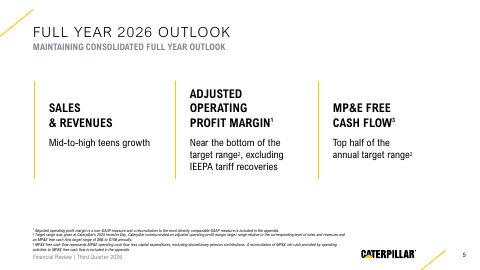
Management still expects full-year 2026 sales and revenues to grow in the mid to high teens. It expects only moderate fourth-quarter sales growth against a strong comparison, plus a dealer inventory drawdown in Construction Industries. Excluding tariff recoveries, the full-year margin should be near the bottom of the target range. The main tension is capacity: Power & Energy sales are limited by how fast engines and turbines can be built. Tariffs of about $2.2 billion and higher freight costs also weigh on margins.
Open the slide deck (PDF, 28 pages) ↗
Showing the first 6 of 28 pages.
From Caterpillar investor relations
SEC filing
up 17% from a year ago
up from $4.88 a year ago
up from $4.95 a year ago
up 38% from a year ago
up from 17.3% a year ago
up from 17.5% a year ago
| Segment or metric | Value | Change |
|---|---|---|
| Power & Energy sales | $8.784 billion | up 18% |
| Construction Industries sales | $7.983 billion | up 18% |
| Resource Industries sales | $4.615 billion | up 15% |
| Financial Products revenues | $1.177 billion | up 9% |
| Power generation retail sales to users | UP 75% | |
| Cat Financial past dues | 1.31% | down from 1.47% a year ago |
Copied from the press release ↗ and other documents in the SEC filing ↗. A figure is published only if its sentence is in the filing.
| From the filing | Q3 2026 | vs year ago | vs last quarter |
|---|---|---|---|
| Revenue | $20.7B | +17.3% | +0.7% |
| Operating income | $4.2B | +38.1% | −1.9% |
| Net income | $3.3B | +42.9% | −8.5% |
| Diluted EPS | $7.13 | +46.1% | −8.2% |
| Free cash flow | $3.7B | +18.7% | −3.4% |
| Operating margin | 20.4% | +3.1 pts | −0.5 pts |
Calculated by code from XBRL, not by the model.
| Metric | Period | Outlook |
|---|---|---|
| Global annual effective tax rate excluding discrete items | full year 2026 | approximately 23 % |
| Capital expenditures | 2026 | about 3.3 $1 billion |
| Restructuring costs | 2026 | about $300 million |
| MP&E free cash flow | 2026 | top half of our annual target range of $6 to $15 billion |
Backlog rose about $38 billion, or 96%, from a year ago, with sequential growth in all three primary segments for four straight quarters. Large reciprocating engine orders now run into 2029 and turbine orders into 2030.
Power & Energy sales rose 18% to $8.784 billion, and power generation sales to users rose 75%. Segment profit margin was 24.4%, up from 21.9%.
Operating profit margin was 20.4% and adjusted operating profit margin was 20.6%, up from 17.3% and 17.5%. The third quarter included $128 million of IEEPA tariff recoveries, and management expects full-year margin near the bottom of the target range excluding them.
Management expects moderate fourth-quarter sales growth, with Construction Industries sales similar to the prior year. A roughly $1.6 billion dealer inventory reduction compares with a decline of $600 million a year earlier.
Caterpillar deployed $2.0 billion to share repurchases and dividends and ended the quarter with $7.9 billion of enterprise cash. Capacity in Power & Energy remains the top pacing factor for growth.
Fourth quarter worked out from the annual figure.
| Q4 2024 | $16.2B * |
| Q1 2025 | $14.2B |
| Q2 2025 | $16.6B |
| Q3 2025 | $17.6B |
| Q4 2025 | $19.1B * |
| Q1 2026 | $17.4B |
| Q2 2026 | $20.5B |
| Q3 2026 | $20.7B |
| Q1 2025 | $4.20 |
| Q2 2025 | $4.62 |
| Q3 2025 | $4.88 |
| Q1 2026 | $5.47 |
| Q2 2026 | $7.77 |
| Q3 2026 | $7.13 |
Fourth-quarter EPS appears once the press release is read; filings report it only for the full year.
| Q4 2024 | 18.0% |
| Q1 2025 | 18.1% |
| Q2 2025 | 17.3% |
| Q3 2025 | 17.3% |
| Q4 2025 | 13.9% |
| Q1 2026 | 17.7% |
| Q2 2026 | 20.9% |
| Q3 2026 | 20.4% |
| Q4 2024 | $2.7B |
| Q1 2025 | $579.0M |
| Q2 2025 | $2.6B |
| Q3 2025 | $3.1B |
| Q4 2025 | $2.7B |
| Q1 2026 | $1.1B |
| Q2 2026 | $3.8B |
| Q3 2026 | $3.7B |
Operating cash flow minus capital expenditure, from cash flow statements.
Each quote matches the transcript word for word.
“As I mentioned, backlog continues to grow due to strong order rates, and we're now taking some large reciprocating orders as far out as 2029 and turbine orders into 2030.”
It shows how far ahead demand for engines and turbines is booked.
“Bringing additional capacity online is still the top pacing factor for growth in power and energy, so working diligently to execute our plans and meet our customers' needs.”
It identifies capacity, not demand, as the main limit on Power & Energy growth.
“We anticipate the typical seasonal dealer inventory reduction to be roughly $1.6 billion, which compares to a decline of $600 million in the fourth quarter of 2025.”
It explains why Construction Industries sales are expected to be flat despite strong end-user demand.
“I would expect, and we'll talk to you a lot more about 2027 in the next quarter, that we start to, you know, claw our way off the bottom of that margin target range as we go forward”
It signals that margins should improve over time, with more detail on 2027 to come.
“Typically, we've only had 12 months or less line of sight to our backlog. and now in particularly this situation, customers are placing orders pretty far out there.”
It shows the backlog has an unusually long horizon, which may make it lumpy from quarter to quarter.
Prime power quoting keeps trending higher, with significant gas prime power orders now landing around 2029 and some diesel backup still rolling into 2028. — Joe Creed
Large engines and turbines are extended into late 2028 and 2029, while smaller products have shorter lead times, and 58% of backlog is expected to ship within 12 months. — Joe Creed
Management wants to claw off the bottom of the range over the next couple of years and will give more detail on 2027 next quarter. — Joe Creed
Power & Energy is paced by capacity with no slack, Construction Industries has a larger dealer inventory drawdown, and the comparison with last year's fourth quarter is tough. — Joe Creed, Kyle Epley
Management said fourth-quarter growth is partly a comparison issue, capacity is increasing steadily, and it will discuss 2027 in January. — Joe Creed
Resource Industries has had three strong order quarters driven by copper, gold and oil sands, and the ramp issues in large mining trucks are described as normal growing pains. — Joe Creed
Management would not break out customer types but sees no significant change in how projects are delivered and keeps line of sight to customer projects. — Joe Creed
Book-to-bill will move around as production ramps and large orders arrive unevenly, so it should be read alongside sales to users and production. — Joe Creed
Management sees no change since last quarter, with diesel standby still growing and the capacity being fairly interchangeable between prime and backup power. — Joe Creed
Construction has seen strong orders and its seventh straight quarter of sales to users growth, supported by rental, the Major Projects joint venture, Cat Compact, infrastructure and data centers. — Joe Creed
First units ship in the fourth quarter and production will ramp through 2027, with the program on track. — Joe Creed
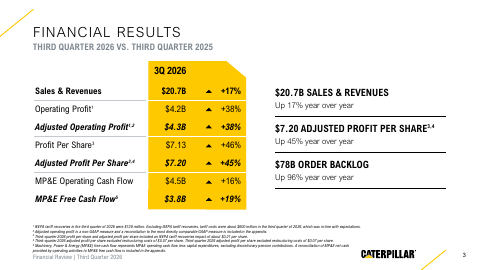
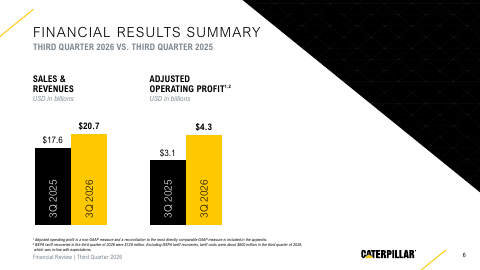
Sales and revenues were $20.7 billion, up 17% from $17.6 billion a year earlier. Profit per share was $7.13 and adjusted profit per share was $7.20, versus $4.88 and $4.95 a year ago.
Operating profit margin was 20.4% versus 17.3% a year earlier, and adjusted operating profit margin was 20.6% versus 17.5%. The quarter included $128 million of IEEPA tariff recoveries.
Power & Energy sales rose 18% to $8.784 billion, led by turbines and large reciprocating engines for data centers. Power generation sales to users rose 75%, and segment profit margin was 24.4%.
Management expects full-year sales and revenues to grow in the mid to high teens, with moderate fourth-quarter sales growth. Excluding tariff recoveries, full-year adjusted operating profit margin should be near the bottom of the target range.
Tariff costs are expected to be around $2.2 billion for 2026, and freight and capacity-expansion costs are weighing on margins. Power & Energy growth is also limited by how fast capacity comes online, and Construction Industries faces a dealer inventory drawdown in the fourth quarter.
Call recording on YouTube ↗. Official replay ↗. Timestamps jump to the moment.
Caterpillar also publishes its official transcript (PDF) ↗.
Welcome to the third quarter 2026 Caterpillar Earnings Conference Call. Please be advised that today's conference is being recorded. All lines have been placed on mute to prevent any background noise. Following the speaker's remarks, we will have a question and answer session. If you would like to ask a question, please press star, then 1 on your telephone keypad. To withdraw your question, please press star, then 1 again. I would now like to hand the conference over to your speaker today, Alex Kapper.
Thank you. Please go ahead. Thank you, Audra. Good morning, everyone, and welcome to Caterpillar's third quarter of 2026 earnings call. I'm Alex Kapper, Vice President of Investor Relations. Joining me today are Joe Creed, Chairman and CEO, Kyle Epley, Chief Financial Officer, Stephanie Boffman, Senior Vice President of the Global Finance Services Division, and Ryan Coleman, Senior Director of IR. During our call, we'll be discussing third quarter earnings release we issued earlier today. You can find our slides, the news release, and a webcast recap at investors .caterpillar .com under events and presentations.
The content of this call is protected by U .S. and international copyright law. Any rebroadcast, retransmission, reproduction, or distribution of all or part of this content without Caterpillar's prior written permission is prohibited. Moving to slide two, during our call today, we'll make forward-looking statements which are subject to risks and uncertainties. We'll also make assumptions that could cause our actual results to be different than the information we're sharing with you on this call. Please refer to our recent SEC filings and the forward-looking statements reminder in the news release for details on factors that individually or in aggregate could cause our actual results to vary materially from our forecast.
A detailed discussion of the many factors that we believe may have a material effect on our business on an ongoing basis is contained in our SEC filings. On today's call, we'll also refer to non-GAAP numbers. For any reconciliation of any non-GAAP numbers to the appropriate U .S. GAAP numbers, please see the appendix of the earnings call slides. For today's agenda, Joe will begin by sharing his perspectives about our results, and he'll highlight key initiatives across our segments.
Then he'll discuss our full-year outlook and insights about our end markets. Powell will provide a detailed overview of results and share key assumptions looking forward. We'll conclude by taking your questions. Now let's advance to slide three and turn the call over to Joe Creed.
All right. Good morning and thanks, Alex. I appreciate everyone joining us today. Our third quarter results reflect the durability of our end markets with our highest sales quarter ever, strong order rates, and a record backlog.
Our team continues to execute our strategic priorities in a dynamic environment, positioning us for a strong year. Sales and revenues were $20.7 billion, up 17 % versus the prior year, driven by strong end market demand. We delivered adjusted profit per share of $7.20, an increase of 45 % versus last year. Strong order rates across all three of our primary segments drove backlog to a record $78 billion. That's an increase of approximately $38 billion, or 96 % from the third quarter last year, and marks the fourth consecutive quarter of sequential backlog growth in all three of our primary segments.
The quarter demonstrated the team's ability to execute in a high-growth environment. Specifically, our power and energy team continue to increase production of large reciprocating engines and turbines while simultaneously expanding capacity to meet demand. The team is effectively managing the operational challenges that come with this rapid growth. Bringing additional capacity online is still the top pacing factor for growth in power and energy, so working diligently to execute our plans and meet our customers' needs. As I mentioned, sales and revenues were $20.7 billion, and they were in line with our expectations.
The increase from the prior year was primarily driven by strong growth in sales volume and favorable price realization in all three of our primary segments. Third quarter adjusted operating profit margin was 20.6%. Excluding IEEPA tariff recoveries, adjusted operating profit margin was in line with our expectations. In the third quarter, we generated MP &E free cash flow of $3.8 billion and deployed $2 billion to shareholders through share repurchases and dividends. Now I'll review third quarter retail statistics.
In power and energy, sales to users grew a robust 36%. Power generation grew 75 % driven by continued very strong demand for turbines and large reciprocating engines used in data center applications. Sales users in oil and gas increased 5 % and were driven by turbines and turbine-related services. Industrial sales users were down due to softness in the EAME region. Now for construction industries. We have one of the broadest ranges of products, technology, and services to support customers whether they prefer to own, lease, or rent equipment.
Combined with healthy construction activity, our unique position has allowed us to outpace the industry throughout the year. In the third quarter, total sales users increased 20%, marking the seventh consecutive quarter of year-over-year growth. In North America, sales users grew a robust 27 % in line with expectations. Dealer rental revenue in North America continued to grow, driving increased investment in their equipment fleets. We also saw strong customer interest in the CAT dealer-owned rental joint venture called Major Projects, which was launched last quarter.
As a reminder, Major Projects will serve customers developing large-scale infrastructure across North America, including transportation, energy, manufacturing, and data center builds. It's a supplemental national rental solution to help deliver larger size class construction equipment and capabilities where existing individual dealer rental fleets aren't sufficient to execute at scale. As a result, rental fleet loading was exceptionally strong in the third quarter, contributing significantly to sales to users growth compared with prior year when fleet loading was a slight headwind.
Even excluding the positive impact from the rental fleet loading, sales to users' growth was strong, driven by residential and non-residential construction activity. Sales to users in the EAME were above expectations, with growth driven by strength in Europe and Africa, partially offset by softness in the Middle East. In Asia-Pacific, sales to users outside of China were lower than we anticipated and declined slightly due to timing. China, however, continued to grow from a low base as we expected.
Latin America continued to grow, but at a lower rate than we anticipated. For resource industries, third quarter sales to users increased 4%, which is below our expectations. Sales to users were higher in heavy construction and quarry and aggregates, but lower in mining due to delays in shipping and commissioning. The rail decrease was driven by lower international locomotive deliveries. Turning to slide four, I'll cover a few highlights since our last earnings call, starting with power and energy.
We serve customers across the power and energy value chain, and demand for our solutions remains strong. To ensure we can meet their needs and maintain operational excellence, we're continually evaluating opportunities to repurpose underutilized facilities across our footprint. In line with that approach, we plan to use a portion of our Winston-Salem, North Carolina facility, which currently produces locomotive engines, as a second assembly and test location for the 3600 series large reciprocating engine. The footprint will support our oil and gas customers to meet the growing need for natural gas compression.
The initiative directly supports previously announced plans to increase large reciprocating engine capacity to nearly three times the 2024 level by 2030. Utilizing our existing footprint and workforce is the most cost-effective and quickest way for us to bring additional capacity online. In construction industries, we launched CAT Compact earlier this year, a key part of our strategy to reach more small contractors in the growing compact construction equipment industry. To support that growth and meet increasing customer demand, we announced a $1 billion investment to expand manufacturing capacity in Sanford, North Carolina.
The investment will create a modern, technology-enabled manufacturing environment designed to improve safety, quality, and operational performance while supporting long-term growth. The facility will incorporate advanced manufacturing technologies, automation, digital production systems, and integrated logistics capabilities to create a more connected and efficient operation. This demonstrates how we're aligning our investments to meet our 2030 targets and positioning Caterpillar for long-term profitable growth. And in resource industries, we announced last month that we're working with Luckstone to expand autonomous hauling technology across two additional Virginia operations.
The expansion follows a highly successful pilot at the Bull Run Quarry, where autonomous trucks have hauled more than 3.5 million tons since going live in November of 2024. These deployments also mark the first use of Caterpillar's autonomous technology on a CAT 775 truck, expanding our advanced autonomy capabilities beyond large mining applications and into quarry and aggregates. Through this customer collaboration, we gained insights that are helping us refine and scale our autonomous hauling solutions that deliver measurable value for operations at job sites around the world.
This expansion marks another important step towards our goal of tripling the number of CAT autonomous trucks by 2030 compared with 2024. Now on slide 5, I'll provide an update on our outlook. Our strong execution through the first nine months positions us well to meet our full year outlook. We continue to expect our full year 2026 sales and revenues to grow in the mid to high teens. Strong order rates and a growing backlog reflect continued broad-based momentum across our business, despite ongoing geopolitical uncertainty.
Excluding the favorable impact from IEEPA tariff recoveries, we continue to expect full-year adjusted operating profit margin to be near the bottom of the target range. Our full-year margin expectation reflects the strategic investments we're making to execute our growth strategy, as well as the ongoing impact of tariffs and higher freight costs due to elevated energy prices. We remain focused on delivering long-term OPEC growth, and we aim to operate around the midpoint of our adjusted operating profit margin target range over time.
We're also maintaining our MP &E free cash flow expectations to be in the top half of our annual target range. Kyle will provide additional details to you shortly. And now I'll discuss our key end markets, starting with power and energy. We continue to work closely with our customers, which allows us to understand and respond to their evolving needs. Customers' view of demand for both oil and gas and power generation remains strong. As I mentioned, backlog continues to grow due to strong order rates, and we're now taking some large reciprocating orders as far out as 2029 and turbine orders into 2030.
We continue to anticipate full-year growth in power generation for both CAT reciprocating engines and solar turbines, driven by increasing energy demand to support the data center buildout related to cloud computing and generative AI. Additionally, prime power demand continues to trend higher as customers look to Caterpillar's turbine and reciprocating engine products to support their need for power solutions. After a record year for sales in 2025, oil and gas is expected to grow moderately again this year.
Reciprocating engine sales are anticipated to increase, driven by strong demand in gas compression applications. We also see continued momentum in demand for reciprocating engine aftermarket parts. Solar turbines oil and gas sales are expected to grow, and the backlog remains healthy with solid order and inquiry activity. Demand for products and industrial applications is expected to grow moderately in 2026 as well. For construction industries, we expect strong fourth-quarter and full-year sales to users growth supported by healthy end markets.
The outlook for North America remains positive with construction spending at healthy levels. Non-residential construction investment continues to be supported by the IIJA, critical infrastructure programs, and data centers. We expect fourth-quarter dealer rental fleet loading to remain strong. However, it will contribute less to sales to users growth than in the third quarter due to lapping strong rental loading in the fourth quarter of last year. In EAME, Europe is expected to remain stable, supported by non-residential construction, while construction activity in Africa is projected to remain strong.
The Middle East continues to face challenges, and we currently anticipate only a limited impact on EAME sales to users. In Asia Pacific, outside of China, stable economic conditions are expected. In China, we anticipate moderate conditions with full-year growth in the above 10-ton excavator industry off low levels of activity. We expect full-year growth in Latin America. We're seeing continued positive momentum in resource industries, with robust order rates driving strong backlog growth. Customer product utilization is high, and the age of the fleet remains elevated.
Most key commodities remain above investment thresholds, and customers are focused on the long term. For full year 2026, we expect strong sales to users growth, primarily driven by rising demand for copper and gold, increasing activity in the Canadian oil sands, and positive dynamics in heavy construction and quarry and aggregates. We expect commissioning delays from the third quarter to catch up, which will contribute to strong sales to users growth in the fourth quarter. We continue to expect rebuild activity to increase moderately compared with last year.
Rail services are anticipated to grow for the year, and we now expect locomotive deliveries to be slightly lower year-over-year due to timing of deliveries. And finally, earlier this month, we announced that Derek York will succeed Denise Johnson as Group President of Resource Industries. I want to congratulate Denise on a remarkable career. Under her leadership, Resource Industries returned to profitability and positioned Caterpillar as an industry leader in mining autonomy and technology. I'm deeply grateful for all she's done to strengthen our relationships with customers, develop our people, and shape the future of our company.
Her impact and influence will be remembered long after her retirement. I've worked closely with Derek for well over a decade, and I'm confident in his ability to lead the RI team into its next chapter of innovation, growth, and customer success. He's a highly respected leader who understands our customers, our strategy, and the industries that we serve. With that, I'll turn it over to Kyle.
Thank you, Joe. Good morning, everyone. I'm going to take a few minutes to walk you through our third quarter results, including details about segment performance, as well as the balance sheet and cash flow.
I will finish with remarks on our expectations for the fourth quarter and current full year assumptions. Beginning on slide six, sales and revenues were $20.7 billion, up 17 % versus the prior year, which was in line with our expectations. Adjusted operating profit was $4.3 billion, and our adjusted operating profit margin was 20.6%. Excluding the IEEPA tariff recoveries, both were in line with our expectations. Moving to slide 7, the 17 % increase in sales and revenues compared to the third quarter of 2025 was primarily driven by strong growth in sales volume and favorable price realization.
The stronger sales volume was mainly driven by higher sales of equipment to end users, supported by healthy in-market demand and strong execution by our team. Dealer inventory increased by $300 million in construction industries, compared to an increase of $600 million in the third quarter of 2025. This created a modest headwind to sales volume in the quarter and was in line with our expectations. Sales and revenues both at a consolidated level and across all three primary segments were in line with our expectations.
Moving to operating profit on slide 8. Operating profit in the third quarter increased by 38 % to $4.2 billion. Adjusted operating profit of $4.3 billion also increased by 38 % versus a prior year. The adjusted operating profit margin was 20.6%, which was an increase of 310 basis points compared to the prior year. Margin benefited from the profit impact of higher sales volume and favorable price realization. This was partially offset by higher manufacturing costs, mainly driven by higher freight and higher expenses related to our capacity expansions.
In the quarter, we recognized $128 million in IEEPA tariff recoveries. Nearly all this amount is reflected in corporate items. For tariffs introduced since the beginning of 2025 and excluding IEEPA recoveries, our third quarter tariff costs were approximately $600 million, and about flat year-over-year, as we anticipated. Moving to slide 9, profit per share was $7.13 in the quarter. Adjusted profit per share was $7.20. Excluding discrete items, the provision for income taxes in the third quarter of 2026 reflected a global estimated annual effective tax rate of 23%.
Finally, the year-over-year impact from the reduction in the average number of shares outstanding due to share repurchases resulted in a favorable impact on adjusted profit per share of approximately 15 cents compared to the third quarter of 2025. On slide 10, I will now review the third quarter results of our segments, starting with power and energy. For power and energy, sales of $8.8 billion increased by 18 % versus a prior year, which was in line with our expectations.
The sales increase versus a prior year was mainly due to higher sales volume and favorable price realization. Services revenues were also strong in the quarter, especially for sales into oil and gas applications. Third quarter profit for power and energy increased by 31 % versus a prior year to $2.1 billion. The segment's margin of 24.4 % was an increase of 250 basis points versus the prior year. The increase was mainly due to the profit impact of higher sales volume.
Favorable price realization was mostly offset by unfavorable manufacturing costs, driven by spend related to our capacity expansions, including higher depreciation, along with higher freight and material costs. Segment margins matched our expectations. Now moving to slide 11. Construction industry sales increased by 18 % in the third quarter to $8 billion as we anticipated. The sales increase versus the prior year was primarily due to the higher sales volume and favorable price realization. Higher sales volume was mainly driven by sales of equipment to end users, which included strong contributions from both retail sales and rental fleet loading.
Both residential and non-residential industries contributed to the growth. Third quarter profit for construction industries was $1.8 billion, a 33 % increase versus a prior year. The segment's margin of 22.9 % was an increase of 250 basis points versus a prior year, mainly driven by favorable price realization and the profit impact of higher sales volume. This was partially offset by unfavorable manufacturing costs, including the impact of freight and tariff costs. SG &A and R &D expenses related to our digital and technology investments also increased compared to the prior year.
Segment margin was also consistent with our expectations. Turning to slide 12, resource industry sales, which were broadly in line with our expectations, increased by 15 % in the third quarter to $4.6 billion, primarily driven by higher sales volume. Price realization was also favorable versus the prior year and slightly better than our expectations, primarily driven by positive geographic mix. Third quarter profit for resource industries increased by 14 % versus the prior year to $622 million. The segment's margin of 13.5 % was roughly unchanged versus the prior year.
This was mainly driven by unfavorable manufacturing costs, primarily due to higher material costs, including tariffs, offset by the profit impact of higher sales volume and favorable price realization. Overall, the segment margin was about in line with our expectations. Moving to slide 13, financial products revenues increased by 9 % versus a prior year to $1.2 billion, mainly due to higher average earning assets across all regions. Segment profit increased by 10 % to $264 million. This increase was primarily due to a favorable impact from higher average earning assets, partially offset by a higher provision for credit losses.
Our customers' financial health remained strong. Past dues were 1.31 % in the quarter, down 16 basis points versus the prior year and remains the lowest level we have recorded since 1998. The allowance rate was 0.91 percent at the end of the third quarter. Business activity within Cat Financial remains healthy. Retail new business volume grew by 6% versus the prior year. In addition, used equipment inventory levels continue to remain low and conversion rates remain above historical averages as customers continue to choose to purchase their equipment at the end of their lease term.
Moving on to slide 14, MP &E free cash flow was $3.8 billion in the quarter. This was an increase of roughly $600 million versus a prior year, mainly driven by stronger profit. CapEx spend was about $700 million in the quarter. We deployed $2 billion to shareholders in the third quarter, of which share repurchases accounted for $1.2 billion and nearly $750 million for our quarterly dividend payment. Earlier this year, we announced our sixth consecutive year of high single-digit quarterly dividend increase, and this year will mark 33 consecutive years of paying higher annual dividends to our shareholders.
Our balance sheet remains strong. We have ample liquidity with an enterprise cash balance of $7.9 billion. In addition, there is $1.6 billion in slightly longer-dated liquid marketable securities to improve yields on our cash. Now, for outlook assumptions. Turning to slide 15, I will start with the fourth quarter. and user demand remains favorable across all three primary segments, and the team is working diligently to deliver on our commitments for the year. At the same time, we are aware of potential headwinds presented by higher cost inflation, which we continue to monitor closely.
For the fourth quarter, we anticipate moderate sales growth versus a prior year. As a reminder, we are lapping a strong quarter last year, which creates a tougher comparison this year. Now let me walk you through each of our three primary segments. In power and energy, we anticipate moderate sales growth in the fourth quarter versus the prior year, as we lap a strong prior year fourth quarter and continue to ramp capacity. Volume growth is expected to be driven by continued strength in power generation, modest growth in oil and gas, and moderate growth in industrial applications as it continues to recover.
We also expect favorable price realization. In construction industries, we expect sales to be similar to the prior year. We anticipate the typical seasonal dealer inventory reduction to be roughly $1.6 billion, which compares to a decline of $600 million in the fourth quarter of 2025. As a result, we expect the year-over-year impact to be about a $1 billion headwind to sales volume in the fourth quarter against the backdrop of continued strong sales to users and industry growth.
As a result, we expect sales volume in construction industries to be down modestly versus the prior year. However, we continue to expect favorable price realization in the fourth quarter. Despite the drawdown, we continue to expect dealer inventories at the end of the year to be higher than the prior year, in anticipation of strong sales to users in 2027. In resource industries, we expect strong sales growth in the fourth quarter versus the prior year. Volume is expected to be driven by higher sales to users and services growth.
We also anticipate favorable price realization. I will now provide some color on our fourth quarter margin expectations versus the prior year. At the enterprise level, we expect higher adjusted operating profit margin versus the prior year. This is primarily due to favorable price realization and the profit impact of higher sales volume. Excluding the impact of lower tariffs, we expect unfavorable manufacturing costs driven by higher freight as well as expenses related to our capacity expansions. SG &A and R &D expenses are also expected to be higher, driven by our continued investment in the strategic initiatives aligned with our 2030 goals.
We anticipate tariff costs excluding IEEPA recoveries of around $600 million, which is similar to what we incurred in the third quarter, but roughly $200 million lower than what we incurred in the fourth quarter of 2025. We continue to expect about 50 % of the tariffs to be incurred in construction industries and 25 % in both power and energy and resource industries. Now for our fourth quarter margin expectations in our three primary segments. In power and energy, we anticipate favorable price realization and stronger volume to drive a higher margin percentage compared to the prior year.
The higher margin compared to the prior year is expected to be partially offset by unfavorable manufacturing costs, including depreciation and expenses related to our capacity expansions, along with higher material and freight costs. We expect fourth quarter margin to be similar to the third quarter. In construction industries, we anticipate a higher margin percentage compared to the prior year, primarily due to the favorable price realization, which is partially offset by lower sales volume. Excluding the impact of lower tariffs, manufacturing costs are expected to be higher, driven by freight.
We also expect higher SG &A and R &D related to our technology investments. Also, as a reminder, our construction industry's fourth quarter margin typically has a sequential step down from the third quarter. We expect this seasonality change to be slightly more than our typical average step down due to the expected lower sale volume, higher SG &A and R &D related to our technology and digital investments, as well as higher freight costs. In resource industries, we anticipate a higher margin percentage compared to the prior year, driven by favorable price realization and the profit impact of higher sales volume, partially offset by unfavorable manufacturing costs, including freight and material.
Now on slide 16, let me provide a few comments on the full year. As Joe mentioned, we continue to anticipate sales and revenues growth in the mid to high teens for the full year 2026. Our strong full year sales and revenues expectations is supported by strong sales to users growth across all three primary segments driven by healthy end markets, strong order rates across all three primary segments driving our backlog growth, increased output from our capacity expansion plans which remain on schedule and a strong year of services growth.
Now for our adjusted operating profit margin for the full year. Compared to last year, we expect a higher adjusted operating profit margin which reflects profit impact of higher sales and favorable price realization partially offset by unfavorable manufacturing costs, including spend related to our capacity expansion, which includes higher depreciation expense, as well as higher freight. We also expect higher SG &A and R &D. Excluding IEEPA tariff recoveries, our full-year adjusted operating profit margin is expected to be near the bottom of our target range.
Excluding our reported year-to-date IEEPA tariff recoveries of about $520 million, we continue to expect full-year 2026 tariff costs of around $2.2 billion. Our outlook does not include any additional AEPA tariff recoveries in the fourth quarter. We now expect restructuring costs of about $300 million in 2026, which is on the low end of our prior range. Our estimated global annual effective tax rate remains approximately 23 % for 2026, excluding discrete items. We also continue to expect MP &E free cash flow to be in the top half of our annual target range of $6 to $15 billion.
dollars. Our CapEx spend for 2026 is now anticipated to be about 3.3 $1 billion, which is slightly below our prior of expectations of 3.5 $1 billion. Now turning to slide 17 to summarize. We delivered another very strong quarter with year-to-date financial results tracking toward another record year for Caterpillar. Our end markets remain healthy with strong order rates and a growing backlog. We continue to drive improved profitability in a dynamic operating environment. We will remain disciplined and committed to operational excellence and the O &E model.
We will continue to look for ways to invest efficiently. We will maintain a strong balance sheet and continue to return substantially all of our MP &E free cash flow to our shareholders through dividends and share repurchases over time. And finally, we will continue to execute our strategy for profitable growth. With that, we will take your questions.
We will now begin the question and answer session. If you would like to ask a question, please press star 1 on your telephone keypad to raise your hand and enter the queue.
If you would like to start your question, simply press star 1 again. Please note we are only allowing one question per analyst. Your first question comes from the line of Tammy Zakaria from JPMorgan. Your line is now open. Ms. Zakaria, your line is open. You may have your line on mute. Hearing no response, we'll go next to Rob Wertheimer with Mellius Research.
Rob Wertheimer Thanks and good morning. I had a couple of questions around PowerGen. Again, two quarters ago, you detailed some of the PrimePower projects you've done.
I think you gave gigawatt numbers. Do you have any update there? Is PrimePower still expanding for you, either in general or if you have any updates on gigawatts? And then you mentioned you're taking orders in the 29. Does that imply that 28 is sold out? Are you selling out current capacity but leaving future capacity for future orders? Can you just sort of talk about how you manage backlog there?
Yeah, good morning, Rob. We still continue to see trending higher prime power, both turbines and reciprocating gensets.
I've had a handful of discussions with customers for prime power just in this last quarter, so a lot of quoting activity continuing to go on. And I think we'll continue to see that trend as we move into the future. We're not seeing anything different in that space. When it comes to, you know, orders and sort of backlog, if it's significant order in gas prime power, we're probably looking at 2029. I mean, maybe some, you know, we'll probably still roll some diesel backup orders into 2028 when we're not completely full.
But, you know, we're still we have frame agreements in the pipeline that kind of convert to orders as we move over time. So, again, we continue to have extended backlog. I'm happy that the backlog grew in all three segments. And, you know, what we're hearing from our customers is they still want more from us if we can get them more power. So, we're trying to ramp as quickly as we can and still, you know, hit our customers' needs.
We'll go next to Tammy Zakaria at JPMorgan.
Hi, good morning. Can you hear me? We can. Hi. Thank you so much for taking my question. So I just wanted to touch on that backlog comment. I think I heard Jill say that the engines and turbine orders are now going as far out as 20, 29, 2030. So is it that the total orders you receive in the quarter are primarily for the out years or are the majority of the orders booked still for the next 12 months?
And given the new capacity that will be coming online, when would you expect this record backlog to start stepping down or is it the new normal for the backlog magnitude?
Yeah, good morning, Tammy. Thanks for the question. So, you know, I want to be clear. I mean, we're taking our orders into 29. We have some in 29 and 2030. We still have more to fill. And, you know, this is a bit of a complicated question because it's going to depend on the product, right?
So for large reciprocating engines and turbines, we're definitely extended out into late 28 into 29. Smaller gensets, smaller engines, obviously lead times are much shorter than that. And on the machine side of the business, the backlog grew in all three segments. Aside from a couple of products where we're ramping production and operationally trying to ramp production, and even in those we're not extended near as far, I would like to produce and get our production ramp closer to stews.
So when we look at the backlog, we want to make sure we're looking at the backlog in the context of sales to users and order rates and the entire system and how it works. So if we can sales to users stay healthy, which is what we're expecting, and we can produce more product, we'll continue to take orders. But I would like to see the backlog. I mean, if we can get it to even come in on the machine side because we can keep up, you know, that would be a good thing.
And I also think if you when you look at, you know, we've had a few quarters of backlog growth. I think we'll continue to see some backlog growth, but it's going to really depend. I mean, customers have time to place orders, you know, and sort of digest what we have. And so I don't know that quarter to quarter it's going to be something we look at as the singular metric. as we start to move out, especially as we get extended.
We're continuing to do long-term planning with our big data center customers and PrimePower customers. We're seeing demand for cloud compute, and our backup power continue to be strong. And then AI obviously comes in on top of that. And the PrimePower numbers, so with those frame agreements, we have a line of sight past the backlog, and we continue to talk to our customers. And then on PrimePower, those are big projects, And I think, you know, they get negotiated individually, and those can come in lumpy in the backlog, as can mining orders.
So, you know, I'm really pleased with the backlog growth we saw in this quarter. It was broad-based, oil and gas, PowerGen, you know, RI, and NCI. So we have good momentum. And just for a reference, we expect 58 % of our backlog is expected to be sold within the next 12 months. and that's comparative to 59 % last quarter.
We'll move next to Jamie Cook at Truist Securities.
Excuse me, good morning. I guess my question, Joe, is just around your longer-term margin framework that you guys have put out there.
You guys have done an exceptional job, but the margins have been pushing towards the lower end. Obviously, we have tariffs and inflationary pressures, et cetera. But like, what do you think with, you know, sort of capacity coming online and price costs in your backlog? What's like a reasonable time for us to assume we can get back towards like the mid to high end of your of your longer term target range? And what would be the major drivers behind that?
And then last, is there any way you can help us frame how much incremental capacity is coming online in 2027 on a dollar basis or any way you could frame it?
Good morning, Jamie. You know, as far as the margin target range, I've said many times I want to operate towards the middle of that range. The sales are growing at a really good clip, which is a good thing, and we've been able to, you know, do the best we can, keep up with customer demand, and it's a progressive target.
So as our margins are going up, the target continues to increase, so we're kind of skipping along the bottom. You know, I would expect, and we'll talk to you a lot more about 2027 in the next quarter, that we start to, you know, claw our way off the bottom of that margin target range as we go forward while we still try to keep up with demand. We also are trying to do this with the tariff headwind, you know, in a smart way where we're not, you know, slowing down investments that would impact the growth and the momentum we have in the business.
So, you know, I'm happy with the progress we've made. Our margins continue to go up as our volume goes up. And, you know, over the next couple of years, we want to try to work our way back to the midpoint.
Next, we'll move to David Rasso at Evercore ISI.
Hi, thank you for the time. I'm trying to figure out the revenue sequentially and what it means when we think about 27 revenue. If you look at the sequential revenue, 3 to 4Q, let's use the guide for the full year, mid to high teens, right?
Let's call it 17%. It implies the fourth quarter, even if I give you back the extra billion, right? The headwind of the dealer inventory, it implies the revenue is barely up sequentially. And, you know, over a long period of time, fourth quarter is up 5 % to 10%. I mean, it moves around. But a year where you're adding capacity, it's a big focus. And, I mean, the demand's there. You speak to it in retail. Even the backlog's still pretty solid.
Just trying to understand, is there some capacity issue, supplier issue? Why is the revenue growth so modest sequentially, especially given the capacity ads? and any implications on how to think about 27 top line would be appreciated as well.
Good morning, David. As we said in a prepared remark, on power and energy, it's really paced by capacity and time-made customer deliveries. So we're not seeing anything different in the business that we would say would impact the fourth quarter, but it is hand-to-mouth.
The teams are working really hard. We had a Tesla go down for a little bit in the third quarter that we were able to overcome, but there's no slack in the system. And then, as you mentioned, you know, and we've kind of said we're going to have the inventory drawdown in CI, which, you know, seasonally isn't unusual. It's going to be a little different than the patterns that we had last year. And then, all right, you know, we are, as we mentioned, we think operationally we're trying to ramp.
So, you know, we're going to obviously get as much product out as we can on large mining trucks and some of those products. But I don't think there's, you know, other than typical seasonality and things that we've talked about on trying to ramp production, we're pretty confident. And this is an inline, our third quarter results came in line as we expected. We haven't really changed our view for what we plan to do in the fourth quarter.
And, you know, as you think about how we're going to finish the year, again, we'll talk to you more about 2027. in January, but our backlog continues to increase. We have longer line of sight. We are drawing down CI inventory, 1.6 billion. We're going to finish the year with almost $700 million more of inventory in place than we finished 2025 heading into 2026. So, we feel good about where we sit right now.
And David, I just, this is Kyle, just to remind you, and I said in my prepared remarks, you know, when we talk about the growth, it's off a really tough comparison versus a 4Q last year just from a consolidated level and then especially from a
power and energy standpoint. But going into 2027, you know, the daily inventory increase in CI, we still expect really strong stews across all three primary segments and 4Q going into 2027.
We'll take our next question from Michael Senecker at Bank of America.
Hey, everyone. Thanks for taking my question. And just kind of following up on David Rass's question, the Q4 implying a moderate sales growth, you guys talked about the dealer D stock. I know your target is 6 % to 9 % CAGR on the revenue growth side, some years higher, some years lower to get to that average.
Just with the backlog with where it is, the framework agreements, and I understand there's a quarter dynamic with destocking, but why would the setup for 27, should we be thinking that we're above that 6 to 9 % CAGR at the higher end based on where retail sales are and where we're seeing it? What would hold us back to be in that line? I'm just kind of curious what the setup and the building blocks would look like for next year on that.
Yeah, so 2027, again, we not much different than how I answered David's question. We're finishing the year strong. We had, as Kyle mentioned, a really strong fourth quarter last year. So when we say moderate growth year over year, some of that's a comp issue. We're paced on capacity on power and energy. We think we'll continue to increase capacity. It's not a cliff event, as we've said. So every quarter, we try to get more and more product out.
We expect to continue that. When it comes to the dealer inventory drawdown. One dealers are independent businesses. Just to remind you, we do work with them. And we want to make sure we have the right inventory in the right place in the right regions of the world with the right products. And we do feel like we're in a good position heading into 2027, finishing the year with more dealer inventory in CI than we finished last year.
So RI orders continue to go up. We've had three really strong quarters in a row of orders in RI, having some operational challenges and inefficiencies as we ramp, but I think we'll continue to work those and get those behind us. So we're pretty confident and bullish in where we sit right now as we watch things. We're focused on delivering a strong fourth quarter and a strong finish to the year, and we'll talk to you guys more about 27 in January.
Next, we'll go to Chad Dillard at Bernstein.
Hey, good morning, guys. I just wanted to spend some time on the mining business. I recall from the beginning of this year, you talked about orders being the highest, I think, since 2012. So I was wondering if you could give an update on how that's trending. Talk about what's driving it more refurbishment versus replacement. And if you can just give a little bit more color on some of the ramping challenges that you're seeing.
and do you have a line of sight to seeing that being resolved in the next quarter or so?
Yeah, good morning. We've had three really good order quarters in a row for RI, which, you know, we're really happy about. As I mentioned in prepared remarks, driven a lot by mining and, you know, and both heavy construction. But in mining in particular, copper and gold, we're starting to see activity in the Canadian oil sands. You know, services are continuing to grow.
So customers are using the fleet, and we're seeing aftermarket rebuilds continue to happen, and customers are starting to order equipment. So that's all a really good sign. As we try to ramp, particularly in large mining trucks is where we've been actually increasing capacity at some of our factories where we can inside our four walls and working with the supply base to get ramped up. They're just sort of, I would say, as normal growing pains and operational challenges when you're increasing capacity and trying to get product out the door.
So, you know, we'll continue to work those. I think we'll get them behind us as we move forward. But it's a great sign that we've had this strength in orders, you know, as we've been waiting for orders to kind of pick up in mining for quite a while. So we're really happy with what we've seen in the first three months of – or the first three quarters of this year.
We'll go next to Jerry Revich at Wells Fargo Securities.
Hi, good morning everyone and congratulations to Denise and Derek. Hi, Joe, Kyle, I want to ask in terms of as you think about the production slots and lead times out to 2930 for turbines and large reciprocating engines. As you folks look at the permit requirements out that far and the counterparty is given some angst about credit in the market, can you just talk about if you've seen any shifts in timing and backlog? And I don't know if you can share what proportion of those production slots are backed by hyperscalers just to build comfort around the moving pieces given all of the use on the permitting side.
Yeah, I mean, I don't think we would quantify hyperscalers versus colos versus others or IPPs, but we work with all of them. Typically, when we roll orders from pipeline in the backlog and working with other customers, we generally have line of sight to the project that they're working on. Our teams are working closely with customers. We continue to see strong oil and gas activity as well for large engines. And so, you know, as we think of this, we've always tend to move, if we can, some slots around to meet customer needs to deliver on their projects.
And we've been doing that the last couple of years because we want to make sure we meet our customers' timeline, but also no need to get product there early. It allows us to meet more customer demand if we're getting it when they need it. And we haven't seen really any significant change in how we're working with our customers to deliver projects and product to get their project timelines. So we continue to talk to our customers. We stay close to them.
We'll follow their lead. But we're not seeing significant changes. But as I said earlier, as we're extended pretty far out, I mean, this is going to be – this is unusual for us. Typically, we've only had 12 months or less line of sight to our backlog. and now in particularly this situation, customers are placing orders pretty far out there. We have a lot of quoting activity in 2930. We've got some quoting activity even beyond as we talk to customers.
But I think they have time to firm up those orders and place the firm orders and move them into our backlog. So we'll see our backlog kind of move in a lumpy way moving forward. But we'll continue to watch sales to users, continue to watch order rates, our backlog, all in conjunction together and stay close to our customers as we move into the end of this year and into next year.
We'll move to our next question from Mig Dobre at Baird.
Yeah, thank you. Good morning. And just to follow up on these last comments, you know, if we're kind of looking at backlog progression or maybe looking at it from the perspective of book to bill, it was as high as 1.7 earlier this year, decelerated to about 1.3 and a quarter here. As you look at the fourth quarter, based on what you know, how should we think about book-to-bill here? And given that you're taking out orders into 29, maybe even 30 for solar, is there some kind of slippage in terms of bookings given how, you know, constrained from a capacity we seem to be?
Yeah, I mean, one of the things you have to look at book-to-bill is we continue to increase production as well. So our sales are continuing to go up. And as I mentioned, for certain products, you know, when you look at our backlog, all three segments are in there and all three have been growing. There's some of them we'd like to actually bring in and increase production. And so as we continue to ramp, you know, book to bill, we'll sort of move around.
And then in power and energy, again, we're extended, you know, way longer than we've ever been. And so we continue to talk to our customers. That's why it's great to have the frame agreements and sort of the pipeline view beyond what's in the backlog. You know, that's what we're using to plan with customers. And, you know, those orders are rolling in the backlog at different times as we continue to move forward. You know, RI and Prime Power Projects, as I mentioned earlier, will also probably come in in not, you know, a smooth sequential fashion.
They'll be lumpy depending on when those orders get placed because they're typically big orders. So, you know, I think we'll continue to talk to our customers. And, you know, again, you can't just look at one metric like backlog growth in a quarter or book to bill in a quarter. It has to be taken into context with continual momentum in sales to users, our ability to produce more and get more product out the door. There's a lot of things that we're watching on the health of the business, more than just book to bill and a singular backlog number.
Our next question comes from Kyle Menges at Citi.
Great. Thanks for taking my question. I would love to hear from you guys how the landscape might be changing a little bit as far as the demand you're seeing in the data center market. Maybe talk a little bit about how you're seeing things evolve in demand for turbines versus NAT gas resips and then for diesel backup. And then also, just as you're booking into the latter part of this decade and having a lot of discussions, it sounds like a lot of quoting activity to 2030 and even beyond, would love to get just some sense of how you could see your mix shifting, maybe that mix of prime versus backup, where you've
been versus maybe where that mix is heading as you look to 2030.
Yeah, as we talk to our customers, we've not seen really any change since the last quarter in our discussions with customers. We continue to see momentum in, you know, standby diesel backup, which has been the growing base of our business for quite a while, you know, before even really AI started to accelerate the growth even more, driven by a lot of demand for cloud compute.
then, you know, AI has obviously accelerated that. You know, when it comes to prime power versus diesel, you know, that's one of the things that's, you know, good about the capacity we put in place. It's pretty fungible as long as we have line of sight to those orders. You know, if you get the largest 3520, you know, that one, they're probably a little more extended on the gas 3520K. But keep in mind as well the capacity we have in place and the momentum we have, you know, it's more than just power generation.
We continue to see the momentum there, oil and gas, and I think we're going to move a lot of natural gas in the next few years and we're really strong in gas compression both at solar turbines and in our reciprocating engine business. Demand is there for that. It's for marine. And large engines also go into our mining products as well. So as the mining picks up, you know, we're excited about, you know, making sure that we can serve those customers.
And really, when you talk about, aside from diesel standby, all these other applications, as the field population grows, we need to be able to support customers in the aftermarket and grow services. So the capacity is all aligned to what we plan to have in place to meet our goals in 2030.
We'll go next to Kristen Owen at Oppenheimer.
Hi, good morning. Thank you for the question. You know, we've talked a lot about the synchronous growth within the portfolio, but I'm hoping you can maybe double-click for us on the construction side.
You called out the tough comps here in the fourth quarter, but backlog growth in construction, can you maybe help us understand or give us some color on the underlying demand, how much of that growth is going into rental for your own fleet versus third parties, and maybe some of those other sources of demand outside of rental and mega projects?
Yeah, good morning, Kristen. Yeah, we've seen really, you know, strong order rates, strong stews continue in construction.
So we're really excited about the progress we have there and the initiatives that we've announced. I think it's the seventh consecutive stew growth quarter. And, you know, we'll see as we move forward. But our goal and our strategy really is to get customers in the cabs and cab machines, whether they want to rent or lease or buy. and we're seeing customers do all three. We're really excited, you know, and we were heavy in the fleet load in the major projects fleet in the third quarter.
And, you know, basically as soon as we can get fleet on the ground, they're moving to projects. So, you know, I think that's going to be a great initiative for us to continue to drive rental. And the point of that is to supplement, if you think about that strategy, the major projects, JV, it supplements the local dealer where they wouldn't be able to get on, have the scale to get to projects before. So it drives not only major projects, but allows each of the individual dealers to be in more rental deals as they move forward as well.
So we're seeing great progress there. We're excited about Cat Compact and how we're taking care of customers in the growing compact equipment industry. And in particular, we've seen it's large infrastructure projects, high IJA spending still has a lot of money left to be spent and projects left to be completed. I'm confident we'll continue to prioritize critical infrastructure as we move forward. Data centers obviously have a little bit of a rollover into CI as well. And so we're seeing really good momentum with the CI team.
We're getting closer to customers than we ever have. And it's showing in their results. And we're seeing strength in all three of our segments right now, which is really exciting.
And today's final question comes from the line of Stephen Volkman from Jefferies.
Hey, good morning. Thanks for sneaking me in. Joe, I'm just wondering any update on the 10-megawatt MAC restart that you're doing and how we should think about that kind of ramping going forward?
Good morning, Stephen.
Yeah, we plan to ship our first units here in the fourth quarter, and we'll continue to ramp as we go through next year on restarting the 10-megawatt MAK engine and using it in power generation. I think that's going to be a great opportunity for us as we move into – we'll get started here in the fourth quarter, but as we move into 2027. So everything's on track with that program. All right. Well, that was the last question.
So I just want to say thanks for joining us today. We really appreciate your questions. And I'm really proud of our team, the Catapult team's strong performance in what's been a pretty dynamic environment as we try to ramp production, add capacity, and take care of our customers. We're well positioned to deliver a strong year and we'll continue creating long-term value for our customers and shareholders. So thank you. I'll turn it back over to Alex.
Thank you, Joe, Kyle, Stephanie, and everyone who joined us today.
A replay of our call will be available online later this morning. We'll also post a transcript on our Investor Relations website as soon as it's available. You'll also find a third quarter results video with our CFO and an SEC filing with our sales to users data. Visit investors .caterpillar .com and then click on financials to view those materials. If you have any questions, please reach out to me or Ryan Coleman. The Investor Relations general phone number is 309-675-4549.
Now let's turn it back to Audra to conclude our call.
Thank you. And that concludes our call. Thank you for joining. You may all now disconnect.