“The way I think about AI is simple. AI gives us the opportunity to make Amex membership even more valuable.”
The CEO frames AI and agentic commerce as a growth opportunity rather than a threat.

American Express (AXP) · Payments
Results filed 23 Oct 2026 · Quarter ended 30 Sep 2026 · Call 57 min · Stephen J. Squeri (CEO), Christophe (CFO)
Read the transcriptSlides (41 pages)Press release ↗Investor relations ↗
Summaries and transcripts are machine-generated and can contain errors.
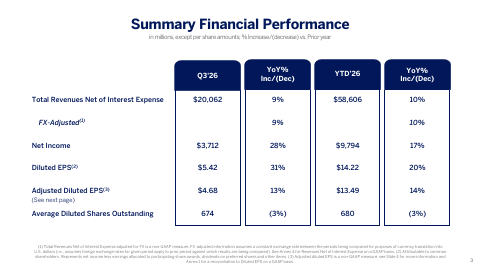
American Express delivered record Q3 revenue of $20.1 billion, up 9% YoY, as EPS rose 31% to $5.42, or 13% to $4.68 on an adjusted basis.
American Express reported third-quarter revenue of $20.1 billion, up 9% from a year ago, driven by higher Card Member spending, growing interest income and strong card fee growth. Net income was $3.7 billion, or $5.42 per share. Excluding a gain on the sale of its Global Business Travel Group stake, net of restructuring, adjusted EPS was $4.68, up 13%. Credit stayed strong, with a net write-off rate of 1.8 percent.
Management raised full-year 2026 EPS guidance to between $18.30 and $18.60 ($17.60-$17.90 adjusted) and says it is on track for another year of 10 percent revenue growth. The tension is cost and competition. Rewards and service costs are expected to moderate only after the Platinum refresh, banks keep pushing into premium cards, and AI could let customers game rewards. The company also faces a regulatory consent order from the OCC.
Open the slide deck (PDF, 41 pages) ↗

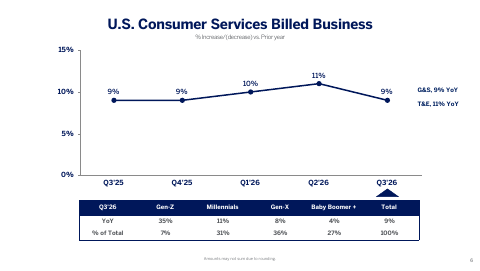
Showing the first 6 of 41 pages.
From American Express investor relations
SEC filing
up 9 percent year-over-year
compared with net income of $2.9 billion a year ago
up 31 percent from $4.14 a year ago
up 13% from a year ago
down from 1.9 percent a year ago
down from 24.1 percent a year ago
| Segment or metric | Value | Change |
|---|---|---|
| U.S. Consumer Services revenue | $9.8B | up 11% |
| Commercial Services revenue | $4.6B | up 6% |
| International Card Services revenue | $3.7B | up 10% |
| Global Merchant and Network Services revenue | $2.1B | up 6% |
| Net card fees | $3.0B | up 16% |
| Billed business (billions) | $454.0 | up 8% |
| Cards-in-force | 155.4 | up 3% |
Copied from the press release ↗ and other documents in the SEC filing ↗. A figure is published only if its sentence is in the filing.
| From the filing | Q3 2026 | vs year ago | vs last quarter |
|---|---|---|---|
| Revenue | $11.2B | +7.8% | +0.2% |
| Net income | $3.7B | +27.9% | +19.4% |
| Diluted EPS | $5.42 | +30.9% | +19.6% |
| Free cash flow | $4.4B | −20.5% | −0.8% |
Calculated by code from XBRL, not by the model.
| Metric | Period | Outlook |
|---|---|---|
| GAAP diluted EPS guidance (raised) | full-year 2026 | between $18.30 and $18.60 |
| Adjusted EPS guidance (raised) | full-year 2026 | $17.60-$17.90 |
| Revenue growth | full-year 2026 | 10 percent |
Revenue was $20.1 billion, up 9%, and EPS was $5.42, or $4.68 adjusted, up 13%.
Management now expects EPS of $18.30 to $18.60, or $17.60-$17.90 adjusted, and reaffirmed 10 percent revenue growth.
Net card fees grew 17% FX-adjusted, helped by the U.S. Platinum refresh, and were the fastest-growing revenue line.
The net write-off rate was 1.8 percent and provisions were $985 million, including a $211 million reserve release.
A $336 million restructuring charge will eliminate about 5 % of positions. The OCC penalty does not affect full-year 2026 guidance.
Fourth quarter worked out from the annual figure.
| Q4 2024 | $10.0B * |
| Q1 2025 | $9.6B |
| Q2 2025 | $10.3B |
| Q3 2025 | $10.4B |
| Q4 2025 | $10.9B * |
| Q1 2026 | $10.5B |
| Q2 2026 | $11.2B |
| Q3 2026 | $11.2B |
| Q1 2025 | $3.64 |
| Q2 2025 | $4.08 |
| Q3 2025 | $4.14 |
| Q1 2026 | $4.28 |
| Q2 2026 | $4.53 |
| Q3 2026 | $5.42 |
Fourth-quarter EPS appears once the press release is read; filings report it only for the full year.
| Q4 2024 | $5.3B |
| Q1 2025 | $4.3B |
| Q2 2025 | $3.7B |
| Q3 2025 | $5.6B |
| Q4 2025 | $2.3B |
| Q1 2026 | $2.7B |
| Q2 2026 | $4.5B |
| Q3 2026 | $4.4B |
Operating cash flow minus capital expenditure, from cash flow statements.
Each quote matches the transcript word for word.
“The way I think about AI is simple. AI gives us the opportunity to make Amex membership even more valuable.”
The CEO frames AI and agentic commerce as a growth opportunity rather than a threat.
“The orders do not impose an asset the cap on the company and the costs associated with remediation are not anticipated to affect 2027 guidance.”
Management limits the financial impact of the OCC consent order.
“we took a $336 million charge for restructuring in the quarter, which is It's expected to result in the elimination of approximately 5 % of our positions globally.”
This sizes the restructuring, which was funded from the GBTG gain.
“You should expect that VCE ratio to kind of like stabilize in this kind of rate. But the growth rate in terms of the VCE dollars to moderate significantly”
The CFO signals that customer engagement cost growth will slow once the Platinum refresh is lapped.
“For the last 15 quarters, the rate has been either 1.2 % or 1.3%. Overall provision expense was $985 million, including a reserve release of $211 million.”
It shows how stable delinquency has been and explains the lower provision.
“and we're only going to allow agents to access our systems that are either approved through API or MCP channels.”
It sets the company's risk-based policy on AI agent access.
Squeri said Amex does not compete simply on points, has no breakage model, and can adjust levers such as spend thresholds, as it did on Platinum. — Stephen J. Squeri
The CFO said engagement cost growth should moderate significantly in Q4 and supports the EPS ambition, but 2027 guidance will come in January. — Christophe, Stephen J. Squeri
Squeri said competition has not changed much, 11% international growth is still strong after 22 double-digit quarters, and Amex is getting the share of revenue it wants. — Stephen J. Squeri
Squeri said Amex will take a risk-based approach and allow only approved agents, and it is too early to judge the effect on engagement costs. — Stephen J. Squeri
Squeri said competition is highly competitive as it has been, because the segment is profitable, and it brings more people into premium products. — Stephen J. Squeri
The CFO said the ratio reflects a more premium portfolio, better new vintages, and an unchanged conservative scenario with about 8 % peak unemployment. — Christophe
The CFO said the high-teens inflection seen in Q3 was expected, but he gave no quarterly or 2027 card fee guidance. — Christophe
The CFO said revolve penetration has been stable, underwriting is unchanged, and the company does not target specific NII or balance levels. — Christophe
Squeri said small business and large multinational are strong, middle market lags, and new platforms and products aim to compete with Ramp and Brex. — Stephen J. Squeri
Squeri said surcharging has not hurt anyone's momentum, honor-all-cards changes are hard to differentiate, and Amex is now pursuing network deals with smaller and mid-sized banks. — Stephen J. Squeri
Squeri said banking is a growing part of the strategy for engaging and acquiring members, with the new business savings account as the latest step. — Stephen J. Squeri
Revenue was a record $20.1 billion, up 9%, and net income was $3.7 billion. Diluted EPS was $5.42, up 31%, or $4.68 adjusted, up 13%.
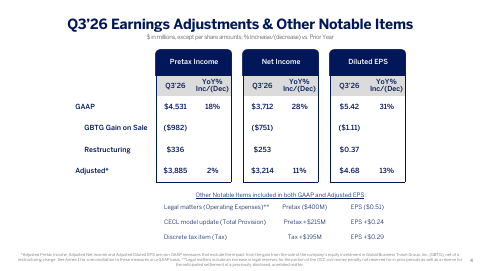
GAAP EPS includes a $982 million pre-tax gain ($751 million after-tax) from selling the GBTG stake. Adjusted EPS excludes that gain and the related restructuring charge.
It raised full-year EPS guidance to between $18.30 and $18.60 ($17.60-$17.90 adjusted) and kept its 10 percent revenue growth expectation.
The net write-off rate was 1.8 percent, down from 1.9 percent a year ago. Provisions were $985 million, including a $211 million reserve release, and delinquency has been 1.2% or 1.3% for 15 quarters.
Management cited the OCC consent order and civil money penalty, which they say do not affect 2026 guidance, and heavy competition for premium customers. They also pointed to rewards gaming with AI and engagement costs that should moderate after the Platinum refresh.
Call recording on YouTube ↗. Official replay ↗. Timestamps jump to the moment.
Welcome to the American Express Q3 2026 earnings call. At this time, all participants are on a listen-only mode until we conduct a question and answer session later on. As a reminder, today's call is being recorded. I will now turn the call over to Kartik Ramachandran, Head of Investor Relations.
Thank you, Donna, and thank you all for joining today's call. Today's discussion contains forward-looking statements about the company's future business and financial performance. These are based on management's current expectations and are subject to risks and uncertainties.
Factors that could cause actual results to differ materially from these statements are included in today's presentation slides and in our reports on file with the SEC. Today's discussion also contains non-GAAP financial measures. Comparable GAAP financial measures are included in this quarter's earnings materials as well as the prior period earnings materials discussed today. All of these are posted on our website at ir .americanexpress .com. We'll begin today with Steve Skwery, Chairman and CEO, followed by Christoph Lekajak, Chief Financial Officer.
After their remarks, we'll move to Q &A. With that, I'll turn it over to Steve.
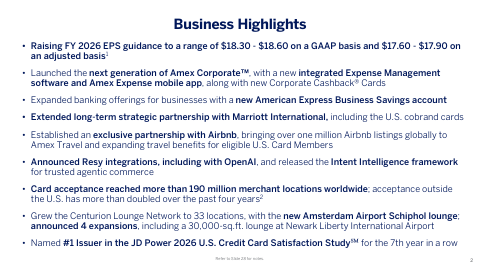
Thank you, Karthik. Good morning, and thanks for joining us. We had another strong quarter with record revenues of $20 billion of 9 % and EPS at $5.42 cents reported and $4.68 on an adjusted basis given our strong performance year to date we are reaffirming our revenue growth guidance of 10 % and raising our EPS guidance to between 1830 and 1860 on a reported basis or between 1760 and 1790 on an adjusted basis there are a number of discrete items in this quarters results Christophe will go through them in detail I'll highlight a few of them first with the
closing of the global business travel transaction in the quarter, we're dropping two-thirds of the gain to the bottom line. Excluding the impact of the gain as well as the portion of it we're using for restructuring, adjusted EPS was $4.68. Second, adjusted EPS includes an expense for legal matters, which includes the unreserved portion of the recently announced civil money penalty levied by the OCC. The fine does not impact our full year 2026 guidance. The orders do not impose an asset the cap on the company and the costs associated with remediation are not anticipated to affect 2027 guidance.
More importantly, the deficiencies cited in the consent order should not have occurred and we are accountable for addressing them thoroughly. This is critical to our future and to maintaining the trust that our customers, regulators, colleagues and investors place in us. We have earned that trust over many years and we can never take it for granted. Also this quarter, as I mentioned, we're using a portion of the gain from the global business travel transaction to continue positioning the company for long-term growth.
Our strong business performance throughout the year has enabled us to step up our marketing and technology investments, so we decided to use some of the gains to invest in making the organization more efficient and better prepared for the future. As a result, we took a $336 million charge for restructuring in the quarter, which is It's expected to result in the elimination of approximately 5 % of our positions globally. Because this quarter's charge is somewhat larger than what we typically do, I'll take a moment to provide a bit more context.
We've got good momentum, but to accelerate innovation and win over the next few years, we needed to become a more agile and efficient organization. With that objective in mind, earlier this year I asked the team to leadership team to identify ways to streamline their organizations, align their teams on the most critical deliverables, and reduce layers to speed decision-making. When completed, we believe this exercise will help us operate and execute more effectively and give us greater capacity to invest in our business priorities.
I'd also like to highlight the latest example of how we're continuing to invest in our membership model to enhance its value to our card members. Yesterday's announcement of our exclusive partnership with Airbnb, which follows the recent announcements of new and expanded Centurion Lounges and our Next Generation Corporate Card and Expense Management Program. We know that card members enjoy the exceptional variety and scope of Airbnb's network of unique locations, and we're excited to bring over 1 million listings globally into our Amex Travel Program, as well as expanding travel benefits for eligible U .S.
card members. Next, I'd like to talk about how we're thinking about AI and the rise of AI assistance. There's been a lot of talk about how companies are using AI to increase productivity, automate processes, and generally make their organizations more efficient. We're using AI to do all of those things, too. But I want to talk about AI and agentic commerce from the customer's perspective, how their experience will evolve, and what it means for American Express. It's still early in the game.
Agentic transaction volumes are still small, but the direction is clear. AI is fundamentally changing how consumers and businesses discover, compare, decide, pay, and manage their finances and their lives. But while AI agents are able to act on customers' behalf, that doesn't change who the customer is. Our customer remains the card member, and the job remains the same, deliver differentiated value and have their back. The way I think about AI is simple. AI gives us the opportunity to make Amex membership even more valuable.
We are well-positioned to do just that. Our differentiated assets, closed-loop network, first-party data, and brand built on trust, security, and service are even greater advantages in an AI world. Our goal is to have membership travel with our card members throughout these new AI-powered experiences, shaping recommendations, securing payments, activating the right value, and supporting the customer after all. In other words, we want to become even more essential to our customers, continuing to embed Amex membership where decisions happen.
That's the key idea between the five key areas we're using AI to enhance the customer experience. First, value propositions. Amex membership is all-encompassing. It's a combination of the unique access, benefits, experiences, rewards, convenience, world-class partnerships, and great service we offer our card members. AI uses the opportunity to take our value propositions much further, combining the proprietary insights from our closed loop, our partner relationships, and access to membership experiences to create entirely new forms of value that are more personalized and differentiated than ever before.
Take dining. Through Resy and our restaurant partnerships, we are already giving eligible card members access to sought-after restaurants and exclusive experiences. We're now using AI to combine that ecosystem with our understanding of individual card members' tastes and preferences. Our dining companion, for example, uses insights from card member spending to make personalized restaurant recommendations. Looking ahead, we can imagine using AI to better understand the kinds of experiences different card members would enjoy, and then working with our restaurant partners to create distinctive experiences tailored to those interests at a level of personalization scale we couldn't achieve before.
That's the opportunity. Taking something American Express already does exceptionally well and leveraging cutting-edge technology to make it even more personal, relevant, and differentiated. Second, customer acquisition. As AI changes how customers search and choose financial products, our ambition is to help shape the discovery and decision-making process, ensuring that the full value of American Express membership is clear and compelling wherever prospective customers are exploring options. We're evolving how we reach prospective customers in this new environment, rethinking traditional search and digital channels, optimizing how our products and benefits are discovered and represented by AI platforms and developing new ways to reach customers through LLMs and agents.
At the same time, we're transforming our marketing and acquisition engine. By combining AI and our proprietary data, we can better identify the right prospects, match them with relevant products and offers, and create more personalized shopping, product application and onboarding experiences. Our goal is to make becoming an American Express member increasingly seamless and tailored to the individual, helping us attract more high-quality customers, improve conversion, and make every marketing dollar work harder. Third, engagement. AI gives us the opportunity to fundamentally change how card members experience membership, making it more proactive, personalized, and relevant throughout their lives.
While we'll do this within our own channels and through partnering with leading AI companies to make our membership assets available through their platforms customers use to discover, plan, and make decisions. Let me give you a few examples. We're deepening our partnership with OpenAI to continue bringing Amex card membership into ChatGPT. Earlier this year, we launched Resy Restaurant Discovery and Reservations in ChatGPT and and are working with OpenAI to launch an Amex plugin that will enable card members to discover and enroll in Amex offers.
We continue to collaborate closely on the future of payments and have built proprietary dining and hotel conversational experiences that use OpenAI models. In our own channels, Wishlist Builder and our travel app uses AI to help customers discover hotels and plan trips. And through our partnership with Perplexity, eligible business card members can now access Amex curated AI tools for tasks like cash flow forecasting and creating marketing campaigns. Our vision is for Amex membership to become an intelligent, personalized experience, proactively bringing the right experiences and benefits to card members at the right moment wherever their journey begins.
Fourth, payments. As AI agents begin to transact on behalf of customers, trust and security become even more important. Our ambition is to make American Express the trusted way to pay across AI ecosystems, ensuring that card members remain in control and that the protections and differentiated value they expect from us extend into this new way to pay. Right now, we're helping to shape the standards for trusted agentic payments. The principle is straightforward. We need to know who the agent is, what the customer has authorized it to do, and have a secure way to complete the payment.
The transaction of the future will carry more than a payment credential, it will carry context. We outlined the capabilities we're building in our Agenting Commerce Experiences, or ACE, Developer Kit, we published in the second quarter, and we're working with several leading AI companies on integrating ACE into their platforms to enable agent-powered transactions. Earlier this month, we also released our intent intelligence framework that sets forth a standard to help ensure customer purchase intent is authenticated and preserved.
And we're developing agent purchase protection to extend the backing of American Express to eligible purchases when registered agents share intent data and then make mistakes. As both a network and an issuer, we are uniquely positioned to connect the card member, the agent, and the merchant throughout the transaction journey. Our near-term focus is on building these capabilities and integrating with leading partners, but the longer-term opportunity is much bigger, ensuring that whenever and however customers choose to transact, they can do so with confidence, control, and the membership value and backing they expect from American Express.
And fifth, servicing. Service has always been a defining part of American Express membership. We intend to combine AI's speed, personalization, and proactive capabilities with the empathy, expertise, and judgment of our colleagues, so customers get faster, more seamless service when their needs are straightforward and exceptional personal support when it matters most. We've been deploying a broad suite of AI tools that help our colleagues access the right information, understand customer needs, develop personalized recommendations, and resolve issues more effectively.
We're also expanding the use of AI to strengthen our capabilities in areas like complaints and disputes to identify issues earlier, understand root causes, improve decision-making, and resolve problems faster. And we recently launched our first few conversational AI voice agents. Looking ahead, we want to move beyond responding to requests to anticipating and resolving customers' needs end-to-end. That means delivering even more seamless service across channels, addressing issues before customers need to reach out, and using insights from every interaction to continually improve the customer experience.
Ultimately, we see AI as a powerful accelerator of our long-term growth strategy. It gives us new opportunities to make membership more valuable, attract and engage more customers, drive more of their spend, and serve them more effectively. We're still in the early stages and will continue to invest with discipline, but we believe AI enables us to build on the competitive strengths we've developed over decades and drive sustainable, profitable growth for years to come. To wrap up, the company continues to perform well.
We are fortunate to have a premium customer base which continues to show great strength and stability. We have good momentum and our financial results continue to be strong. The progress we're making across the business together with our talented colleagues who are focused on delivering the best customer experience every day gives me great confidence in the future. We are on track to deliver another year of 10 % revenue growth and mid-team DPS growth. And more importantly, we have momentum to sustain strong results in the years ahead.
I'll now turn it over to Christophe.
Thanks, Steve, and good morning, everyone. Q3 was another strong quarter, and we continue to see good momentum across the business. Customer behavior looked very similar to what we've seen over the past year. strong and consistent spend growth, especially in the T &E categories, balanced growth in line with spend, high retention rates, and excellent credit performance. Strength and stability in customer behavior drove revenue up 9 % year-over-year, with net card fee growth accelerating to 17 % effects adjusted.
This quarter reflected stable VCE engagement, discipline operating expenses, and continued investment in future growth. We reported gap EPS of $5.42 this quarter, up 31%. Before getting into the business trends, let me walk through EPS in more detail. There are several adjusted and notable items this quarter, and I want to be clear about their impact on our results. First, the sale of our investments in the Global Business Travel Group resulted in a gain of $1.11 per share.
Second, as we previously said, we expected to use a portion of the gain to support the company's long-term growth, and consistent with that objective, we have taken a restructuring charge of $0.37 per share. Adjusting for the global business travel group gain and the restructuring charge, EPS was $4.68, up 13 % year-over-year. The adjusted EPS includes three other notable items this quarter. First, an increase in legal reserves of 51 cents, which includes the remaining portion of the OCC civil money penalty that was not previously reserved for, as well as a reserve for the anticipated settlement of an unrelated matter.
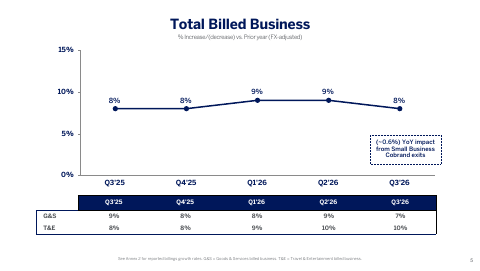
The second item is a discrete tax benefit of 29 cents per share. And finally, a $0.24 benefit from the most recent updates to the sea solar reserve models. Combined, these three items had no meaningful impact on the adjusted EPS this quarter. Turning to bill business, overall spend was 8 % this quarter, in line with the trend of the past four quarters. This quarter included about a 60 basis point year-over-year impact from the co-brand exits that I previously discussed, with the Amazon co-brand portfolio sale happening midway through the quarter.
Sequentially, spend growth also saw a small impact from the last quarter's Amazon Prime Day and other promotional retail days in the U .S. These impacts were mostly concentrated in goods and services, which grew 7 % this quarter. Discretionary spending was strong, with T &E up 10 % year-over-year. Airline spending accelerated to 13%, while restaurants, our largest T &E category, saw spend growth of 9%. U .S. consumer spending was up 9.4 % this quarter, reflecting the continued strength in our premium customer base.
While growth moderated slightly through Q2, it was in line with Q1 and continues to run above the levels we saw in 2024 and 2025. In fact, Q3 is the third highest quarterly growth rate in three years. One year after the U .S. consumer platinum refresh, spend retention remains at 99 % for the portfolio. Turning to commercial, spend was up 3 % this quarter. Excluding the impact that the co-brand portfolio exists, spend growth was 5 % for the second consecutive quarter.
We're seeing strong take-up on the graphite card that we launched earlier this year. And looking ahead, our new corporate cashback card and integrated expense management capabilities will give us additional opportunities to drive engagement and spend growth. Spent growth in international was up 11%. Merchant coverage now reaches over 190 million locations globally, up from 160 million a year ago. Outside the U .S., the number of locations accepting Annex has more than doubled over the last four years.
We are pleased with the outcomes of our investments in customer acquisition and driving greater engagement from our existing card members. We acquired 3.1 million new cards in the quarter, with 76 % of new accounts on fee-paying products. Turning to balances and credit on page 10. Total balances increased 8 % year-over-year in line with bill business. Importantly, we continue to grow balances from our premium customer base while maintaining best-in-class credit results.
This is very much by design, reflecting our focus on attracting highly credit-worthy customers who both spend and borrow with us. And the quality of those customers is reflected not only in our credit performance, but also in the economics of our lending business. In fact, this quarter is a good illustration of this dynamic. Balances grew 8%, NII grew at a faster rate at 10%, and ride-off dollars only grew at 3%. Delinquency rate remained very low and stable.
For the last 15 quarters, the rate has been either 1.2 % or 1.3%. Overall provision expense was $985 million, including a reserve release of $211 million. The reserve release was driven by enhancements to our CISL models. We feel very good about the quality of our credit performance and the stability we see in the portfolio. Turning now to revenue. Revenue was $20.1 billion, up 9 % year-over-year. Revenue growth would have been about a one-point higher, excluding the impact of the small business core rent portfolio exits.
Net interest income was up 10 % this quarter, continuing to grow faster than balances. NII growth in the quarter at about a 2 % point impact year-over-year from the core grant portfolio exits. Net car fees continue to be our fastest growing revenue line. As expected, we've seen an acceleration in growth to 17 % FX adjusted this quarter, supported by the very strong results we've seen on the U .S. Platinum refresh. Turning now to expenses.
The VCE to revenue ratio was 44.3 % this quarter. We are beginning to see growth in car member services moderate following the step up from the Platinum refresh last year. Looking ahead, we expect VCE growth to moderate significantly in Q4 as we fully lock the Platinum refresh. Returning to growth rates more consistent with what we saw before the refresh. We are also continuing to evolve our value propositions in ways that enhance the customer experience and support attractive product economics.
For example, we recently introduced membership rewards redemption for statement balances, which has seen strong adoption. This feature provides car members with greater flexibility in how they use their rewards, while also supporting the overall economics of the program. Marketing expense was up 11%, reflecting the additional investments we made in customer acquisition following our strong performance in the first half of the year. On page 18, we can see operating expenses were down 3 % year-over-year, reflecting the notable items I mentioned earlier.
Excluding the global business travel group game, restructuring and legal items, underlying OPEX growth was 3%. As Steve said earlier, we have invested significantly in strengthening risk and controls in the past few years, and we will do what's needed to establish a durable and effective program that meets our own and our regulators' expectations. The ongoing investments are in our run rate, and we do not expect the additional cost to impact our 2027 guidance. Before closing, let me address one of the most recurring questions we get about our margins and how they have evolved over the past years, especially as we ramp up marketing and technology spend and invested in richer value propositions via the VCE expenses.
The decisions we make are profitability-based and aim at maximizing risk-adjusted returns and capital generation. Page 19 shows our ROE over the last 16 years. As you can see, we have increased the ROE from an average of 25 % to 28 % 10 years ago to around 35 % more recently. And over this period of time, we are on track to more than double the size of our revenue and triple EPS. At the same time, we have also reduced the share count by over a quarter.
This performance can be tracked back to our spend and fee-based model, characterized by high loyalty and engagement, greater differentiation versus competitors, lower credit risk, including in distress, lower capital intensity, and higher operating leverage from scale. These results in very strong capital generation that we return to shareholders. In Q3 specifically, we returned $2.2 billion of capital to shareholders, including $1.6 billion of share repurchase and $0.6 billion of dividends. And we ended the quarter with a CET1 ratio of 10.9%, reflecting the gain from the sale of GBTG that happened at the end of the quarter.
That brings me to guidance. Given our performance year-to-date, we are reaffirming our full-year revenue growth guidance of 10 % and raising EPS guidance to a range of 1830 to 1860 and 1760 to 1790 on an adjusted basis. With that, I'll turn the call back over to Karthik, and we'll take your questions.
Thank you, Christoph. We will now start the Q &A session. We ask that you please limit yourself to just one question. Thank you for your cooperation.
Operator?
Ladies and gentlemen, if you wish to ask a question, please press star then 1 on your touchtone phone. You'll hear a tone indicating that you've been placed in queue. You may remove yourself from the queue at any time by pressing star then 2. If you're using a speakerphone, please pick up the handset before pressing the numbers. Our first question is coming from Sanjay Sakrani of KBW. Please go ahead.
Thank you. Good morning. Steve, definitely appreciated all your comments on the Agenda Commerce and all the initiatives you guys have.
I guess one of the concerns that I've been hearing quite a bit about from investors is just how people might gamify rewards and allocate their spending to the highest rewards benefit. So to the extent that that would happen, right, how would you guys adjust your model, or is there something that you guys can do offensively to, you know, stay on the offensive?
Thanks for the question, Sanjay. I think, look, customers have always had the ability to optimize across carts.
And our strategy really hasn't been to really compete simply on points or rational rewards. And, you know, I think the other thing that's important to understand is we really don't have a breakage model. So we don't benefit when people don't use our rewards. I think that when you think about the closed loop and the ability to even match our card members' desires and our merchants' desires, I think that gives us a huge advantage. And I think our overall model is so much more than just about points.
It's access. It's service. It is security, which I think service and security in AI is going to be even more important. And it's one of the reasons that when I decided what we were going to talk about today, everybody, you know, talks about AI from an efficiency perspective and expense reduction productivity, which is very, very important. But what I wanted to do was to sort of demonstrate across the five key dimensions how it will actually be an accelerator for us.
And the last thing I'll say is when we've had gamification or when we've had people that do certain things, we have levers within our model, and we've shown this with the platinum card where we can get to spend thresholds that require those benefits to be made, which which then sort of eliminates that ability to game the system. So I think we have a lot of tools at our disposal, but I think the most important tool we have at our disposal is our card members that love our product and love what our product does for them.
So, but again, like anything else, we'll see how it all plays out.
The next question is coming from Ryan Nash of Goldman Sachs. Please go ahead. Good morning, everyone. Good morning, Ryan. Good morning. Good morning, Steve. How are you? Great to hear.
So, as you think about spending across the company, Christoph obviously spoke about the strength versus history. You know, maybe just talk about what you're saying, can you, you know, maintain this kind of level? And then, given Christoph's comments regarding the moderating of these CEs, can you maybe just talk big picture about the potential for mid-teens EPS into next year and your confidence
So let me start with that.
So on the VCE, so the VCE is performing as we expected. And as you know, this quarter is the quarter we're going to lap the Platinum Refresh, which is the event that created the step up in the VCE ratio. So as you think about going forward, and Q4 is going to be a good example for that, You should expect that VCE ratio to kind of like stabilize in this kind of rate. But the growth rate in terms of the VCE dollars to moderate significantly and, you know, to be more consistent with what we saw pre-refresh.
And, you know, we're not going to get into guidance for 2027 at this stage, Ryan. You're going to have to wait for January for that. but either like that is going to help us maintain that meeting CPS ambition that we have been using for years to think about the performance of this company so I feel good about that and I will say I will add one more point on the VCE to Steve's comment here, we introduced this quarter amount based redemption which is like a very convenient way for members to redeem their points, and we saw a very strong takeout for this.
So convenience is also a very important feature here in terms of those VCE and our ability to control that expense. In terms of the spend, listen, we see, you know, there is a bit of noise this quarter because of the impact coming from the sale of this co-brand portfolio. So that creates some discontinuity in the trends. Obviously, we have a lot more information that you have, but when we control for that, we're very pleased with that, you know, with those trends.
In this U .S. consumer segment, we're reporting this quarter 9.4 % spend growth. It is the third highest we've seen over the last three years, and that is despite the timing of the Amazon Prime Days. And it's not only Amazon, as a matter of fact, because, you know, large retailers, you know, kind of like follow the similar schedule. So, so despite that headwind that kind of like, you know, created a lift in Q2 and a bit of a, you know, downward trend in Q3, we're seeing 9.4 % billing growth and very strong growth in discretionary categories such as T &E and airlines.
So, you know, a lot of momentum and strength, you know, in our billings.
Yeah, and the only other thing I'd say is that, you know, as Christoph said, airline spending was really high. Restaurant spending continues, you know, to be high. It was up 9%. It's the largest heating category. But just to highlight, Resy restaurants were up 18%. And then when you go and look at the fine hotels and resorts and the hotel collection, that's up 50%.
And so that's just another example of when you marry our card members with our merchants through our programs, how, you know, you get, you just get more than one plus one equals two. And so those are the kind of things that I think, you know, will continue to help drive growth for us as well.
The next question is coming from Don Fandetti of Wells Fargo. Please go ahead.
All right. Good morning. Steve, you know, if you look at...
If you look at the banks, they're just continuing to press hard into the premium segment, you know, adding billions to the marketing budget. I wanted to just get your sense on how you're thinking about market share and U .S. consumer. And then can you comment on the moderation and the international bill business?
Yes. Let me go with the second one first. You know, look, it's 22 straight quarters of a double-digit growth rate international. You know, we went from 13 to 11.
Let's see, we'll see how that plays out, but, you know, 11 % growth is still very strong growth. And, you know, the demographic from a card acquisition perspective, which still continues to be strong, is predominantly, you know, millennials and Gen Z. As far as the competitive frame, you know, look, the competitive frame, it really hasn't changed all that much. I mean, people, you know, there's a lot more, I think there's a lot more talk about it now, but it's been a battle for 10 years.
And, you know, people continue to step up their game, but we continue to step up our game as well. And so, you know, obviously we've increased our marketing budget over time, but as a result of that we've also increased our revenue. And let me also be clear about one thing. When we look at the premium segment, we're looking from a revenue perspective. And what we're looking for is sort of that three-legged stool, right? Obviously, we drive spend.
We drive tremendous, you know, card fee income. We're, you know, at $3 billion for the quarter, up 17 % year over year, and we continue down that path. And so, and then obviously, you know, our premium card members want to revolve, and they are revolving, and we're taking advantage of that. And not only do we take advantage of that, but we take advantage of that with best in class credit performance. And so, I think the challenge or the thing that we continue to face is continue to innovate.
And I think we've been doing that. We've been doing that, as you see, across multiple segments, whether it's how we're We're embedding AI within some of the value propositions. The Airbnb announcement yesterday, which we're very excited about. And then, you know, you just look from a corporate and a small business perspective. And so, yeah, it's competitive and, you know, it keeps us on our toes, but we continue to do well and we're getting the share of revenue that we're looking to get, and the results show that.
The next question is coming from Erica Najarian of UBS. Please go ahead.
Hi. Thank you so much for taking my question. Hello. Steve, really appreciate that you sort of addressed, you know, the topic at hand up front. Rewards maxing was not part of my lexicon until recently. I guess I'm wondering, you know, given that you're planning to be at the forefront of AI, you know, that leads us to conclude that, you know, unlike some financial institutions that are blocking access from the bots, you will allow AI to be part of the ecosystem and therefore allow your, you know, your members to help them, you know, maximize their experience.
Is there sort of a financial measure that investors can think of, you know, about the future impact, whether it's, you know, you know, helping us, you know, understand, you know, how much of the benefits are already used or optimized and, you know, if AI increases that enjoyment of benefits, does that impact the VCE percentage, but then there's a revenue offset? Like, I guess like investors are also thinking about, you know, what the financial impact could be of this rewards maxing.
Yeah. All right. Well, you started out with not rewards maxing in Ole Missycon, and we ended with lots of rewards maxing. So let me give you my perspective on sort of, you know, AI overall. And, you know, I'll just try and summarize some of the things that I said. But I think when you take a step back, you have to embrace AI. And you have to embrace it, and you have to do what your customers want to do.
Having said that, I think in terms of you've heard a lot about banks that are blocking, and look, we're going to take a risk-based approach too. We're just not going to let assistance run rogue through our systems, and that's not going to happen. We need to protect our customers, merchants, and we're only going to allow agents to access our systems that are either approved through API or MCP channels. We're also focused on providing a very consistent membership experience, meaning we don't want AI agents to be pinging Resy every four seconds and disadvantaging our other card members are we still on one an echo okay anyway so we're going to be selectively selectively looking at agents and how they act
having said that as I said within within in my remarks earlier, I think there's going to be opportunities for us to embed our AI, our own agents within AI platforms. We're doing that today. And what we want to do is make sure that on these AI platforms, our assets are discoverable, much like we're doing with OpenAI, with, you know, with Resy, and like we'll do with our own things like Wish Builder. I think in terms of rewards maximization, we've got a lot of gaming today that goes on and it's part of the overall mix.
But I think with AI, as it might allow people to game a little more, it also will allow us to manage it a little bit better as well by using AI tools to understand what people are doing and then how do we modify our value proposition. You've seen us do this. You've seen us do this with the $75 ,000 limit in terms of passes for Platinum Card, and you'll see other controls that are put into the system.
I think it's a little too early in the game to determine what the impact will be on VCE, but what I also would say is, you know, when you look at the entire model, card member engagement is so important to us. And as people continue to engage with our benefits, we tend to get a higher share of wallet. We get better credit benefits out of this. And I think ultimately, engagement leads to a better outcome for American Express.
Thank you. The next question is coming from Bill Krakachi of Piper Sandler. Please go ahead. Hey, Bill.
Hey. Good morning. So, you guys have faced many waves of competition for premium card members in the past. But I'd love your thoughts on any changes you might be seeing in the competitive intensity in the current environment. Does it feel any different today, particularly with players like Capital One now operating a closed loop, you know, generating higher returns and having historically demonstrated a willingness to step up investments to prioritize their long-term positioning, even if that means compromising near-term profitability?
Just would really love any insights that you can share on what you're watching there. That would be great.
I mean, look, I think Citi, Capital One, Chase, everybody is sort of playing in this space. To be honest, we really don't see much difference than what we've seen. It's highly competitive. It's been highly competitive. And our assumption is it will remain highly competitive. It's highly competitive because it's a very profitable segment of the card base. The other thing I think that this competition does, which a lot of people lose focus of, there's a subset of card members that have premium characteristics but don't look at themselves as premium card members necessarily.
And so it's introduced more people into that part of the TAM, which may not have been there before. They're creditworthy enough, but they weren't taking, you know, they weren't participating in, you know, with those products and services. And I think that's worked out well for everybody.
Our next question is coming from Rob Wild, Hack of Autonomous Research. Please go ahead. Hi, guys. Hey, Rob. Hey, Rob.
I wanted to ask about the allowance coverage ratio in the context of the growth in NII and lending imbalances down to 2.6 now.
You have the CISO model adjustment remixing the higher-end borrowers, and we can see the scenarios in the back of the deck, but I guess the question is how much does the 2.6 reflect any conservatism with respect to the broader environment, or maybe to ask the question another way, is there any color you can get from what you think like a normal environment allowance coverage ratio might be?
So, I'll take that question. And so, yes, in the appendix, we're showing, you know, in a simplified way the, you know, the scenarios, the economic scenarios we're using.
And I guess you're focusing on, you know, the downside scenario. I don't have the numbers in front of me, but I think we're assuming like some kind of like peak unemployment in the like 8 % range, right? And so it's a pretty aggressive scenario. Listen, you know, the fundamental dynamic here and why their reserve rate is at 2.6 and it's below where we were when we introduced CECL, I think it was in 2020. The key dynamic here is the premiumization of the portfolio.
As, you know, we focus more on fee-paying card members, as we focus more on VCE, we are attracting, you know, card members and, you know, that have a great credit profile. And that, you know, you're slowly improving the credit metrics across the portfolio. You see that as well in the write-off rate that we're reporting this quarter and the delinquency rate. The delinquency rate are not only best in class, they've been stable at 1.2%, 1.3 % for 15 quarters, right?
And, you know, when you look at by vintage, you know, the new vintages are performing better from a credit standpoint than the past vintages. And you can track that again to, you know, their positive selection that happens in our acquisition marketing engine. Another metric that we report every quarter is the percentage of those new accounts joining the franchise on a fee-paying product, which is a good indicator as well of the premiumness of that vintage. And it's the highest I think we've seen since we reported that metric at 76%, right?
And so fundamentally, Rob, what's happening here is that, of course, we are, you know, very disciplined in our underwriting decisions. but safely but surely the portfolio is getting more and more premium by the day. And we keep, you know, we haven't changed the kind of like economic scenarios that we use in terms of, you know, the conservative scenario over the past years. And, you know, that's what's driving, you know, the performance on CECL.
The next question is coming from John Pancari of Evercore ISI.
Please go ahead. Good morning. Good morning, John.
I'm just on the card fee front. I know you noted last quarter that card fees should grow in high teens in the fourth quarter. You didn't seem to put that in your slide deck this quarter, but I believe Stevie just mentioned that you should continue down that path in that you mentioned the 17 % third quarter. So, is there any change there in how you're thinking about the fourth quarter or how you think about maybe if you can also elaborate on, I know you're not giving 27 yet, but how you're thinking about that pace as you progress through 27, just given the dynamics that you're seeing in the space?
Thanks.
Yes, I'll take the question, John. Good morning. So, on the card fee, you might remember we entered the year saying you should expect a downward trend or moderation in terms of the growth rate. And then in the end of the year, the second half of the year, you should expect an inflection point and exit in the high teens. We saw that inflection point this quarter, right? And, you know, you saw it like we were at 15 % in Q2, and this quarter we are at 17 % effects adjusted.
So that's the inflection point that we were expecting and that we saw. I'm not going to give you guidance about how to think about this 27 card fee. Again, you're going to have to wait until January for that. And we also don't give quarterly guidance on card fee. But if you take a step back, the performance of this line has been amazing since 2019, since we started focusing more of our energy investments, innovation towards premium products and fee-paying experiences and customers.
And that 17 % is amazing. The fact that we are able to accelerate it again is remarkable. And it's the fastest-growing line we have in the P &L. And it's definitely a key contributor as well to their very strong ROE performance. So we're going to keep, you know, focusing on this, and we'll update you in terms of how to think about that growth rate when we get to, you know, 2027 at the beginning of the year.
The next question is coming from Terry Ma of Barclays. Please go ahead. Hi, sir. Good morning, Terry. Hey. Good morning.
So you've talked in the past about the opportunities to capture more borrowing share from your existing premium customers. Are you seeing any meaningful change in revolve behavior? And just how much more runway do you see to grow lending faster without changing the credit profile of the franchise?
Yeah. So, you know, in terms of the boring, you know, our – I don't think we report regularly our penetration rate here, but it has been stable, I would say, over the past years.
You know, what matters to us is that we meet the needs of our con members, right? And if they want to borrow, we're there for them. If they don't want to borrow, then so be it. We don't need them to borrow for us to have a profitable relationship. That has been our mantra for years. It remains our mantra. And of course, NII plays an important role in our economics, but we're not changing our underwriting approach here.
And what we've seen as well in terms of penetrating the wallet of our Cod members is that the The better, you know, like the more spend we capture and, you know, the more premium the product is, the more likely we are to capture the revolve and to meet the revolving needs of our con members. So our strategy remains the same, right? Serve our customer the best way we can. Focus on premium customers. Meet their borrowed needs when they have some.
And that's our approach. We are not kind of like targeting a specific number in terms of NII or in terms of AR balances.
The next question is coming from Darren Peller of Wolf Research. Please go ahead. Good morning. Morning, Darren. Hey, good morning, guys. Thanks.
Can you just retouch again on the competitive landscape around commercial for a moment? And I know you mentioned a bit more about premium, but just revisiting your initiatives, what kind of progress and milestones you'd like to see in terms of some element of an acceleration potential in the overall segment volume, and then maybe just business milestones as well as you integrate more of the platforms you've brought on.
Thanks.
Yeah, so I think that when you look at the commercial space, there's really three segments. One we call SME, but it's really small, and it's also middle, and then you've got corporate. I think small continues to perform very, very strong. And we're doing quite well there. I think our cashback product that we launched, you know, a couple quarters ago, last quarter, has performed, the graphite product has performed a lot better than we even anticipated it performing.
I think then you have the large and the multinational, and that continues to be a real sweet spot for us. and it's growing exactly as we would expect it to grow. I mean, that's traditionally a T &E piece. I think where the competitive piece is is really within the middle market piece there, and that's where I think, you know, from our perspective, we have not grown the way we've wanted to grow, and that's why we did the center acquisition.
And with the center acquisition and the platform that that sits on as Nova, the launch of our business savings account, the launch of our corporate cash back program, corporate liability within that segment. These are things that we needed to more effectively compete with RAMP and with BREX. And I think those are two of the big competitors that are out there. And what they unlocked in this segment was sort of the automation and the expense management piece of this, And then, obviously, the introduction of agents within.
And so what you'll see from us as we move forward, you will see the introduction into this platform of more agents that will help middle and larger businesses do their work. And you will see us then sort of make all of these products and services available to the back book. And so I think it'll take a little bit of – it'll continue to take a little bit of time, but we feel we are not only a better position than we were at this time a year ago, but we're also got the roadmap as we move forward here to continue to make these capabilities available to a wider base of our middle market and large customers.
The next question is coming from Mihir Bhatia of Bank of America. Please go ahead. Good morning. Hi. Good morning.
Thank you for taking my question. I wanted to maybe touch on the Visa Mastercard settlement. That's been in the news again this week. You know, it's expectations that it might get approved soon. So I wanted to ask specifically for you all in terms of, I guess, a two-part question. One is just in terms of the settlement and if it relaxes, as it relaxes on all cards, expands surcharging.
Do you expect there to be a change in merchant behavior from that? And how are you thinking about the competitive implications proposed from that settlement? And part of the reason I asked is it feels like there's been momentum in your network business this year with more pure network-type deals being announced, whether it was, you know, NFL or Lowe's, and I think there was another one last week. So what brings you, you're rethinking your network business and the implications of the settlement.
Okay. So I think, look, I think from a network perspective, you know, I think we've really pivoted from a strategy in that we're looking at, and I'll try and say this the best way possible, but we're not looking to partner with the bigger banks. I think we made a lot of efforts to attempt to partner with some of the bigger banks. That didn't really pay off for us. And I think, you know, whether we're now partnering with Synchrony or we're partnering with Red Financial or we're partnering with others, I think it's allowing us to reach more segments of the population that we traditionally wouldn't reach.
And so we will continue to see, I believe, more and more of those deals be done, not bigger deals with big banks, but probably some smaller to mid-sized banks with specific entities. And so, you know, people like the brand, and we offer a lot of value. And I think, you know, with Bread Financial, the synergy there between our NFL deal and their NFL partnership, it just made all the sense in the world for us to do business with them, and we respect them a lot.
As far as the Visa MasterCard settlement, we're going to have to see how that all plays out. But, look, surcharging is pretty much a fact of life. It's small businesses right now. It doesn't really appear to have affected anybody's business. If anything, it's not a great experience for consumers, and it aggravates consumers when they see it. And so that's number one, but I don't think that really has affected anybody's momentum at this point. As far as honor roll cards, good luck.
It's going to be really hard, I think, for people to differentiate. And if you want to see a consumer backlash, you know, if you think about one Visa card over another Visa card, MasterCard, so forth and so on, I think, you know, you'll have a lot of consumer outrage with that. But, again, we'll see how that all plays out in the marketplace. place, but, you know, more to see here.
Our final question today is coming from Chris Kennedy of William Blair.
Please go ahead. Good morning.
Thanks for taking the question. I think maybe 10 % of your U .S. customers have a deposit account with American Express, and I recall digital banking was a key area of investment for you guys. Can you just talk about that journey and kind of the role of banking products going forward?
Yeah, well, you have the statistic exactly correct. I think, you know, one of the things that we really try and do with our customers is expanding organic core.
And banking services are part of that core. And if you think about understanding someone's creditworthiness, understanding and building a bigger relationship with them, I think banking services is more important. We're on a journey as it relates to banking services. You want to make sure you get this right. You want to make sure you have the right controls in place and everything else. And so I think you'll see this continue to play a bigger part in our overall strategy in not only engaging with our card members but acquiring card members.
And I think there is more to come here. but even with just the launch, you know, this quarter of the business savings account for our small business customers, it's another step in that direction.
Great. Thanks, Steve. With that, we will bring the call to an end. Thank you for joining us and for your interest in American Express.
Ladies and gentlemen, that concludes today's conference call. Thank you for participating. You may now disconnect.