0:10:44 · James Heaney · New models
What is the biggest improvement in the new model generation versus Axon 2, and when will it be fully rolled out?
The new models can use more compute and have more room to optimize, but management will not commit to a full-rollout timeline. — Adam Farooge
0:11:38 · James Heaney · Q4 guidance
Why is the Q4 revenue guide of 8 to 10% sequential growth more conservative than Q3's 14%?
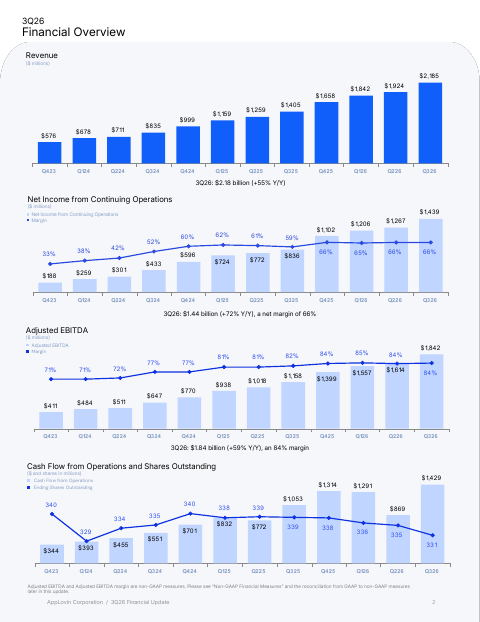
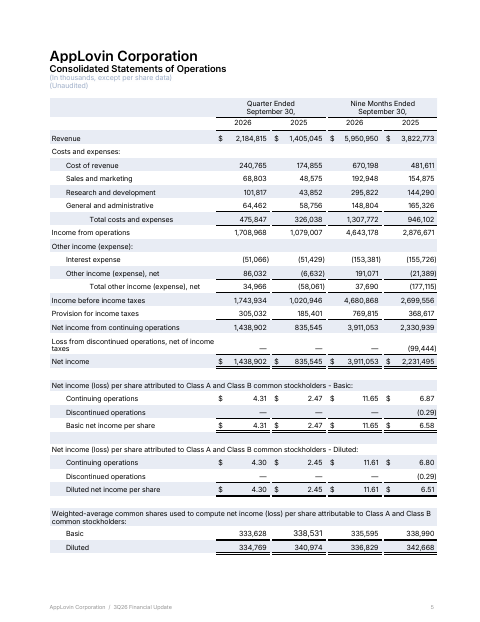
Guidance method is unchanged and reflects normal seasonality, model updates already live, and higher data center costs. — Matt Stump
0:12:37 · Jason Bazinet, Citi · Referral partnerships
Is AppLovin pleased with progress from its referral partnerships?
It is still a work in progress over a multi-quarter, multi-year horizon, but customer additions are accelerating. — Adam Farooge
0:13:36 · Matthew Kost, Morgan Stanley · Gaming and CTV
Does the new model change expectations for gaming revenue growth, and how prominent is connected TV in the roadmap?
Management stays committed to roughly 30% long-term growth, says the model could lift gaming further, and calls connected TV promising but not something to count on soon. — Adam Farooge
0:16:05 · Benjamin Black, Deutsche Bank · Consumer flywheel
Can the new architecture tip the consumer data flywheel, and how sticky is holiday spend into 2027?
Bigger models and more data go hand in hand, and holiday spend follows normal e-commerce seasonality with a weaker Q1 for the same advertiser. — Adam Farooge
0:19:18 · Steven Ju, UBS · Auction pricing
Could new e-commerce bidders inflate auction prices and compress ROI for existing advertisers?
Management says better predictions raise return on ad spend even if CPMs rise, and that scale has improved advertiser ROI over three years. — Adam Farooge
0:21:26 · Robert Kolbrith, Evercore · Architecture and brands
Could the larger architecture become generalizable across media types, and is brand performance spend an opportunity?
A generalized architecture is possible, and performance marketers who can track results digitally are likely to shift dollars into apps. — Adam Farooge
0:23:31 · Clark Lampin, BTIG · Supply and buyback
Could better models expand effective ad supply, and does the larger buyback authorization allow more opportunistic repurchases?
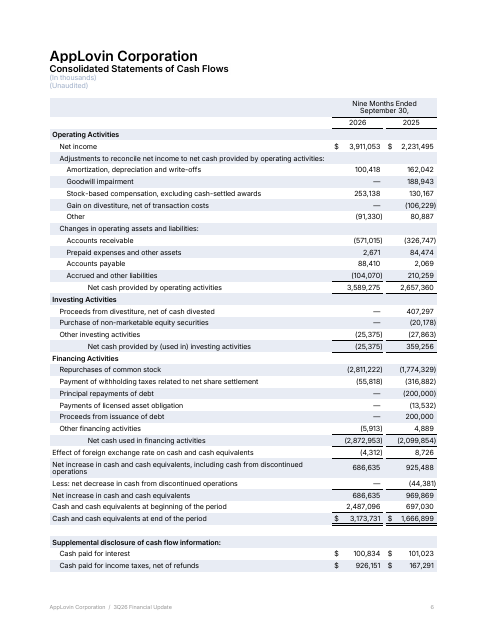
Supply sources are limited, so consumer ads diversifying what users see is the main near-term lever, and the buyback was opportunistically stepped up on a stock-price dislocation. — Adam Farooge, Matt Stump
0:27:31 · Martin Yang, Opco · Ad formats
Is the long-term goal diverse ad formats or better Gen AI video, and has e-commerce learning time improved?
Both will matter, and the models learn faster with less data, but advertisers still validate results through incrementality studies, so ramp-up is slow. — Adam Farooge
0:30:07 · Rob Sanderson, Loop Capital · Consumer go-to-market
How is consumer go-to-market progressing, is ad creative still a barrier, and is there enough data for larger models?
Advertisers helped by the team or sophisticated ones succeed, creative is an opportunity rather than a barrier, and more data would help though there is no rush. — Adam Farooge
0:34:00 · Shweta Kajaria, Wolfe · Visibility
What could management share to give investors more visibility into durability of growth?
Management says it cannot provide predictive KPIs yet and points to its record of beating the high end of guidance in 14 of 16 quarters. — Adam Farooge
0:36:48 · Ralph Shackert, William Blair · Model and competition
Is the new model effectively an Axon 3.0, and what is the competitive picture after last quarter's concerns?
It is comparable in technical complexity but is still in partial rollout, and other companies doing well has not squeezed AppLovin. — Adam Farooge
0:38:53 · Brian Smilic, JPMorgan · Growth drivers
What will drive long-term growth, and what gaming assumptions are embedded in the Q4 guide?
Growth components are hard to predict, with consumer customers a key driver, and the guide assumes consistent gaming and consumer seasonality plus model improvements so far. — Adam Farooge, Matt Stump
0:41:13 · Alec Brandolo, Wells Fargo · M&A and APAC
What would an ideal data acquisition look like, and why is e-commerce traction strongest in APAC?
A MoPub-style deal buying data and customer relationships would fit, and APAC advertisers face less attribution complexity and spin up dedicated sites. — Adam Farooge
0:44:13 · Omar Dasuki, B of A · Self-learning
Is the 3% to 5% self-learning tailwind still present and assumed in guidance?
Self-learning exists in any such model but cannot be isolated as a specific percentage. — Adam Farooge
0:46:21 · Jim Callahan, Piper Sandler · MAX supply
How fast is MAX supply growing, and what is happening to supply acquisition costs?
MAX supply is still growing at a strong double-digit rate, and rising publisher payouts must be offset by AppLovin improving its technology faster. — Adam Farooge
0:48:06 · Vasily Karasioff, Cannonball · Take rate
How has take rate changed, and would it differ between consumer and gaming?
AppLovin does not track take rate, and consumer and gaming should behave similarly because they compete in one auction. — Adam Farooge
0:50:26 · Tim Noland, SSR · Data ownership
Who owns the data in mediation transactions?
The MAX auction exposes only win and price information to everyone, and the ad content stays with the advertiser that produced it. — Adam Farooge
0:53:22 · Matthew Swanson, RBC · Consumer onboarding
How much of consumer onboarding performance is on AppLovin versus advertisers, and which customers does it prioritize?
It is largely a learning curve for new media buyers, and AppLovin prioritizes more sophisticated customers through partnership deals. — Adam Farooge